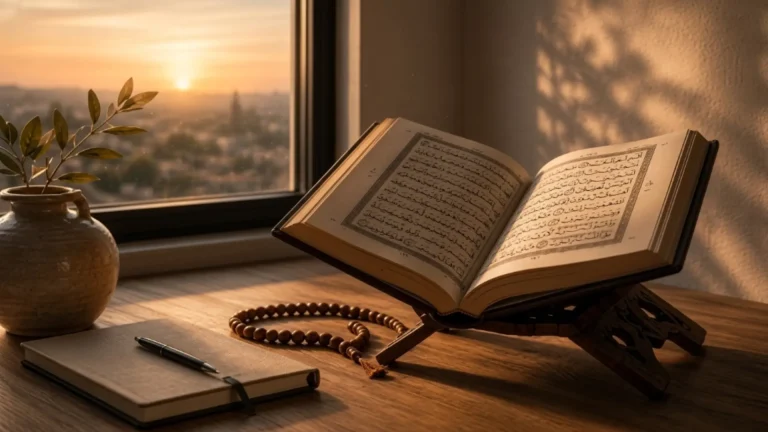

Why Surah Al-Kahf Protects Against the Dajjal: The 4 Trials Explained
Surah Al-Kahf protects against the Dajjal because it directly answers the same 4 trials he will use to test humanity: faith, wealth, knowledge, and power. The Prophet ﷺ singled out this surah for a reason. Its four stories rehearse the exact deceptions the Dajjal will bring at the end of time, so a believer sees them as something familiar rather than something new.
The Prophet ﷺ said: whoever memorizes the first ten verses of Surah Al-Kahf will be protected from the Dajjal (Sahih Muslim 809). A separate narration names the last ten verses instead, which is why scholars recommend learning both.
This guide covers the hadith evidence, the four stories, the classical scholarship behind the verses, the dua the Prophet ﷺ taught for this exact trial, and a few practical steps for building the habit.
What the Hadith Actually Says
Abu al-Darda narrated that the Prophet ﷺ said whoever memorizes the first ten verses of Surah Al-Kahf will be guarded from the Dajjal. This hadith appears in Sahih Muslim, Abu Dawood, An-Nasa’i, and At-Tirmidhi, making it one of the most well-attested protections recorded anywhere in the Sunnah.
A second, separate hadith recommends reciting the entire surah every Friday. Abu Sa’id al-Khudri reported that the Prophet ﷺ said whoever recites Surah Al-Kahf on Friday will have light shine for him between the two Fridays. Reciting on Friday and memorizing the ten verses are two distinct virtues, not one instruction repeated twice, and the rhythm fits naturally alongside other weekly acts of worship, including the middle prayer that Surah Al-Baqarah singles out for special care.
First Ten Verses or Last Ten Verses?
Scholars transmitted both versions of the hadith, so this is not a contradiction to resolve. It is two valid narrations to combine.
- First ten: Memorize verses 18:1–18:10 if you are starting, since this is the version recorded by Imam Muslim.
- Last ten: Memorize verses 18:101–18:110 once the first ten feel secure, since a separate authentic narration recommends this set instead.
- Full surah: Recite all 110 verses on Thursday night or Friday, since the recitation window runs from Maghrib on Thursday through Maghrib on Friday.
- In sections: Read the surah in parts across that window if reciting it in one sitting is not realistic, since splitting the reading does not reduce the reward.
These verse ranges sit inside the Qur’an’s wider system of division into surahs, juz, and smaller units, a structure covered in more depth in Kitaab Academy’s breakdown of how the Qur’an’s text is organized.
The 4 Stories in Surah Al-Kahf and the Trials Behind Them
Surah Al-Kahf is built around four stories. Each one targets a different trial, and together they cover every major pressure a person of faith will face.
1. The People of the Cave: The Trial of Faith
A group of young believers live in a society that has rejected monotheism. Rather than compromise under pressure, they flee to a cave and ask Allah directly for guidance: "Our Lord, grant us mercy from Yourself and prepare for us right guidance in our affair" (18:10). Allah puts them into a deep sleep for 309 years. When they wake, the disbelief they fled has vanished from their town. The trial here is social: the pull to hide belief, dilute practice, or blend into a hostile crowd.
2. The Owner of the Two Gardens: The Trial of Wealth
Allah gives the parable of two men, one wealthy and arrogant, one poor and faithful. Walking through his flourishing gardens, the rich man denies that the Hour will ever come and assumes his wealth proves Allah favors him. His companion warns him to credit Allah rather than himself. Overnight, the gardens are destroyed, and his regret arrives too late to matter. Wealth becomes a trial the moment it is mistaken for a personal achievement rather than a loan from Allah.
3. Musa and Khidr: The Trial of Knowledge
Musa (as) is asked who is the most knowledgeable person on earth and answers that he is, without attributing his knowledge to Allah. Allah sends him to learn from Khidr (as), who takes three actions Musa cannot understand in the moment: damaging a boat, ending a boy's life, and repairing a wall for free. Only at the end does Khidr explain the reasoning behind each one. Knowledge turns into a trial when it convinces someone they are qualified to judge everything they see.
4. Dhul-Qarnayn: The Trial of Power
Dhul-Qarnayn is given the power to travel across the east and west of the earth. He commands armies and resources, yet governs with justice, refuses payment for building a barrier against Gog and Magog, and credits every success to Allah rather than himself. Power corrupts only once its holder forgets where that power came from.
Why Iblis Sits at the Center of the Surah
Allah mentions Iblis’s refusal to bow to Adam in the middle of these four stories, between the story of the cave and the story of the two gardens. This placement is deliberate. Iblis sits at the midpoint of the surah as though positioned at the center of every trial, seeking to exploit each one against humanity. It reframes the four stories: they are not just examples of faith, wealth, knowledge, and power in the abstract, but a map of exactly where Iblis, and later the Dajjal, will attack. The same kind of internal structure, where a single mention reframes everything around it, shapes other surahs too, including the four-stage path the heart takes back to health in Surah Yunus.
How the Dajjal Will Exploit These Same 4 Trials
Hadith describing the Dajjal’s emergence show his deception following the identical structure Surah Al-Kahf lays out.
- Faith: He demands people worship him instead of Allah, echoing the persecution the cave dwellers fled.
- Wealth: He commands the sky to rain and the earth to yield crops for his followers, echoing the false security of the garden owner.
- Knowledge: He presents news and illusions that most people cannot verify, echoing Musa’s limited view of Khidr’s actions.
- Power: He rules vast territories the way Dhul-Qarnayn once did, but without his justice or humility.
The Prophet ﷺ described the Dajjal as the greatest trial to face humanity since the time of Adam. Surah Al-Kahf rehearses each piece of that trial in advance, verse by verse, story by story.
The Scholarly Wisdom Behind the First Ten and Last Ten Verses
Ibn Al-Jawzi examined why these specific verses, and not others, carry this protection. His analysis, recorded in Al-Mushkil min Hadith As-Saheehayn, splits the wisdom into two sets.
The opening verses warn of severe punishment and promise a lasting reward for righteous believers. This weakens the illusion of the Dajjal’s false paradise and false punishment before he even appears. The same opening verses rebuke those who claim Allah has a son, exposing the absurdity of any human claiming divinity. They open, notably, with praise of Allah, the same structural device that anchors the five surahs that begin and end with Alhamdulillah.
The closing verses describe Hellfire and hearts sealed off from remembrance of Allah, which weakens the power of the fire the Dajjal will falsely present as paradise. These verses also stress that Allah is one and indivisible. That detail matters because the Dajjal himself will be missing an eye, a physical flaw no true deity could carry.
The Dua the Prophet ﷺ Taught Against the Dajjal
Memorizing Surah Al-Kahf is not the only protection the Prophet ﷺ established. Aisha (ra) reported that he regularly sought refuge from the Dajjal inside the prayer itself. He said it after the final tashahhud and before the closing salam. This hadith is recorded in Sahih Bukhari and Sahih Muslim:
“O Allah, I seek refuge in You from the punishment of the grave, from the torment of the Fire, from the trials of life and death, and from the evil of the trial of Al-Masih ad-Dajjal.”
Many scholars treat this dua as a stressed sunnah in every obligatory prayer, not an optional add-on. Reciting Surah Al-Kahf weekly is one shield. Repeating this dua daily is another. Together, they form a steady, built-in request for protection, the same kind of steadiness that carried the Companions through apparent setbacks like the Treaty of Hudaybiyah.
Islamic tradition also describes how the Dajjal’s story ends. Classical commentators tend to read his appearance literally. Some modern scholars read it as a broader warning about deception and injustice. Either way, he will roam the earth for 40 days. One of those days will last as long as a year. Isa (as) will then descend and defeat him near the gate of Lud.
A recent paper in the El-Sunan Journal of Hadith and Religious Studies traces this literal-versus-symbolic debate across the six major hadith collections. Knowing that his rule is temporary, and that it ends in defeat, is itself part of what protects a believer from taking his claims seriously.
6 Lessons Surah Al-Kahf Teaches for Surviving the Dajjal's Trials
Beyond the four stories, individual verses across the surah give direct guidance for facing every kind of trial, not only the Dajjal’s.
- Peer pressure: Verse 18:28 instructs believers to stay close to those who remember Allah rather than chase popular trends.
- Worldly attachment: Verse 18:45 compares this life to vegetation that turns green, then dries out and scatters in the wind.
- Humility: Verse 18:69 has Musa promise Khidr he will remain patient rather than argue from a position of pride.
- Sincerity: Verse 18:110 reminds believers to associate no partner with Allah in worship, however subtle that partnership might be.
- Calling others to truth: Verse 18:27 instructs the Prophet ﷺ to recite what has been revealed to him without distortion.
- Accountability: Verses 18:47–48 describe the Day of Judgment, when every person stands before Allah with nothing hidden. The same theme of a delayed but certain return runs through the context behind Surah Al-Qasas, revealed as the Prophet ﷺ left Makkah.
Building the Habit
Two things make this practice stick: a fixed time and a starting point small enough to keep. Pair Surah Al-Kahf with something already on your calendar, such as the walk home from Jumu’ah or a few minutes after Fajr on Friday. Don’t treat it as one more task competing for attention. Start with the ten verses named in the hadith, not the full 110. That goal is already complete on its own. The rest can follow once it holds.
This is close to how Arabic and Tafsir are taught in practice at Kitaab Academy. Live classes are built for working adults, and a growing library covers surah-by-surah study. One surah is studied closely enough that its structure, not just its translation, becomes visible.
FAQs
Why is Surah Al-Kahf recited specifically on Fridays?
The Prophet ﷺ said that light will shine for a person from one Friday to the next if they recite Surah Al-Kahf on Friday. This is a separate virtue from the Dajjal-protection hadith. It is tied to the day itself, not to any specific set of verses.
How many verses of Surah Al-Kahf protect against the Dajjal?
Ten verses, either from the beginning or the end of the surah. This is based on separate authentic narrations recorded in Sahih Muslim and other hadith collections.
What are the four trials of the Dajjal mentioned in Surah Al-Kahf?
Faith, wealth, knowledge, and power. These match the four stories of the cave dwellers, the garden owner, Musa and Khidr, and Dhul-Qarnayn.
Can I recite Surah Al-Kahf in parts instead of all at once?
Yes. The recitation window runs from Maghrib on Thursday through Maghrib on Friday. Reading the surah in sections across that period does not reduce the reward.
Does the name mention the Dajjal in Surah Al-Kahf?
No. The surah never names the Dajjal directly. The connection comes entirely from hadith, where the Prophet ﷺ explained why these specific verses and stories protect against him.
Is there a dua for protection from the Dajjal outside of Surah Al-Kahf?
Yes. The Prophet ﷺ taught a specific dua recited after the final tashahhud in every obligatory prayer. It is recorded in Sahih Bukhari and Sahih Muslim, and it asks Allah for refuge from the trial of Al-Masih ad-Dajjal alongside three other trials.