How Much Does an Online Qur’an Class Cost? A Complete Pricing Breakdown
Online Qur’an classes have transformed how Muslims worldwide access Islamic education. What once required finding a local scholar or enrolling in a physical madrasa is now available through a screen, with qualified instructors teaching from anywhere in the world. But pricing across the industry is surprisingly opaque. Some academies advertise “$10/month” in their metadata while their actual plans start at $45. Others list low hourly rates that exclude registration fees, materials, and the hidden cost of rotating through unvetted tutors.
This guide provides an honest pricing breakdown of what online Qur’an classes actually cost in 2026, what you should expect at different price points, and why choosing the cheapest option often ends up costing more in the long run.
What Online Qur'an Classes Typically Cost
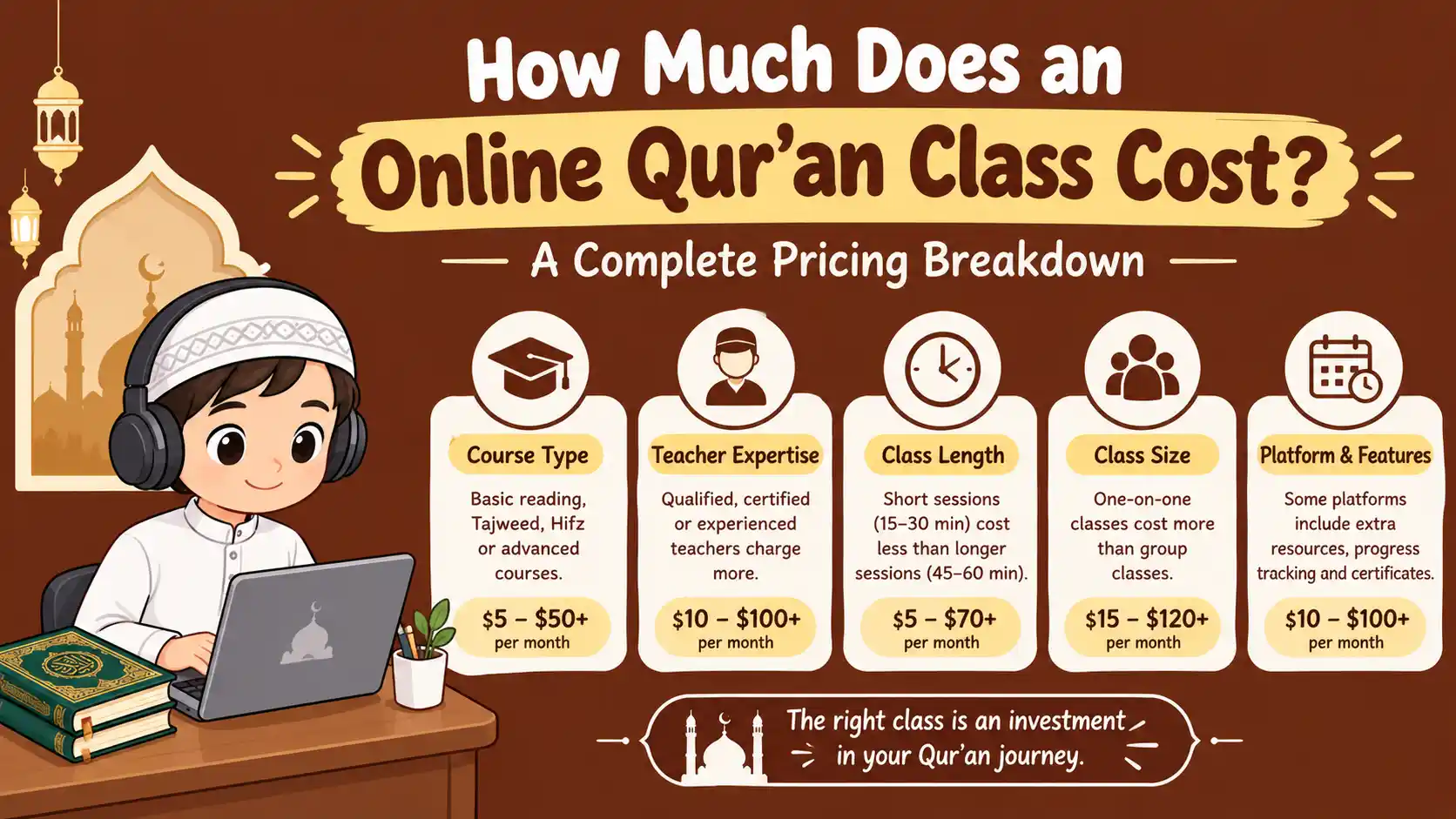
Based on current market data from established academies, here is what you can expect to pay for one-on-one online Qur’an instruction in the United States:
Schedule | Classes/Month | Budget Range | Mid-Range | Premium |
|---|---|---|---|---|
2 days/week (30-min sessions) | 8 | $34 to $42 | $44 to $60 | $55 to $70+ |
3 days/week (30-min sessions) | 12 | $50 to $58 | $60 to $80 | $65 to $90+ |
5 days/week (30-min sessions) | 20 | $75 to $90 | $90 to $130 | $130 to $175+ |
Hifz programs (5 days/week) | 20 | $120 to $150 | $150 to $220 | $175 to $300+ |
The effective hourly rate across the industry ranges from approximately $8 to $30 per hour for one-on-one instruction. Group classes tend to be cheaper per student but offer significantly less individual attention and correction time.
For context, private home tutors for Qur’an recitation in major U.S. and U.K. cities charge $25 to $40 per hour, making online academies considerably more affordable while often providing better qualified instructors and structured curricula.
Regional Pricing Differences
Pricing varies significantly by the student’s country, reflecting both purchasing power and local market rates:
Region | Typical Monthly Range (2-3 days/week) |
|---|---|
United States (USD) | $40 to $80 |
United Kingdom (GBP) | £25 to £60 |
Canada (CAD) | $50 to $115 |
Australia (AUD) | $58 to $125 |
Gulf States (USD equivalent) | $35 to $65 |
Europe (EUR) | €35 to €75 |
These ranges cover the vast majority of established academies. Outliers exist on both ends: some volunteer-run programs offer free classes with limited availability, while premium scholars and ijazah programs can charge $50 or more per hour.
What Determines Price: The Factors Most People Overlook
Not all online Qur’an classes deliver the same value, even at the same price point. Six factors separate programs that produce real results from those that waste months:
Teacher Qualifications
The single biggest differentiator. A certified Qur’an instructor with an ijazah (chain of transmission) and formal training in Arabic grammar and Tajweed commands higher rates than an untrained native speaker reading from a script. This premium is justified because an unqualified tutor can teach incorrect pronunciation that takes months to unlearn. The letter ض (dhad) alone is mispronounced by so many students that classical scholars named Arabic “the language of the Dhad” to emphasize its distinctiveness.
At Kitaab Academy, every instructor is certified in Arabic grammar, Tajweed, and Qur’anic sciences, and students work with the same dedicated teacher throughout their program rather than rotating through a pool of available tutors.
One-on-One vs. Group Classes
Group classes can cost as little as $5 per hour per student, but the math tells a different story. In a group of five students during a 60-minute session, each student receives roughly 10 to 12 minutes of direct recitation time and individual correction. For Qur’an recitation specifically, where pronunciation errors must be caught and corrected in real time, this limited attention creates a ceiling on how fast students can progress.
One-on-one instruction costs more per session but produces faster measurable progress. A student receiving 30 minutes of undivided attention twice per week will typically outpace a student in a group class meeting five days per week, because every minute is spent on their specific mistakes and their specific pace.
Curriculum Structure vs. Freelance Tutoring
Tutor marketplaces connect learners with individual instructors, often at rates of $10 to $15 per hour. The rate is attractive, but there is usually no structured curriculum, no progress tracking across sessions, and no quality assurance beyond user reviews. The learner is responsible for choosing what to study and how to progress, which is like asking a patient to design their own treatment plan.
Structured academies charge more because they provide a defined progression. Kitaab Academy’s 7-level curriculum takes students from zero Arabic knowledge to reading Classical Arabic with comprehension, with each level building on specific grammar, vocabulary, and reading milestones. This structure means the student never has to wonder what to study next or whether they are making real progress.
Session Length and Frequency
Most academies offer 30-minute sessions, which keeps per-session costs low but requires higher frequency (4 to 5 days per week) for meaningful progress. Some programs offer 60-minute sessions at roughly double the per-session price, which works better for students who prefer fewer, longer study blocks.
Research on language retention consistently shows that daily short sessions produce better long-term retention than weekly long sessions of equal total time. For Qur’an memorization specifically, 30 minutes daily outperforms 2 hours twice per week, even though the total weekly time is lower.
Hidden Costs to Watch For
Several pricing practices inflate the actual cost beyond advertised rates:
Introductory pricing that expires.
Some academies offer the first month at $5 to $7 per hour, then increase to $12 to $18 per hour without making the permanent rate equally visible.
Registration and material fees.
One-time charges of $20 to $50 that are not included in the advertised monthly rate.
Missed class policies.
Some programs charge for missed classes regardless of notice, while others allow rescheduling. A strict no-rescheduling policy effectively increases your cost by every session you cannot attend.
Currency conversion fees.
Students paying in a currency different from the academy’s billing currency may pay 2 to 4% extra through their bank or payment processor.
How Kitaab Academy's Pricing Works
Kitaab Academy operates on a semester-based model rather than the monthly subscription model most online Qur’an academies use. Here is how the pricing breaks down:
Group Classical Arabic Classes:
$600 per 15-week semester. Each semester includes 2 hours of live Zoom instruction per week with a certified instructor, recorded sessions for review, office hours for additional support, and access to a class WhatsApp group. This works out to approximately $40 per week or $10 per hour of live instruction.
This pricing model reflects a fundamentally different approach from the per-session tutoring model. Rather than paying for individual 30-minute recitation sessions, students enroll in a structured academic program that covers Classical Arabic grammar, Qur’anic vocabulary, and reading comprehension across a defined curriculum.
What is included at no extra cost:
- Recorded class sessions for review between live meetings
- Office hours with the instructor for questions
- Course materials
- WhatsApp group for peer interaction and support
- No registration fees, material fees, or hidden charges
- Full refund for students who withdraw before the 4th class of a semester
- Option to defer payment to a future course within one year if withdrawing before the semester midpoint
One-on-one personalized instruction is also available, with scheduling arranged directly with the instructor. Contact the academy for personalized program pricing.
For self-paced learners, the Kitaab Library offers recorded Arabic vocabulary drills, Islamic studies content, and course reviews at $9.99 per month, providing a low-cost entry point for students who want to build foundational knowledge before enrolling in live classes.
Price vs. Value: Why the Cheapest Option Is Rarely the Best
The online Qur’an education market has a persistent problem: the lowest-priced academies often employ undertrained tutors who teach recitation without understanding, skip grammar entirely, and rotate instructors so frequently that no single teacher tracks a student’s progress.
Consider the real cost of a budget academy that charges $35 per month but takes 4 years to reach a level that a structured program reaches in 2 years. Over 4 years, that student pays $1,680 in tuition. A student at a higher-quality program paying $160 per month who reaches the same level in 2 years pays $3,840 in tuition but gains 2 extra years of proficiency. The dollar cost is higher, but the time cost is dramatically lower.
This calculation becomes even more compelling when you factor in Arabic comprehension. Most budget Qur’an classes teach recitation only, which means the student can pronounce the words but does not understand them. A program that integrates Arabic vocabulary and grammar alongside recitation produces a qualitatively different outcome: a student who understands what they are reciting.
Research on memory and depth of processing shows that meaningful material is retained approximately 5 to 10 times longer than material perceived as meaningless. A student who understands the Arabic of the Qur’an retains their memorization dramatically better than one who has memorized sounds without meaning. This retention advantage compounds over years, reducing the need for constant revision and freeing time for new learning.
What to Look for Before Enrolling
Before committing to any program, verify these five things:
Teacher credentials
Ask specifically whether instructors hold an ijazah and have formal training in Arabic grammar and Tajweed. “Native Arabic speaker” is not a qualification for teaching Qur’anic recitation.
Curriculum documentation
A quality program should be able to show you exactly what each level covers, what milestones mark completion, and how long each level typically takes. If the answer is “we customize for each student” without any underlying structure, there is no curriculum.
Trial policy
Most reputable academies offer a free trial class. If a program requires payment before you have met the teacher and experienced a session, that is a significant red flag.
Instructor continuity
Ask whether you will work with the same teacher throughout your enrollment or rotate through available tutors. Continuity matters enormously for a subject where individual pronunciation habits, learning pace, and specific weaknesses must be tracked over months.
Transparent pricing
The monthly or semester rate should include everything. If registration fees, material fees, or platform fees appear after you have committed, the advertised price was misleading.
For children’s Qur’an classes, these factors are even more important. Children need consistent instructors who build rapport, age-appropriate pacing, and structured progression through Tajweed and recitation fundamentals. Kitaab Academy’s one-on-one children’s program provides dedicated instructors for each child with classes covering Tajweed, Qur’an recitation, and Islamic studies.
FAQs
How much do online Qur'an classes cost per month?
Most established academies charge between $40 and $130 per month for one-on-one 30-minute sessions, depending on frequency (2 to 5 days per week). Group classes are typically less expensive per student, and semester-based programs like Kitaab Academy charge $600 for a full 15-week semester of structured instruction.
Are expensive Qur'an classes worth the extra cost?
Higher-priced programs typically employ certified instructors, provide structured curricula, and maintain instructor continuity. These factors directly impact learning speed and retention quality. A student who reaches proficiency in 2 years at a higher rate often spends less total money than one who takes 4 years at a lower rate.
Do I need to learn Arabic to read the Qur'an?
You can recite the Qur’an phonetically without understanding Arabic, and millions of Muslims do. However, understanding Arabic transforms the experience from recitation to comprehension. Even basic vocabulary covering the Qur’an’s most frequent words noticeably deepens your connection to the text during prayer and study.
What is the cheapest way to learn the Qur'an online?
Free and low-cost options exist, including volunteer-run programs, YouTube channels, and apps. These can supplement structured learning but rarely replace it. For self-paced study, the Kitaab Library offers recorded courses at $9.99 per month. For live instruction, budget academies start around $34 to $40 per month for 2 sessions per week.
Do online Qur'an academies offer free trials?
Most reputable academies offer one to three free trial classes before requiring payment. Kitaab Academy offers free info sessions where prospective students can learn about the program, meet instructors, and ask questions before committing to a semester.
Should I choose one-on-one or group Qur'an classes?
One-on-one classes provide faster progress because every minute is spent on your individual recitation, pronunciation, and pace. Group classes are more affordable but divide teacher attention among multiple students. For Qur’an recitation specifically, where real-time pronunciation correction is essential, one-on-one instruction produces noticeably faster results.