
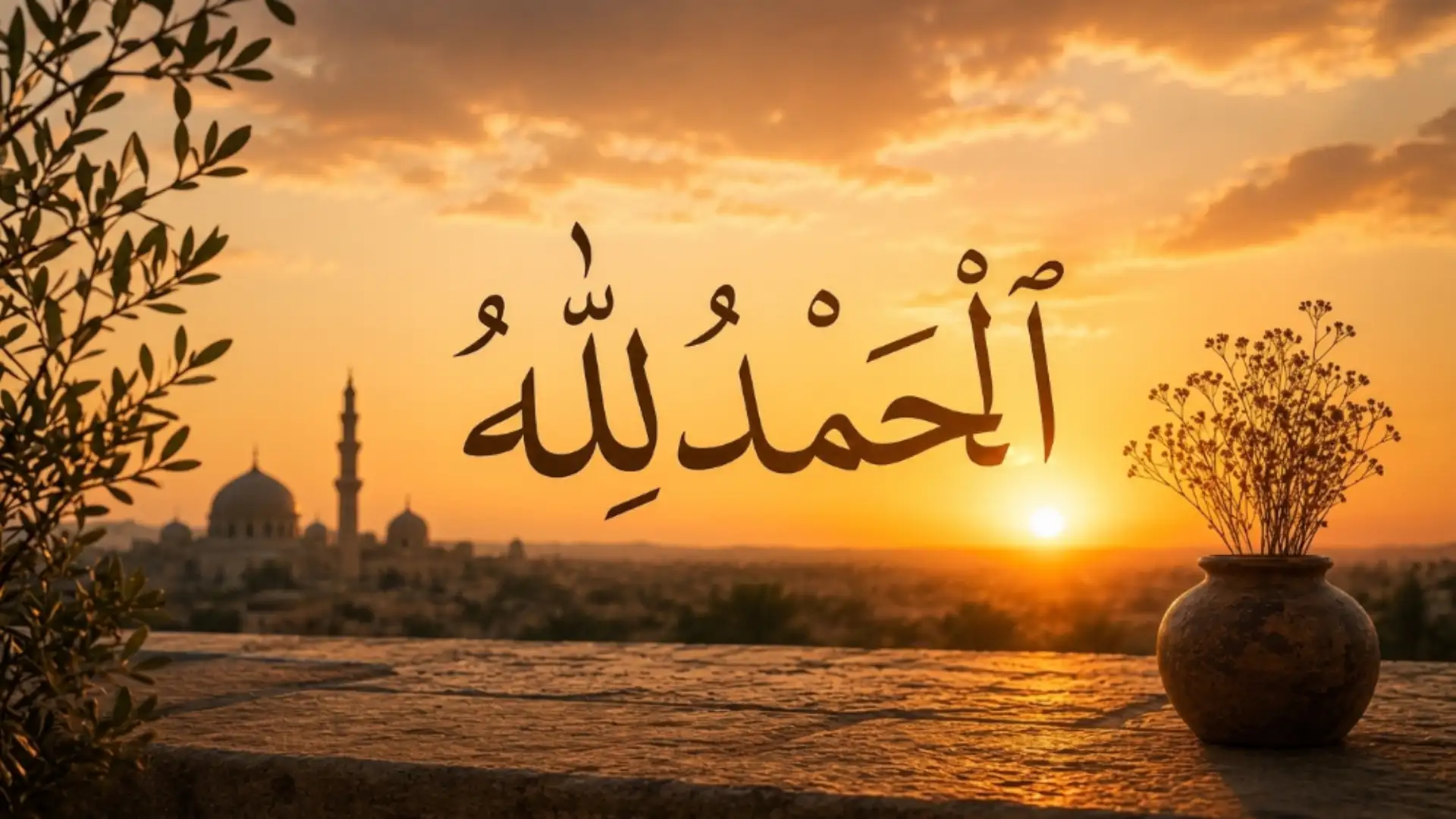
The Symmetry of ‘Alḥamdulillāh’ in the Qur’an
Five surahs in the Qur’an open with Alhamdulillah, and five others close with it. No other phrase in the Qur’an frames this many surahs at both ends. This article covers what the phrase means, lists the ten surahs that carry it, and explains why classical scholars treat this pattern as a real feature of the text rather than a coincidence.
What Does Alhamdulillah Mean?
Alhamdulillah (الْحَمْدُ لِلَّه) means “all praise belongs to Allah.” The phrase has three parts:
- Al- is the definite article “the.” It turns “some praise” into “all praise,” covering every kind of praise in every situation.
- Hamd is praise for who someone is, not only for what they gave you.
- Lillah means “belongs to Allah,” and it marks exclusive ownership. The praise is His alone.
Put together, the phrase says that every form of praise, in every circumstance, belongs to Allah as its rightful owner.
Hamd vs. Shukr: The Key Difference
Muslims often treat hamd and shukr as the same word in English, but classical Arabic keeps them apart.
- Shukr responds to a specific favor. You thank someone for a gift, a job, or a recovery.
- Hamd praises someone for their qualities and actions, whether or not you personally benefited.
This is why Muslims say Alhamdulillah in both comfort and hardship. Shukr needs a recent gift, while hamd only needs recognition that Allah is praiseworthy by nature.
Hamd vs. Madh and Thanaa
Arabic has two other near-synonyms for praise: madh and thanaa, and each covers different ground.
- Madh praises good qualities in anyone, living or not, deserving or not, before or after a good deed.
- Thanaa is madh with extra eloquence and flattery added.
- Hamd praises only living, intelligent beings, and only after a genuinely praiseworthy act done out of love and reverence rather than obligation.
Madh is too broad for this context, and shukr is too narrow. Hamd sits between the two, which is one reason scholars see it as the better fit for how the Qur’an opens.
Grammar adds a further layer. Alhamdulillah is a nominal sentence (jumlah ismiyyah), not a verb-based one (jumlah fi’liyyah). A verb-based version, such as “I praise Allah,” ties the praise to one speaker and one moment, while the nominal form drops both limits. It states praise as a standing fact, true regardless of who says it or when.
The Five Surahs That Begin With Alhamdulillah
- Al-Fātiḥah (١:٢ / 1:2): al-ḥamdu lillāhi rabbi l-ʿālamīn. This is the opening surah of the Qur’an, praising Allah as Lord of the worlds.
- Al-An’ām (٦:١ / 6:1): al-ḥamdu lillāhi lladhī khalaqa s-samāwāti wa l-arḍ. This praises Allah for creating the heavens, the earth, darkness, and light.
- Al-Kahf (١٨:١ / 18:1): al-ḥamdu lillāhi lladhī anzala ʿalā ʿabdihi l-kitāb. This praises Allah for revealing a Book free of any crookedness.
- Sabaʾ (٣٤:١ / 34:1): al-ḥamdu lillāhi lladhī lahu mā fī s-samāwāti wa mā fī l-arḍ. This praises Allah for owning everything in the heavens and the earth.
- Fāṭir (٣٥:١ / 35:1): al-ḥamdu lillāhi fāṭiri s-samāwāti wa l-arḍ. This praises Allah for originating the heavens and the earth, and for appointing angels as messengers.
Each of these five openings ties the praise to a different reason. Al-An’ām and Fāṭir praise Allah for creation, Al-Kahf praises Him for revelation, and Sabaʾ praises Him for total ownership, while Al-Fātiḥah offers the all-encompassing praise that opens the whole Qur’an. Al-Kahf carries extra weight among the five, since the Prophet ﷺ singled it out as protection against the trials of the Dajjal, a theme covered separately in Why Surah al-Kahf Protects Against the Dajjal.
The Five Surahs That End With Alhamdulillah
- Al-Isrāʾ (١٧:١١١ / 17:111): wa qul al-ḥamdu lillāhi lladhī lam yattakhidh waladan. This is the final verse of the surah, praising Allah for having no child, no partner, and no need for a protector.
- An-Naml (٢٧:٩٣ / 27:93): wa quli l-ḥamdu lillāhi sa-yurīkum āyātihi fa-taʿrifūnahā. This is the final verse, a command to praise Allah while watching for His signs.
- Aṣ-Ṣāffāt (٣٧:١٨٢ / 37:182): wa l-ḥamdu lillāhi rabbi l-ʿālamīn. This is the final verse, closing on the same praise that opens Al-Fātiḥah.
- Az-Zumar (٣٩:٧٥ / 39:75): wa qīla l-ḥamdu lillāhi rabbi l-ʿālamīn. This is the final verse, spoken once every soul has been judged with full fairness.
- Al-Jāthiyah (٤٥:٣٦ / 45:36): fa-lillāhi l-ḥamdu rabbi s-samāwāti wa rabbi l-arḍ. This is the second-to-last verse of the surah. The final verse, 45:37, shifts to a different theme, Allah’s majesty, so this is the one surah in the group where the praise sits just before the close rather than in the closing line itself.
Four of these five surahs end their very last verse on Alhamdulillah. Al-Jāthiyah is the exception worth noting, since its last line moves to a related but different statement about Allah’s majesty.
The Deeper Pattern Behind This Symmetry
This five-and-five balance is not an isolated curiosity. It sits inside a larger, well-documented feature of the Qur’an: the link between how a surah opens and how it closes.
Al-Suyūṭī’s Classical Treatise on Surah Symmetry
Imam Jalāl al-Dīn al-Suyūṭī, a widely cited scholar of Qur’anic sciences, devoted an entire treatise to this idea, titled Marāṣid al-Maṭāliʿ (Capturing the Beginnings). A full English translation of this treatise is published by the Yaqeen Institute for Islamic Research, a peer-reviewed academic source. Working through the surahs in order, al-Suyūṭī traced dozens of these opening-to-closing echoes. Sūrat al-Anʿām opens and closes on the same theme, setting up false equals to Allah, while Sūrat al-Naḥl opens with a warning against haste and closes with a command to patience. The Alhamdulillah pattern is one instance among many that his treatise catalogs.
Ring Composition in Modern Qur’anic Scholarship
Modern scholarship studies a related structure under the name ring composition, or chiastic structure, where a text’s opening and closing sections correspond to frame what sits between them. A peer-reviewed study in the Journal of Islamic Sciences examined this exact question, analyzing the relationship between how surahs end and how the surahs after them begin, and found a consistent, integrative connection running through the Qur’anic text. The Alhamdulillah symmetry is a related but distinct case, since instead of linking consecutive surahs, it mirrors across ten separate surahs spread from the Qur’an’s first chapter to well past its halfway point.
Two things follow from this pattern. Beginnings matter, since the five opening surahs meet praise with praise before anything else is said. Endings matter too, since the five closing surahs resolve the same way, and even Az-Zumar’s account of the Day of Judgment settles on Alhamdulillah once the judging is done. Whether a given surah opens with hamd, closes with it, or does neither, these ten surahs are one visible sign that praise frames the text rather than sitting at its margins.
Why the Qur’an Opens Every Surah With Purpose
The Alhamdulillah openings are one case of a wider principle: no surah in the Qur’an begins arbitrarily. Classical scholarship groups every one of the 114 surah openings into ten recognized styles, including praise, the disjointed letters, direct address, declarative statements, and oaths. Studying these categories falls under ilm al-munasabat, the study of the Qur’an’s internal coherence, a subject connected to how the Qur’an is organized as a whole and covered in more depth in The Divisions of the Qur’an. A related example of purposeful ordering is the sequence of names for the Qur’an in Sūrah Yūnus, examined in The Four Stages of Transformation in the Qur’an.
Noticing these openings is part of tadabbur, reflective and unhurried study of the Qur’an. A reader who catches that Al-Fātiḥah, Al-Kahf, and Fāṭir all open the same way starts to read the Qur’an differently, less like 114 disconnected chapters and more like one text with recurring signals running through it.
How to Study This Symmetry Properly
Why Translation Alone Falls Short
Catching a pattern like this takes more than one read-through in translation, since translations often smooth over the exact grammatical form of a phrase. The distinction between jumlah ismiyyah and jumlah fi’liyyah, covered earlier in this article, mostly disappears once the Arabic is rendered into English. A reader working from the Arabic text catches that distinction directly, rather than relying on someone else’s summary of it.
That kind of reading is a skill, and it’s one Kitaab Academy teaches directly. The Arabic for Busy Adults program is built around exactly this, giving you enough grammar and vocabulary to read a surah like Al-Jāthiyah and notice its structure yourself, instead of depending on a translation footnote.
The Children’s Qur’an Program starts the same habit early, so recurring phrases like Alhamdulillah become familiar rather than foreign. Both programs open with a free trial class, so you can bring a question like this one to your first session before committing to anything.
For more reflections along these lines, Kitaab Insights publishes similar breakdowns of Qur’anic structure, and the Kitaab Library holds a growing set of lessons for self-paced study.
FAQs
How many surahs begin with Alhamdulillah?
Five surahs begin with Alhamdulillah: Al-Fātiḥah (1:2), Al-An’ām (6:1), Al-Kahf (18:1), Sabaʾ (34:1), and Fāṭir (35:1). No other phrase opens this many surahs in the Qur’an.
How many surahs end with Alhamdulillah?
Five surahs end with Alhamdulillah: Al-Isrāʾ (17:111), An-Naml (27:93), Aṣ-Ṣāffāt (37:182), and Az-Zumar (39:75) close on it in their final verse, while Al-Jāthiyah (45:36) carries it in its second-to-last verse.
What does Alhamdulillah mean in English?
Alhamdulillah means “all praise belongs to Allah.” The definite article al- makes the praise total rather than partial, hamd is praise for who someone is rather than what they gave, and lillah marks that the praise belongs exclusively to Allah.
What is the difference between Hamd and Shukr?
Shukr is gratitude for a specific favor, while hamd is praise for someone’s inherent qualities. Shukr needs a recent gift to respond to, but hamd only needs recognition that Allah is praiseworthy by nature, which is why Muslims say Alhamdulillah in both ease and hardship.
Is Al-Fātiḥah the only surah with the full phrase “Alhamdulillahi Rabbil-Alamin”?
No, three surahs use this exact longer phrase. Al-Fātiḥah opens with it, and Aṣ-Ṣāffāt and Az-Zumar both close with it. The other three surahs in this symmetry use a related but shorter form of Alhamdulillah.
Why do some surahs begin with Alhamdulillah instead of another phrase?
Each opening ties the praise to a specific reason. Al-Fātiḥah praises Allah as Lord of the worlds, Al-An’ām and Fāṭir praise Him for creation, Al-Kahf praises Him for revealing the Qur’an, and Sabaʾ praises Him for owning everything in the heavens and the earth.
What is ring composition in the Qur’an?
Ring composition, or chiastic structure, is a literary pattern where a text’s opening and closing sections correspond to frame the content between them. Scholars have documented this within individual surahs, such as Sūrat Yūsuf, and across the wider Qur’an, as with the Alhamdulillah surahs.





One Comment