
Modesty in Islam: What Haya Really Means and How to Practice It Daily
Modesty in Islam is the practice of haya. It is a God-conscious sense of shame that guards the heart, the eyes, the tongue, the body, and behavior from indecency. It applies to men and women equally. It begins inside the heart before it ever reaches clothing. The Prophet Muhammad ﷺ named it the defining trait of the entire religion. This guide walks through haya’s roots in the Quran, its base in hadith, its limits in fiqh, its 10 known shades, and simple steps to build it. Kitaab Academy’s Islamic Studies team reviewed this guide and checked it against classical hadith collections and published academic research.
One question comes up in almost every beginner Arabic class. Why does a single word, haya, cover shyness, faith, clothing, and manners all at once? English does not have one word that does this job. That gap in translation is part of why modesty in Islam gets flattened into “dress code” online. It isn’t. Dress is one small branch of a much larger tree.
What Does Modesty Mean in Islam?
Modesty in Islam carries a specific Arabic name: haya. Haya covers a sense of conscience, shyness, and bashfulness. It covers every feeling that stops a person from indecent speech or behavior. It is not limited to clothing. Haya touches the gaze, the tongue, the body, online conduct, and private intention.
Haya comes from hayah, the Arabic word for life. Classical Arabs measured how “alive” a person was by how much haya they carried. A person with no haya was seen as closer to an animal driven only by appetite than to a full human being. That is because shamelessness shows a conscience that no longer reacts to anything.
Ibn al-Qayyim, writing in the 14th century, argued that haya is what makes hospitality, promise-keeping, and honesty possible in the first place. Remove it, and none of these obligations would hold on their own.
Islamic scholarship recognizes two layers of haya:
- Instinctual haya: Found in every human being, no matter their religion. It is the discomfort a person feels at their own nakedness, or when they see indecency in public. The Quran shows its start in the story of Adam and Hawwa (Eve). Once they ate from the forbidden tree, “their bodies became visible to them, and they started covering themselves with leaves” (Surah Taha 20:121).
- Faith-based haya: Grows through worship and remembrance of Allah. It keeps a believer away from sin even when no one else is watching. The Quran points to this same idea when it describes how worship changes behavior. The same idea runs through the four stages of transformation the Qur’an describes as it moves a heart from carelessness toward discipline.
What the Quran Says About Modesty
Four verses anchor the Quran’s teaching on haya:
| Verse | What It Establishes |
|---|---|
| Al-A'raf 7:26–27 | Clothing is a favor from Allah and a form of taqwa (God-consciousness). Satan's goal is to strip people of it. |
| An-Nur 24:30–31 | The shared command to lower the gaze and guard chastity, given to men and then to women. |
| Al-Qasas 28:25 | A woman is described as "walking with haya" while approaching Musa (Moses) at the well of Madyan. |
| Al-Ahzab 33:53 | Household modesty. Asking for something from behind a screen instead of face to face. |
Ibn Kathir’s commentary on Surah An-Nur treats the Quran’s repeat of the same command to both sexes as deliberate. It closes the door on treating modesty as a women-only duty.
The scene at the well of Madyan is worth a closer look too. It is the same setting behind the promised return in Surah Al-Qasas, where Musa’s years of exile finally lead him back to Egypt. Haya, in that story, is not just background detail. It is what marks the woman as trustworthy before she says a single word to a stranger.
Why Is Haya Called the Signature Trait of Islam?
The Prophet ﷺ said, “Every religion has its own signature trait, and the signature trait of Islam is haya” (Sunan Ibn Majah, no. 4181; authenticated by al-Albani). Several other narrations reinforce the same status, each with its own chain and grading:
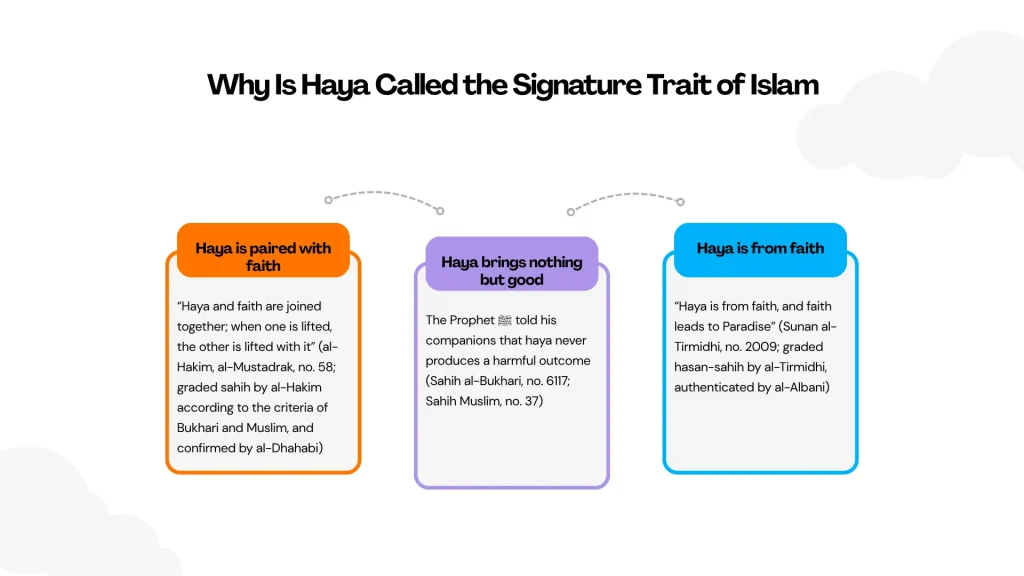
- Haya is paired with faith: “Haya and faith are joined together; when one is lifted, the other is lifted with it” (al-Hakim, al-Mustadrak, no. 58; graded sahih by al-Hakim according to the criteria of Bukhari and Muslim, and confirmed by al-Dhahabi).
- Haya brings nothing but good: The Prophet ﷺ told his companions that haya never produces a harmful outcome (Sahih al-Bukhari, no. 6117; Sahih Muslim, no. 37).
- Haya is from faith: “Haya is from faith, and faith leads to Paradise” (Sunan al-Tirmidhi, no. 2009; graded hasan-sahih by al-Tirmidhi, authenticated by al-Albani).
Every narration above is cited by book and hadith number on purpose. Readers who want to verify them directly, rather than take a summary on faith, can look each one up in a printed or online edition of the collection cited. They can also cross-check the primary texts sitting in the Kitaab Library.
Ibn al-Qayyim, in Madarij al-Salikin, divided haya into 10 distinct shades. This classification rarely appears outside specialist Islamic literature. It rewards sitting with, rather than skimming:
- The haya of guilt: Felt after wrongdoing, as with Adam’s shame after his mistake in Paradise.
- The haya of inadequacy: Felt by the angels, who confess they have not worshipped Allah as He deserves.
- The haya of awe: Grows in proportion to a person’s knowledge of Allah’s greatness.
- The haya of generosity: Shown when someone stays silent rather than embarrasses a guest.
- The haya of chastity: Restrains a person from discussing intimate matters directly.
- The haya of humility: Felt when asking Allah for help while aware of one’s own shortcomings.
- The haya of love: The instinctive shyness felt in front of someone deeply loved.
- The haya of servitude: Recognizing that no act of worship can fully match Allah’s greatness.
- The haya of dignity: Felt when a person’s conduct falls short of their own standards.
- The haya of self-reproach: The most complete form, where a person feels ashamed before their own conscience before ever feeling ashamed before others.
Ibn al-Qayyim was not just listing feelings for their own sake. His point in naming all ten was that haya is a family of related states, not one single emotion. Each one points back to the same idea: awareness of being seen by Allah first.
Haya as an Attribute of Allah
Haya is not only a human virtue. Islamic texts describe Allah Himself as haiyy, meaning full of haya. The Prophet ﷺ said, “Allah is haiyy and generous. When a person raises their hands to Him in supplication, He is too shy to send them back empty-handed” (Sunan al-Tirmidhi, no. 3556; authenticated by al-Albani). Scholars are careful here. This attribute fits Allah’s majesty. It does not compare to human shame. This is grounded in the verse, “There is nothing similar to Him” (Surah Ash-Shura 42:11).
Before talking about dress, it helps to define awrah. This is the parts of the body Islam requires a Muslim to cover in front of others. The scope changes depending on context.
Awrah for Men
The majority view across the four madhabs, Hanafi, Maliki, Shafi’i, and Hanbali, places the awrah between the navel and the knee in front of other men. Fuller covering is expected in mixed or public settings.
Awrah for Women
The majority view holds that a woman’s whole body must be covered in front of unrelated men. Scholars differ on whether the face and hands are included. Hanafi and Maliki scholars generally say the face and hands may stay uncovered. A minority view within Shafi’i and Hanbali scholarship extends the rule to the face too. This is the basis some women give for wearing niqab.
Awrah Within the Immediate Family
Spouses and close relatives who cannot lawfully marry each other (known as mahram) can relax these boundaries. Modesty in conduct still applies.
A 2020 peer-reviewed study in the Journal of Ma’alim al-Qur’an wa al-Sunnah worked through this same territory by analyzing Quranic verses and authentic hadith directly, rather than relying on secondhand summaries. It reached the same conclusion most classical scholars do: modesty functions as an adaptive trait, not a restriction imposed against human nature.
This is also a topic where living, qualified scholarship matters more than any single article. A local imam or a structured Arabic and Islamic studies course can walk through the reasoning behind each madhab’s position in a way a summary never fully can.
Modest Dress: Hijab, Khimar, Jilbab, and Niqab
These four terms get used interchangeably online, but they refer to different garments:
| Term | What It Covers |
|---|---|
| Hijab | Generally used broadly for the headscarf that covers the hair and neck. |
| Khimar | A longer covering that drapes over the head and falls past the chest, mentioned in Surah An-Nur 24:31. |
| Jilbab | An outer garment or cloak worn over regular clothing, mentioned in Surah Al-Ahzab 33:59. |
| Niqab | A face veil, worn by women who follow the scholarly opinion that the face is part of the awrah. |
Beyond terminology, modest clothing in Islam avoids five things: transparency, tight fits that outline the body’s shape, designs meant to draw attention, boastful or proud styling, and copying the opposite gender’s dress on purpose. None of this is a fashion statement. It is an expression of the same haya running through this whole article, whether worn by a man in loose, dignified clothing or a woman in hijab.
Modest fashion has grown into a global commercial category over the last decade. Abaya and hijab brands now market collections the same way any apparel industry does. This has sparked a real debate among Muslim writers and scholars.
Does branding modesty as a fashion trend risk turning haya, an inward discipline, into an outward look that can be bought, styled, and photographed for attention? There is no single resolved answer here. What most scholars agree on is a simple test: clothing chosen to please Allah looks the same whether or not anyone is watching. Clothing chosen for its look or social value tends to shift depending on who might see it.
Haya Within Marriage and Family
Haya does not disappear inside marriage. It changes shape. Between spouses, the strict boundaries of awrah lift. But haya still shapes how a couple treats each other: with privacy, without humiliation, and without describing intimate details to others afterward. The Prophet ﷺ warned against this last point directly. He compared a person who shares private marital details to two devils meeting on the road.
Toward children, haya reappears as something modeled long before it is explained. A parent’s own restraint in speech and dress teaches more than any lecture does. This is part of why families building this habit early often look for a structured Children’s Qur’an Program rather than leaving it to chance. Toward in-laws and extended family, haya shows up as modest dress, respectful distance from a spouse’s unrelated relatives, and restraint in what gets discussed across generations.
Lowering the gaze means avoiding a second, lingering look at what stirs desire outside a lawful context. This discipline reaches well beyond face-to-face interaction. Social media feeds are built to hold attention. Streaming platforms normalize what Islam asks Muslims to avoid. Private messages, where no one else is watching, can weaken resolve. All of these test this discipline in ways earlier generations never had to face.
The Quran frames the discipline as protective rather than restrictive: “That is purer for them” (Surah An-Nur 24:30). Haya treats the gaze as the first gate to the heart, not an afterthought once other boundaries are already in place.
Modesty in Speech and Behavior
Haya extends into how a Muslim speaks and acts in public. This means speaking respectfully without vulgarity, turning down flirtatious conversation, avoiding attention-seeking behavior online or offline, and staying calm rather than reacting with anger. Aisha (RA) reported that the Prophet ﷺ “was never vulgar, nor lewd, nor loud and unruly in the markets, and he never repaid evil with evil” (Sunan al-Tirmidhi, no. 2016; authenticated according to the criteria of Bukhari and Muslim).
Haya in speech does not mean silence. It means restraint paired with dignity. The next section covers this distinction directly, because getting it wrong causes real harm.
Haya has a limit. Once it stops a person from doing something Allah requires, it stops being haya. It becomes timidity mislabeled as virtue.
Al-Ahnaf b. Qays, an early Muslim leader, put it directly: haya has a designated limit, and whatever exceeds it deserves a different name entirely.
This shows up in a few recurring situations:
- Silence about oppression: Staying quiet out of a desire to avoid conflict rather than genuine shyness.
- Avoiding questions about religious obligations: Refusing to ask leaves a person uninformed rather than humble.
- Conforming to peer pressure: Going along with open wrongdoing in a group is cowardice dressed up as modesty.
Aisha (RA) praised the women of Medina specifically because their haya “did not prevent them from understanding their religion” (Sahih al-Bukhari, no. 38). This is why scholars insist haya must be paired with knowledge, not replaced by it. This point comes up constantly in Arabic classes, where students often assume asking a “basic” question about prayer or fiqh is somehow shameful. The opposite is closer to the truth.
Building Haya: A Practical Starting Point
Haya grows the way most habits grow: unevenly, and mostly through repetition rather than sudden feeling. A workable starting sequence looks like this:
- Act on modest conduct before the feeling of shyness arrives: Waiting for the emotion first reverses the natural order.
- Lower the gaze deliberately around screens: The temptation there is constant and unsupervised.
- Keep regular prayer: The Quran states plainly that “the prayer prohibits immorality and wrongdoing” (Surah Al-Ankabut 29:45). This is the same restraining function behind guarding the middle prayer, which Surah al-Baqarah singles out on its own.
- Keep the company of people who model the same restraint: Haya spreads socially the same way its absence does.
Al-Ghazali, in Ihya Ulum al-Din, made a related point about virtue generally: character is built by acting the part consistently, long before it becomes an inner disposition.
For someone starting from nothing, the honest advice is to go slowly. New Muslims especially tend to feel like clothing, friendships, entertainment, and family expectations all need to change overnight. They don’t.
Understanding why haya matters comes first. Gaze and media habits are usually easier to shift early. Clothing and social changes can follow at a pace that holds, with the support of people who are patient rather than judgmental.
FAQs
What is haya in Islam?
Haya is the Arabic term for the God-conscious sense of shame that restrains a Muslim from indecent speech, dress, and behavior. It combines an instinctual component present in every human being with a faith-based component that grows through worship.
Is modesty only about clothing?
Clothing is one expression of haya, but the concept also covers the gaze, speech, online conduct, and private intention. Clothing is just the visible tip of something much larger.
Do men have modesty requirements in Islam?
Yes. The Quran commands men to lower their gaze and dress with dignity in Surah An-Nur 24:30, immediately before repeating the same command to women in 24:31.
What is the difference between hijab, khimar, jilbab, and niqab?
Hijab is commonly used for the headscarf. Khimar refers to a longer head covering mentioned in the Quran. Jilbab is an outer cloak. Niqab is a face veil worn by women who follow the view that the face is part of the awrah.
Take the interpretation as reflection or guidance, never as a guaranteed outcome. Bring an unclear or heavy dream to someone wise, trustworthy, and grounded in Islamic knowledge. Don’t search a generic symbol list instead.
Can haya ever be unhealthy?
Yes. It becomes unhealthy when it stops a person from seeking knowledge, correcting wrongdoing, or speaking up against harm. Scholars separate this misapplied shyness from true haya, which never blocks what Allah requires.