Shirk, sihr (magic), unjust killing, riba (interest), consuming an orphan’s wealth, fleeing the battlefield, and slandering chaste women. Prophet Muhammad ﷺ named these seven in a single hadith recorded by both Imam al-Bukhari (Sahih al-Bukhari 2766) and Imam Muslim (Sahih Muslim 89), calling them the sins that “doom a person to Hell.”
The list comes from one narration, not a ranking system. Scholars have debated its scope for over a thousand years. This article covers all seven sins in detail. It also explains why classical jurists later pushed the count closer to seventy, and where scholars disagree on the finer points. It is part of a wider series on Quranic themes and Islamic ethics published by Kitaab Academy.
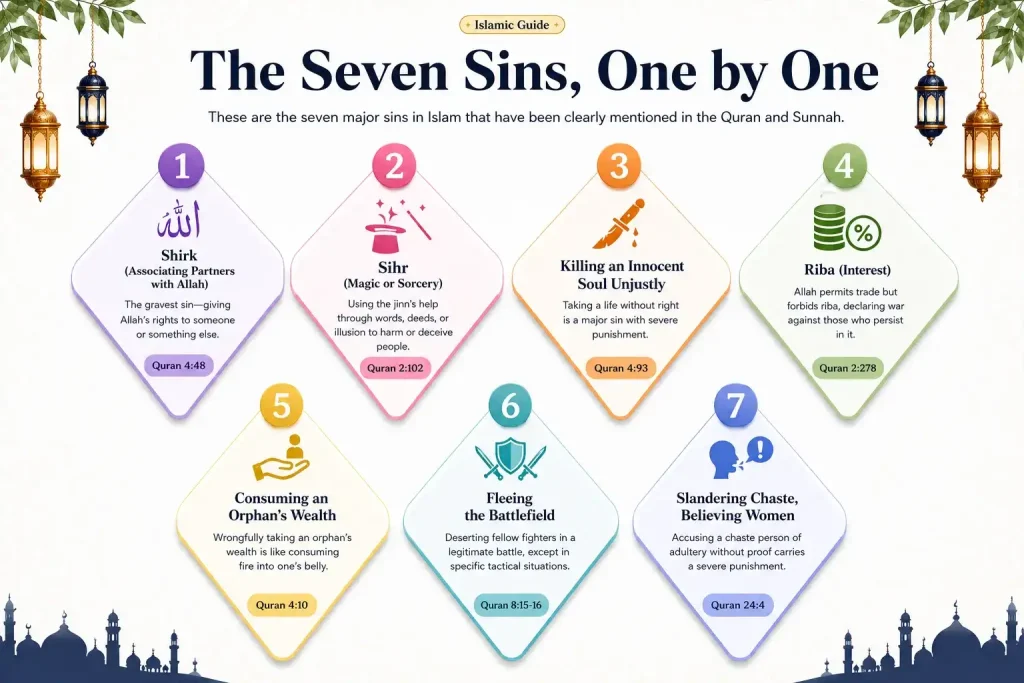
The 7 Major Sins at a Glance
| # | Sin | Quranic Reference | Warning or Punishment |
|---|---|---|---|
| 1 | Shirk | 4:48 | No forgiveness if unrepented before death |
| 2 | Sihr (magic) | 2:102 | Treated as disbelief; capital offense in all four Sunni schools |
| 3 | Unjust killing | 4:93 | Hellfire, Allah's wrath, qisas or blood money under fiqh |
| 4 | Riba (interest) | 2:278 | A notice of war from Allah and His Messenger |
| 5 | Consuming an orphan's wealth | 4:10 | Described as "consuming fire" |
| 6 | Fleeing the battlefield | 8:15-16 | Anger from Allah, Hellfire as refuge |
| 7 | Slandering chaste women | 24:4 | Eighty lashes, testimony rejected permanently |
The Hadith Behind the List
Abu Hurairah narrated that the Prophet ﷺ told his companions to avoid seven “destructive” sins. When they asked what these were, he listed shirk, magic, unlawful killing, consuming riba, consuming an orphan’s wealth, fleeing the battlefield, and slandering chaste women. Both al-Bukhari and Muslim included this narration in their collections, which places it among the most rigorously authenticated hadiths in Sunni scholarship.
Ibn Hajar al-Asqalani, in his commentary on Sahih al-Bukhari, notes that the Prophet ﷺ used the word “seven” here as an example of the worst sins, not as a final count. That distinction matters, and it shapes almost everything scholars later wrote on the subject. Kitaab Insights has touched on this pattern before, in a piece on the four stages the Quran describes in a person’s spiritual transformation, the same principle applies here: a single number in a hadith often marks a category, not a ceiling.
How Scholars Verify This Hadith's Authenticity
Hadith scholars grade a narration by tracing its chain of transmission (isnad) back to the Prophet ﷺ and checking every narrator in that chain for two things: trustworthy character (‘adalah) and a reliable memory (dabt). A hadith earns the label “sahih” — authentic — only when every link in its chain meets both standards, with no hidden defect (illah) or contradiction with a stronger narration.
This particular hadith carries the highest classification available: muttafaqun ‘alayh, meaning both Imam al-Bukhari and Imam Muslim independently verified and included it in their collections. Out of the roughly 7,000 hadiths in Sahih al-Bukhari, a relatively small number reach this joint standard, which is part of why scholars treat this list of seven as a firm starting point rather than a debatable one.
The Seven Sins, One by One Islamic Law
Shirk means giving Allah’s rights to someone or something else. This can happen through idol worship, seeking a saint’s help as Allah’s equal, or relying on horoscopes for guidance. It sits first on the list because it strikes at tawhid, the single belief everything else in Islam rests on. The word tawhid carries legal and theological weight in Arabic that translations often flatten. This is part of why structured Arabic study for adults tends to change how a person reads verses like these. The term stops being an abstract label and starts carrying its full original scope.
Allah states that He forgives every sin except shirk for whoever dies upon it unrepentant (Quran 4:48). Scholars agree that this makes shirk the gravest of the seven. They differ, however, on how to classify borderline cases. For instance, some folk practices may count as shirk, while others may only count as lesser acts of disobedience (bid’ah).
Sihr means using the jinn’s help, through words, deeds, or illusion, to harm or deceive people. The Quran describes how this played out with Pharaoh’s magicians. It also describes how the angels Harut and Marut warned the people of Babylon that magic was a trial, not a gift (Quran 2:102).
All four Sunni schools of law treat confirmed sihr as a capital offense, though their procedures differ. Imam Malik held that a proven sorcerer is executed without first being asked to repent, since the practice of sihr is itself treated as an act of disbelief. Other jurists required the standard process given to an apostate: an invitation to repent before any penalty is carried out.
Allah warns that whoever kills a believer intentionally faces Hellfire, His wrath, and severe punishment (Quran 4:93). Islamic law limits lawful killing to specific cases. These include executing a convicted murderer, punishing a previously married adulterer, or stopping an armed criminal who threatens innocent lives.
Classical fiqh actually splits killing into three categories, each with a different ruling. Intentional killing (qatl al-‘amd) can carry the death penalty. Quasi-intentional killing (shibh al-‘amd), such as a fight that unintentionally turns fatal, usually carries blood money instead of execution. Purely accidental killing (khata’) requires blood money and expiation but no legal punishment. The hadith’s warning applies most directly to the first category.
Allah permits trade but forbids riba outright. He warns those who continue in it of “a notice of war from Allah and His Messenger” (Quran 2:278). Classical scholars divide riba into two forms:
Riba al-fadl: Exchanging a lesser amount of a commodity for a greater amount of the same commodity. For example, trading one sa’ of wheat for two sa’s of wheat.
Riba al-nasi’ah: Charging extra for delaying repayment. This is the pattern most conventional bank interest follows today.
Contemporary scholars still disagree on where this leaves modern financial products such as mortgage substitutes and credit cards. A few permit narrow exceptions under necessity (darurah). Most, however, maintain that any predetermined return on a loan falls under riba al-nasi’ah, regardless of the product’s name.
An orphan, in Islamic law, is a child who lost their father before reaching puberty. Guardians are commanded to protect and grow an orphan’s property, not draw from it for their own benefit. Allah warns that whoever wrongfully consumes an orphan’s wealth “is only consuming into their bellies fire” (Quran 4:10).
Jurists generally permit a guardian who is genuinely poor to take a fair, documented wage for managing the orphan’s affairs. They differ, though, on how “fair” is defined, and on whether a wealthy guardian may take anything at all. These are the kinds of boundaries, around fairness, trust, and other people’s property, that households usually try to instill well before a child is old enough to manage money themselves. That is the age range Kitaab Academy’s children’s Qur’an and Islamic studies program is built around.
A soldier who deserts fellow fighters during a legitimate battle falls under this sin. Two exceptions apply: retreating as a tactic, or regrouping with another unit. The Quran states both exceptions explicitly (Quran 8:15-16). Scholars have historically debated how to apply this ruling once wars stopped resembling the face-to-face battles of early Islamic history, particularly in cases involving modern conscription or defensive warfare.
Accusing a chaste woman of adultery without four witnesses carries a legal punishment of eighty lashes (Quran 24:4). The same ruling extends to slandering a chaste man, though the verse specifically addresses women since such accusations have historically targeted them more often. Scholars note that this hadd punishment applies only when the accusation cannot be proven. An accusation later shown to be true does not carry this penalty.
Why Some Scholars Count 70 Major Sins, Not 7
The companion Abdullah ibn Abbas said the major sins are closer to seventy than to seven, and most classical scholars followed his reasoning rather than treating the hadith’s list as exhaustive. Imam adh-Dhahabi’s 14th-century work, Al-Kaba’ir, catalogs roughly seventy major sins, including abandoning the five daily prayers, severing family ties, and disrespecting parents. Readers who want to work through the primary Quranic verses behind each of these categories, rather than a secondhand summary, can find translated mushaf editions and tafsir volumes in the Kitaab Library.
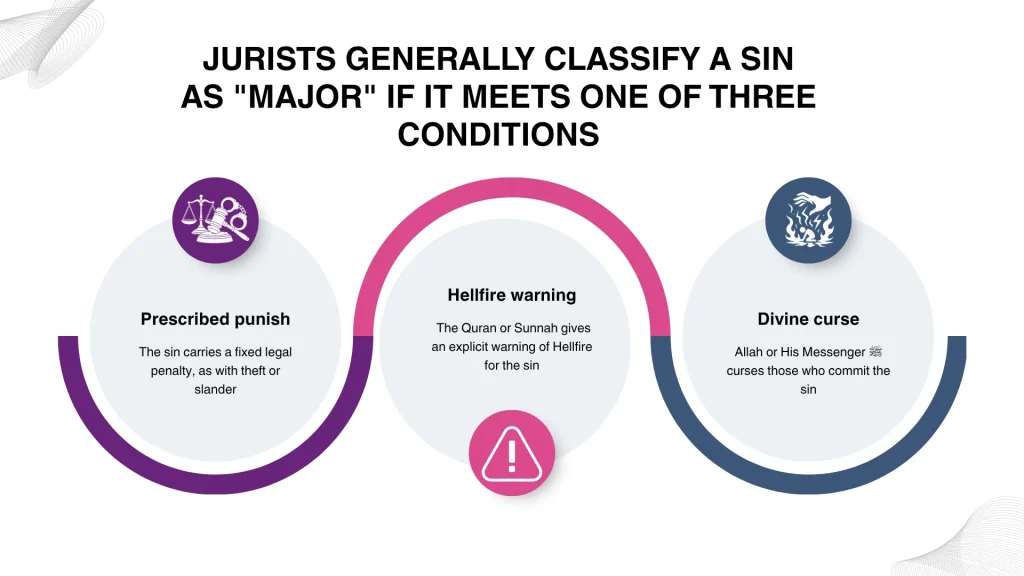
Jurists generally classify a sin as “major” if it meets one of three conditions:
- Prescribed punishment (hadd): The sin carries a fixed legal penalty, as with theft or slander.
- Hellfire warning: The Quran or Sunnah gives an explicit warning of Hellfire for the sin.
- Divine curse: Allah or His Messenger ﷺ curses those who commit the sin.
This is also where scholarly opinion splits further. Some later scholars, including Ibn Abbas himself in a different narration, suggested there is no fixed number at all — that every sin becomes “major” in proportion to how deliberately and persistently a person commits it.
Sins Against Allah vs. Sins Against Other People
Classical jurists also sort these seven sins by who is wronged, since that affects what repentance requires. Shirk, sihr, and fleeing the battlefield fall mainly under huquq Allah, meaning rights owed to Allah alone.
Repentance for these needs only sincere regret and a firm resolve to stop. Unjust killing, consuming an orphan’s wealth, and slandering chaste women fall under huquq al-‘ibad, meaning rights owed to other people. Repentance for these stays incomplete until the wronged person is compensated, forgives the wrongdoer, or receives justice through a legitimate authority.
Riba sits in the middle category. Scholars generally treat it as a violation of Allah’s command that also causes direct financial harm to another person. Because of this, many jurists require both sincere repentance and returning any unlawfully gained interest.
Common Misconceptions About the 7 Sins
A few misunderstandings come up often enough to address directly:
- Completeness myth: The list of seven is not complete. The hadith names seven examples of the worst sins, and classical scholarship, following Ibn Abbas, expands the count toward seventy.
- Idol-worship myth: Shirk covers a wider range of acts. These include relying on fortune-tellers, believing an object brings luck independent of Allah’s will, or showing off in worship to gain praise from other people (a lesser form scholars call “hidden shirk”).
- Superstition myth: Islamic law treats confirmed sihr as a major sin with legal consequences. This is because the Quran describes it as an act that can lead a person out of the fold of Islam, not a harmless folk practice.
- High-interest myth: Any predetermined return on a loan, however small, falls under riba’s definition in classical fiqh. The amount charged changes only its severity in practice, not the ruling itself.
Major Sins vs. Minor Sins
Allah promises that avoiding the major sins brings automatic forgiveness for minor ones (Quran 53:32). A study, The Concept and Psychological Effects of Sins in Islam found that unrepented sin leaves a documented, cumulative effect on a believer’s spiritual state. It gradually dulls their sensitivity to further wrongdoing.
A separate paper, Persistence and its Impact on Minor Sins among Muslims in Kwara State, Nigeria, found that Friday sermons in the communities studied disproportionately address the major sins listed above. Minor, everyday sins such as backbiting go largely unaddressed, even though the same study found these minor sins accumulate into serious harm when left unchecked over time.
Repenting From a Major Sin
Classical scholars, including Imam an-Nawawi, outline four conditions for a valid repentance (tawbah) from any of these sins:
- Stop the sinful action.
- Feel genuine remorse over having committed it.
- Resolve never to return to it.
- Return any rights or property taken from another person, where applicable.
Jurists add a fifth condition specifically for sins against other people, such as slander or consuming an orphan’s wealth. Repentance is not considered complete until the wronged person is compensated or has forgiven the wrongdoer directly.
FAQs
Which of the seven is the worst?
Shirk, since it is the only one of the seven that the Quran says Allah will not forgive for a person who dies upon it unrepentant.
Do all scholars agree there are exactly seven major sins?
No. The hadith names seven as examples. Most classical scholars, following Ibn Abbas, count closer to seventy once they include the Quran’s other warnings.
Is missing prayer part of the original seven?
It doesn’t appear in the Bukhari-Muslim hadith itself, but adh-Dhahabi and most later scholars include it in the wider list of major sins.
Does the eighty-lash punishment for slander apply if the accusation turns out to be true?
No. Jurists agree the hadd punishment applies only to unproven, false accusations.
What is the unforgivable sin in Islam?
Shirk is the only sin the Quran describes as unforgivable, and only if a person dies upon it without repenting first.
What are the 3 greatest sins according to scholars?
Several classical scholars rank shirk, unlawful killing, and sihr as the three gravest of the seven, since each one carries the most severe warnings in the Quran and hadith.
Does Allah forgive every sin if a person repents sincerely?
Yes. Allah accepts sincere repentance for any sin, including all seven discussed here, as long as it happens before death. Where another person was wronged, their rights need to be addressed too.
How many total sins are there in Islam?
There is no single, agreed-upon number. The Prophet ﷺ named seven as the clearest examples. Adh-Dhahabi’s classical work catalogs around seventy major ones, and minor sins are considered too numerous to count individually.