What Is Hajj in Islam?
Hajj is the annual pilgrimage to the sacred city of Makkah that every eligible Muslim completes at least once in a lifetime, as the fifth pillar of Islam. It falls in Dhul Hijjah, the twelfth month of the Islamic calendar, and runs for five to six days. Well over a million Muslims travel to Makkah each Dhul Hijjah to perform rites that trace back to Prophet Ibrahim (AS) and were later confirmed by Prophet Muhammad ﷺ.Below is a full walkthrough: what the word means, where the pilgrimage came from, who is required to go, how the rites unfold day by day, and what a pilgrim actually gains from the journey.
What Is Hajj?
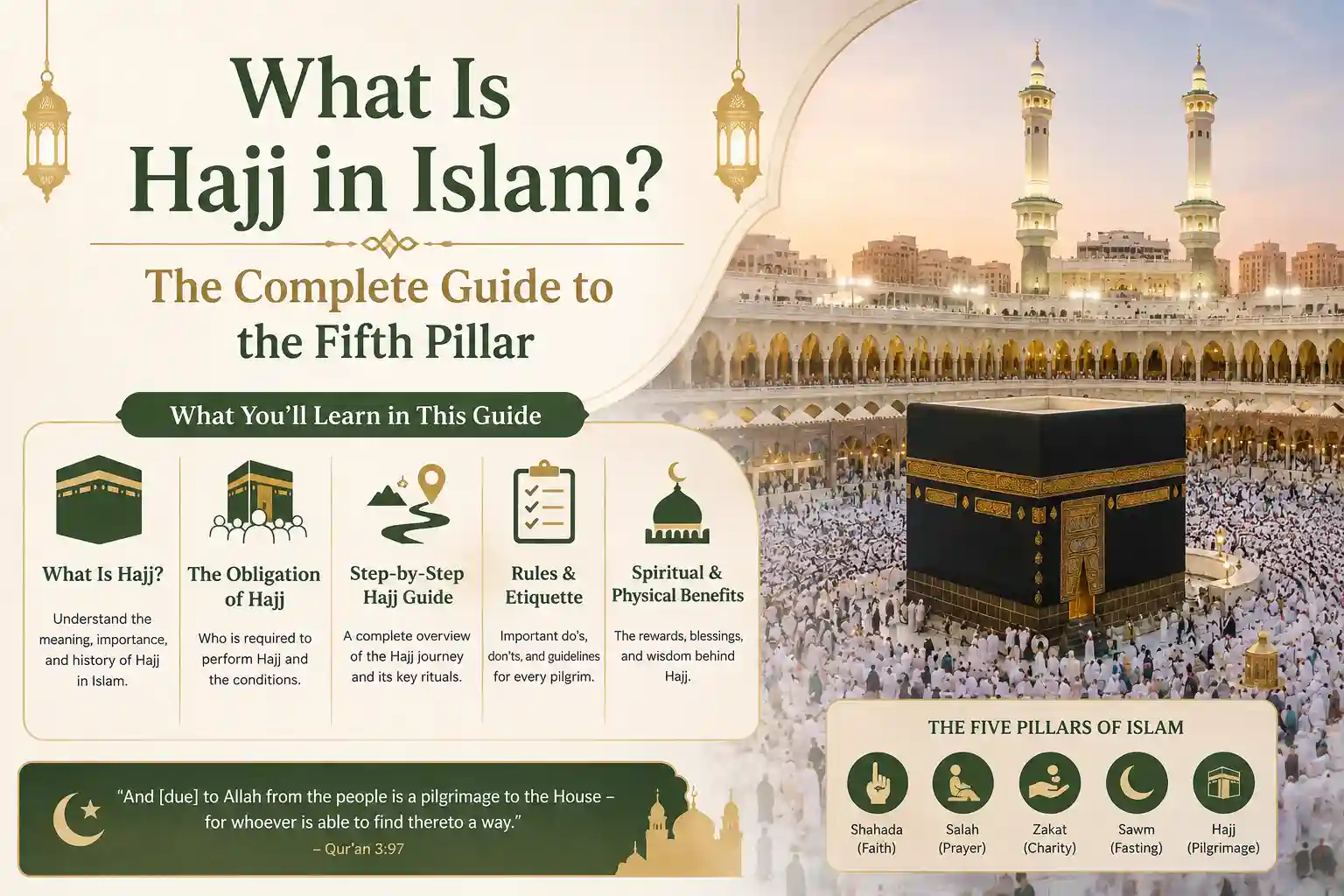
Hajj is a set of specific acts of worship performed in and around the Kaaba in Makkah, following an order the Prophet ﷺ demonstrated during his own pilgrimage in 632 CE. The word itself comes from an Arabic root meaning “to set out with a definite purpose.” Allah commands it directly in Surah Aal-e-Imran, verse 97: pilgrimage to the House is owed to Allah by anyone who can find a way there.
Muslims who study this verse in its original Arabic, such as through Kitaab Academy’s Arabic classes built for busy adults, often notice how much weight the wording carries beyond its English translation. Scholars across the four major schools of Islamic law, Hanafi, Maliki, Shafi’i, and Hanbali, treat this verse as the basis for Hajj being fard ‘ayn, an individual duty on every capable adult Muslim.
Islam is built on five pillars, and Hajj is the last of them, completing a structure that moves from belief to practice to sacrifice:
- Shahadah, the declaration of faith
- Salah, five daily prayers
- Zakah, obligatory charity
- Sawm, fasting through Ramadan
- Hajj, pilgrimage to Makkah
Where Salah shapes a Muslim’s daily rhythm, and Zakah shapes their relationship to wealth, Hajj asks for both at once: time, money, and physical effort, in a single act of worship. Readers interested in another pillar can look at Guarding the Middle Prayer, a Kitaab Academy piece on the place of Salah in the Quran.
When Does Hajj Take Place?
Hajj begins on the 8th of Dhul Hijjah and continues through the 12th or 13th, depending on moon sighting. Because the Islamic calendar is lunar, the pilgrimage moves roughly 11 days earlier each year on the Gregorian calendar, so it cycles slowly through every season over a person’s lifetime. The pilgrimage closes with Eid al-Adha, the four-day festival that begins on the 10th of Dhul Hijjah and commemorates Ibrahim’s (AS) willingness to sacrifice for Allah’s sake.
The story starts with a mother and her son, alone in an empty valley. Allah instructed Ibrahim (AS) to leave his wife Hajar and infant son Ismail (AS) in Makkah, then a barren stretch of land with no water source. When their supplies ran out, Hajar ran between the hills of Safa and Marwah searching for help, seven times back and forth, until Allah opened the spring of Zamzam beneath her son’s feet. That same route forms the ritual of Sa’i today, and the well still flows.
Ibrahim (AS) later returned to Makkah and, with Ismail (AS), rebuilt the Kaaba as a house dedicated solely to Allah. The pilgrimage survived for centuries afterward among the Arabs of pre-Islamic Arabia, though idol worship gradually corrupted its original purpose. After the conquest of Makkah, Prophet Muhammad ﷺ cleared the Kaaba of idols and restored the rites to their original form. He performed Hajj only once, in 632 CE, in what became known as the Farewell Pilgrimage. This journey also produced his final sermon at Arafat, still cited today as a foundational statement on human dignity and equality.
Who Must Perform Hajj? The Conditions of Istita'ah
Not every Muslim carries the obligation of Hajj. It applies only once a person reaches istita’ah, meaning capability. Jurists across the four madhhabs generally agree on the following conditions:
- Being Muslim. Hajj is an Islamic rite and does not apply outside the faith.
- Sound mind. The obligation does not fall on someone unable to understand it.
- Adulthood. Reaching puberty triggers the duty, though a child who performs Hajj earlier still earns reward. Families sometimes bring children along for the experience through the Qur’an program for children, even though it won’t count as their obligatory pilgrimage.
- Financial capacity. A person needs enough surplus wealth to cover the trip and to leave their dependents provided for while they’re away.
- Physical capacity. Someone unable to make the journey or bear its rigors is exempt, though families sometimes arrange Badal Hajj, having another Muslim perform it on their behalf.
- A safe, lawful route, which for women traditionally includes travelling with a mahram or, more recently, as part of an organized women’s group under updated Saudi regulations.
A fuller academic treatment of these conditions across all four schools is available in a paper from the International Journal of Academic Research in Business and Social Sciences, which works through how each madhhab defines physical and financial ability.
8th Dhul Hijjah: Ihram and Mina
Pilgrims enter Ihram, a state of ritual purity marked by simple white, unstitched garments for men and modest ordinary dress for women, and declare their intention before heading to Mina, where they spend the day and night in prayer.
9th Dhul Hijjah: Wuquf at Arafat
This day is built entirely around one event: standing at Arafat. Pilgrims gather on the plain from noon until sunset for prayer and reflection, and most scholars consider this Wuquf the single most essential rite of the entire pilgrimage. A Hajj without it does not stand. After sunset, everyone moves to Muzdalifah to sleep under the open sky and gather pebbles for the following days.
10th Dhul Hijjah: Eid al-Adha
Several rites come together on this day. Pilgrims throw seven pebbles at Jamarat al-Aqabah, the largest of three stone pillars representing the rejection of Satan’s whispers to Ibrahim (AS). An animal sacrifice follows, along with shaving or trimming the hair, and then Tawaf al-Ifadah, seven circuits around the Kaaba.
11th to 13th Dhul Hijjah: Continued Rami
The 11th and 12th repeat the stoning, this time at all three Jamarat in sequence, with a pause after the first two pillars to face the qibla and make du’a. Some pilgrims add an optional third day of stoning on the 13th before a farewell Tawaf and the journey home.
The Essential Pillars
Four or five rites, depending on the school followed, are considered essential enough that skipping them invalidates the pilgrimage: Ihram, Tawaf, Wuquf at Arafat, and Tawaf al-Ifadah. Sa’i sits in a slightly different place across the madhhabs. The Maliki, Shafi’i, and Hanbali schools count it as a pillar on the same level as Tawaf. In contrast, the Hanafi school treats it as wajib, obligatory but not quite a pillar, meaning a pilgrim who misses it owes a compensatory sacrifice rather than an invalid Hajj.
The Three Types of Hajj: Tamattu, Qiran, and Ifrad
Before reaching the miqat, the boundary where Ihram begins, every pilgrim settles on one of three valid approaches.
Hajj Tamattu'
This type combines Umrah and Hajj with a break in between: the pilgrim exits Ihram after completing Umrah, then re-enters it for Hajj on the 8th of Dhul Hijjah. It requires an animal sacrifice and tends to suit pilgrims arriving from abroad who want rest between the two rites.
Hajj Qiran
This type also combines both, but under one continuous Ihram with no exit in between. The Prophet ﷺ performed this type himself, since he had brought a sacrificial animal from Madinah, and it likewise requires a sacrifice.
Hajj Ifrad
This type covers Hajj on its own, without Umrah attached. No sacrifice is required, and it traditionally suits residents of Makkah, who can perform Umrah separately at any point during the year.
Scholars differ on which of the three carries the greatest reward, but all four madhhabs agree that each one fulfills the obligation of Hajj.
Hajj Umrah Obligation Required once in a lifetime for capable Muslims Voluntary Timing Only the 8th to 13th of Dhul Hijjah Any time of year Rites included Ihram, Tawaf, Sa’i, Arafat, Muzdalifah, Rami Ihram, Tawaf, Sa’i.
Because Umrah shares several rites with Hajj, it’s sometimes called the “lesser pilgrimage,” but the two are not interchangeable, and performing Umrah does not remove the separate obligation of Hajj.
The Benefits of Hajj
- Forgiveness and renewal: Hajj offers a genuine fresh start, a real chance to be cleansed of years of accumulated sin.
- Equality before Allah: The plain white Ihram garments strip away any visible sign of wealth or status. For a few days, every pilgrim stands as an equal, no matter where they come from.
- A direct link to the prophets: Every rite retraces the footsteps of Ibrahim (AS), Hajar, Ismail (AS), and Muhammad ﷺ. This is part of why so many pilgrims describe the journey as one that reshapes their faith, a theme explored further in The Four Stages of Transformation in the Qur’an on Kitaab Insights.
- Patience built through hardship: Walking several kilometers a day in heat and crowds, over close to a week, builds a kind of patience that’s hard to find elsewhere.
- Measurable psychological benefits: A peer-reviewed review published on PubMed looked at this pattern closely. Despite the physical strain, pilgrims who complete Hajj generally report less distress and more emotional resilience in the months that follow.
- 2025 pilgrim count: 1.67 million pilgrims completed Hajj, according to Saudi Arabia’s General Authority for Statistics. This is slightly down from the record 1.84 million recorded in 2023.
- Countries represented: Pilgrims arrived from 171 countries in 2025. Roughly 90% travelled from outside Saudi Arabia.
- Historical roots: The rites of Hajj trace back close to 4,000 years, to the era of Ibrahim (AS).
- The Prophet’s own Hajj: Muhammad ﷺ performed Hajj once, in 632 CE.
- Repeated rites: Tawaf involves circling the Kaaba seven times. Sa’i covers seven trips between Safa and Marwah.
Conclusion
Hajj brings together everything Islam asks of a believer. It combines belief, discipline, sacrifice, and humility into a single journey, retraced every year by millions of Muslims. Understanding its history, conditions, and rites is a good starting point. For those who meet the conditions of istita’ah, the pilgrimage itself remains the fullest way to experience what these rituals actually mean.
This kind of understanding usually grows alongside a real connection to the Quran itself, not just its translation. Kitaab Academy builds its courses around exactly that goal, and the Kitaab Insights blog keeps adding reflections on the verses, surahs, and history that shape how Muslims understand acts of worship like Hajj.
FAQs
What does the word "Hajj" mean?
It means “to set out with intention.” It describes a journey undertaken deliberately, for Allah’s sake alone.
How many days does Hajj last?
Five to six days, from the 8th to the 12th or 13th of Dhul Hijjah.
Can someone else perform Hajj on my behalf?
Yes. Badal Hajj lets a capable Muslim perform the pilgrimage for someone who has died, or for someone permanently unable to travel due to age or illness.
Is Hajj required every year?
No. It’s required only once in a lifetime for those who meet the conditions of istita’ah. Any additional pilgrimage is voluntary.
What happens if a Muslim can never afford or physically manage Hajj?
The obligation is lifted. Islamic law does not require Hajj from anyone who genuinely lacks the money or physical strength to perform it safely.
How much does Hajj cost?
Cost varies widely by country of departure, package type, and how close the accommodation sits to the Haram. Prices range from a few thousand dollars on budget packages to much more for private or five-star arrangements.
What is the Talbiyah recited during Hajj?
The Talbiyah is a declaration pilgrims repeat throughout Hajj after entering Ihram. It affirms that they answer Allah’s call, and that all praise, blessing, and dominion belong to Him alone.
Can women perform Hajj without a mahram?
Classical scholarship generally requires a mahram for women travelling for Hajj. Some modern authorities, including Saudi Arabia’s own rules, now also allow women to travel in an organized, verified women’s group instead.
Which type of Hajj is best for first-time pilgrims?
Most scholars recommend Tamattu’ for first-timers. The break between Umrah and Hajj gives new pilgrims time to rest and adjust before the more demanding days of Hajj begin.