Understanding the Real Differences Between Arabic and Qur’anic Arabic
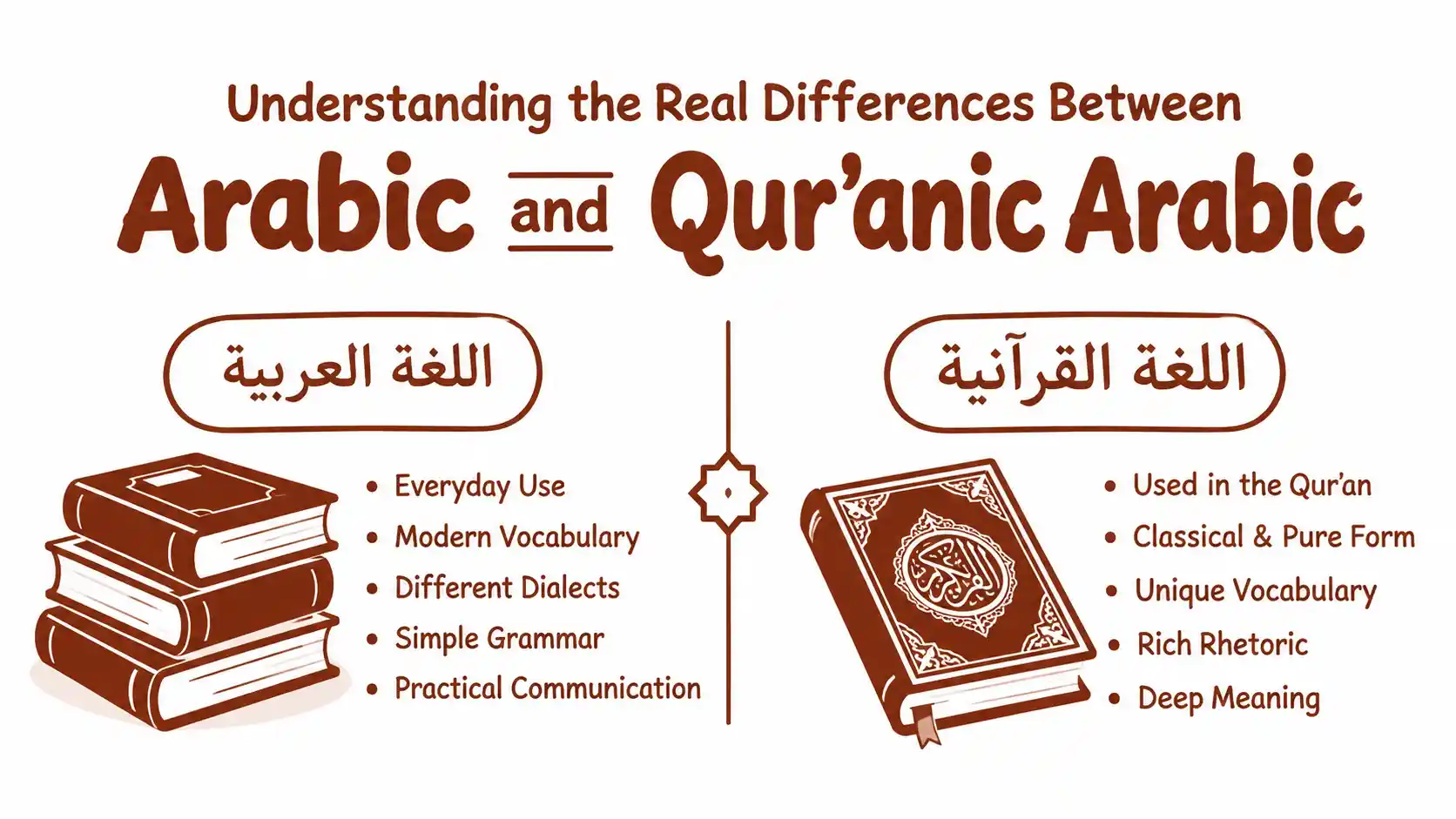
Arabic is not one language. It is a family of related forms that share a common script and root system but differ in grammar, vocabulary, and purpose. When someone says they want to “learn Arabic,” they could mean any of at least three distinct things: Modern Standard Arabic (MSA), a spoken regional dialect, or the Classical Arabic of the Qur’an.
For the estimated 1.8 billion Muslims worldwide, this distinction matters more than it does for any other language community on earth. The Arabic of the Qur’an is not a historical curiosity. It is a living text recited daily in prayers, memorized in its entirety by millions of huffaz, and studied as the direct word of God. Understanding how it differs from the Arabic used in newspapers, classrooms, and conversations is the first step toward choosing the right learning path.
This guide breaks down each form of Arabic, explains the specific differences that matter for learners, and clarifies which form to prioritize based on your goals.
The Three Forms of Arabic Every Learner Should Know
Classical Arabic (The Language of the Qur’an)
Classical Arabic, also called Qur’anic Arabic or Fusha al-Turath, is the language in which the Qur’an was revealed in the 7th century CE. It is rooted in the dialect of the Quraysh tribe of Mecca, though it incorporates vocabulary and poetic conventions from across the Arabian Peninsula.
Several features distinguish it from every other form of Arabic in use today:
Full case ending system (I’rab).
Classical Arabic uses three grammatical cases on nouns and adjectives: nominative (ـُ), accusative (ـَ), and genitive (ـِ). These short vowel endings change based on the word’s function in the sentence. In the phrase “قرأ الطالبُ الكتابَ” (the student read the book), the student (الطالبُ) takes the nominative ending because it is the subject, while the book (الكتابَ) takes the accusative because it is the object. This case system is consistently applied throughout the Qur’an and is essential for correct recitation (Tajweed).
Dual grammatical number.
Arabic has three grammatical numbers: singular, dual (exactly two), and plural. While MSA retains the dual in theory, Classical Arabic uses it far more rigorously and frequently. The Qur’an uses the dual form extensively in verbs, pronouns, and nouns.
Richer verb patterns.
Classical Arabic employs all ten standard verb forms (awzan) with greater frequency and complexity than MSA. Some verb forms that appear regularly in the Qur’an are rare or absent in modern usage.
Layered vocabulary with multiple meanings.
Many Qur’anic words carry several layers of meaning that depend on context, grammatical form, and the broader passage. The word “ضرب” (daraba) has over a dozen meanings in Classical Arabic, including to strike, to travel, to present (a parable), and to set forth, depending on preposition, context, and sentence structure. This semantic richness is deliberate and is part of what Islamic scholars call the Qur’an’s inimitability (i’jaz).
Tashkeel (diacritical marks).
The Qur’anic text is always written with full vowel markings (fatha, damma, kasra, sukun, shadda, tanwin) because correct pronunciation is a religious obligation in recitation. These marks are largely absent from modern written Arabic.
The Qur’an contains approximately 77,430 total words with around 14,870 unique word forms derived from roughly 1,700 to 2,000 root words. Despite its reputation for difficulty, this is a remarkably concentrated vocabulary. The 125 most frequently occurring words cover approximately 50% of the entire text, making focused study highly efficient.
Modern Standard Arabic (MSA)
MSA, called Fusha al-Asriyya, emerged in the late 19th and early 20th centuries as Arab intellectuals standardized a modern written form based on Classical Arabic. It is the official language of all 22 Arab League member states, used across media, education, law, diplomacy, and formal writing.
MSA preserves the core grammar of Classical Arabic but with significant simplifications:
Simplified case endings.
While MSA textbooks teach I’rab, native speakers routinely drop case endings in speech and even in much of written media. A news anchor reading from a script may apply some case endings, but a professor lecturing or a journalist writing a column typically does not. This is a major departure from Qur’anic Arabic, where every ending carries grammatical and sometimes theological significance.
Modern vocabulary.
MSA includes thousands of words that did not exist in the 7th century: هاتف (telephone), حاسوب (computer), ديمقراطية (democracy), بنك (bank). Many are Arabized loanwords from European languages, a category entirely absent from the Qur’an.
Standardized syntax.
MSA sentence structure is more predictable and formulaic than the Qur’an’s, which uses word order variations, ellipsis, and rhetorical structures for emphasis and beauty. Qur’anic Arabic sometimes places the object before the verb or the predicate before the subject for deliberate effect, structures that would be marked as unusual or incorrect in MSA composition.
Reduced semantic density.
In MSA, most words have one or two standard meanings. The layered, context-dependent meanings of Qur’anic vocabulary are a feature of the classical language that MSA has largely streamlined for the sake of clarity and efficiency.
Spoken Dialects (Ammiyya)
Regional dialects like Egyptian, Levantine, Gulf, and Maghrebi Arabic are the mother tongues of native speakers. No one grows up speaking MSA or Classical Arabic at home. Dialects differ from both MSA and Qur’anic Arabic in pronunciation, vocabulary, and grammar, sometimes so significantly that speakers of different dialects struggle to understand each other.
However, all dialects share approximately 60 to 70% of core vocabulary with MSA, and most Arabic speakers understand MSA through exposure to media and education. Dialects are relevant to this discussion because many learners mistakenly believe that learning a spoken dialect will help them understand the Qur’an. It will not, at least not directly. Qur’anic comprehension requires engagement with the classical grammar and vocabulary that dialects have shed over centuries.
The Key Differences That Matter for Learners
Feature | Qur’anic Arabic | Modern Standard Arabic |
|---|---|---|
Case endings (I’rab) | Fully applied, essential for meaning | Taught but routinely dropped |
Vocabulary | Fixed, 7th-century lexicon of ~14,870 unique forms | Evolving, includes modern coinages and loanwords |
Diacritical marks | Always present in the text | Rarely used outside children’s books |
Verb forms | All 10 patterns used frequently | Some patterns rare in practice |
Word order | Flexible for rhetorical effect | More standardized |
Dual form | Used extensively | Used but less rigorously |
Semantic depth | Words carry multiple layered meanings | Words tend toward single standard meanings |
Living speakers | No native speakers; used in worship and scholarship | No native speakers; used in formal/written contexts |
One critical similarity: neither Qur’anic Arabic nor MSA is anyone’s mother tongue. Both are learned forms. This means that every Arabic learner, including native dialect speakers, studies these forms formally. A child growing up in Cairo speaks Egyptian Arabic at home but learns MSA in school and Qur’anic Arabic in religious education. This shared learning experience means that non-native learners are not as far behind as they might assume.
The traditional practice of memorizing Qur’an after Fajr prayer aligns precisely with this cognitive science. It also provides a distraction-free environment before the demands of the day begin.
Which Form Should You Learn First?
The answer depends entirely on your primary goal. Here is a practical framework:
If your goal is Qur’anic comprehension and Islamic scholarship:
Start with Qur’anic Arabic directly. The Qur’an’s concentrated vocabulary means a focused learner who masters the most frequent words can begin understanding real verses within months. Kitaab Academy’s 7-level curriculum is designed specifically for this path, building Classical Arabic grammar and Qur’anic vocabulary from Level 1 through a structured progression taught by certified instructors.
If your goal is professional or academic use:
Start with MSA. It is the language of Arab media, business, law, and academia. MSA fluency lets you read any Arabic newspaper, follow a news broadcast, or write a formal report. Because MSA is descended directly from Classical Arabic, an MSA foundation makes transitioning to Qur’anic Arabic significantly easier.
If your goal is conversational fluency:
You need a spoken dialect (Egyptian for the widest media comprehension, Levantine or Gulf for regional travel). However, starting with MSA for 3 to 6 months before adding a dialect gives you a grammatical foundation that accelerates dialect acquisition, since all dialects are simplifications of the MSA grammar system.
If your goal is all of the above:
Start with MSA and Qur’anic Arabic simultaneously. This is the most efficient path for learners who want both worldly communication and spiritual comprehension. The two forms share roughly 70 to 80% of their grammar, so studying them together reinforces both rather than creating confusion. A dialect can be added once the shared foundation is solid.
Why Understanding Arabic Makes Qur'anic Memorization Easier
Many Muslims memorize the Qur’an without understanding its Arabic, treating memorization as a purely phonetic exercise. This works, but it is dramatically slower than it needs to be.
Research on memory and depth of processing consistently shows that meaningful material is retained approximately 5 to 10 times longer than material perceived as meaningless. A student who understands that “الحمد لله رب العالمين” means “All praise is due to God, Lord of all worlds” encodes the verse as a meaningful thought. A student who memorizes the same sounds without understanding encodes it as a sequence of arbitrary phonemes, which the brain treats the same way it treats a random string of numbers.
The root system makes this transition accessible. The Qur’an’s vocabulary reduces to roughly 1,700 to 2,000 distinct roots, and just 300 of the most common roots cover approximately 80% of the text. A learner who invests in understanding Arabic roots alongside memorization gains a compounding advantage: each new root makes the next surah easier to retain.
For children beginning Qur’an studies, introducing basic Arabic vocabulary alongside recitation builds comprehension from the start, preventing the disconnect between recitation ability and understanding that many adult Muslims later spend years trying to bridge.
The "Which Arabic" Question Is Often the Wrong Question
Most learners stall on the question of which Arabic to learn because they treat the forms as competing options. In practice, they are layers of the same language. Classical Arabic is the foundation on which MSA was built, and MSA is the bridge that connects Classical Arabic to the modern world.
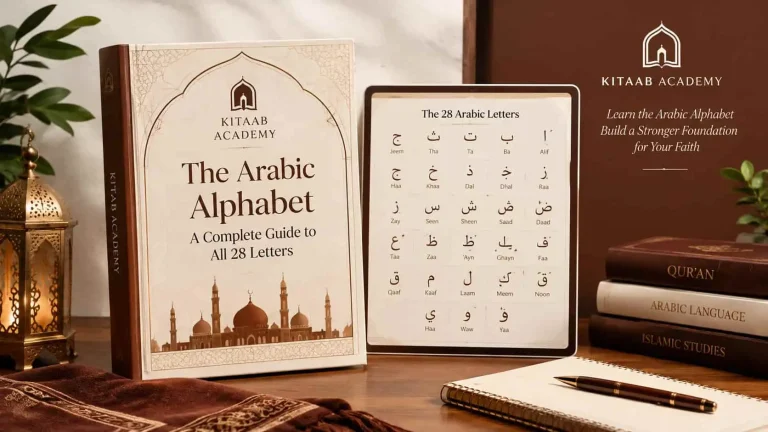
A learner who studies the Arabic alphabet is learning a script shared by all three forms. A learner who understands basic Arabic vocabulary rooted in the trilateral root system is building knowledge that applies to Qur’anic Arabic, MSA, and dialects simultaneously. The root ع-ل-م (ayn-lam-mim), meaning knowledge, produces عَلِمَ (he knew), عِلْم (knowledge/science), عَالِم (scholar/scientist), مُعَلِّم (teacher), and تَعْلِيم (education), words used identically across all forms of Arabic.
The real question is not “which Arabic” but “what is my starting point and what is my destination?” Once you answer that, the learning path becomes clear. For the millions of learners whose destination is understanding the Qur’an in its original language, the most direct route is a structured program that teaches Classical Arabic grammar and high-frequency Qur’anic vocabulary from day one, supplemented by the recorded courses in the Kitaab Library for self-paced reinforcement between live sessions.
FAQs
Is Qur'anic Arabic harder than Modern Standard Arabic?
Qur’anic Arabic has a more rigorous case ending system and richer vocabulary with layered meanings, which makes it more complex in some areas. However, its vocabulary is finite and concentrated, with just 125 words covering 50% of the text. This concentration actually makes focused Qur’anic study more achievable than mastering the open-ended vocabulary of MSA.
Can I understand the Qur'an if I only know MSA?
Adults can absolutely memorize the Qur’an. While children benefit from stronger phonological memory, adults have advantages in discipline, motivation, and the ability to understand the meaning of what they memorize, which significantly improves retention. Many adults complete hifz in 3 to 5 years with consistent daily practice.
Do I need to learn Arabic to read the Qur'an?
You can recite the Qur’an phonetically without understanding Arabic, and millions of Muslims do. However, understanding Arabic transforms the experience from recitation to comprehension. Even basic vocabulary covering the Qur’an’s most frequent words noticeably deepens your connection to the text during prayer and study.
Should I learn a dialect before studying the Qur'an?
Dialects will not help you understand the Qur’an because they have simplified or dropped many of the grammatical structures that Classical Arabic relies on. If your primary goal is Qur’anic comprehension, start with Classical Arabic directly or with MSA as a stepping stone. A dialect can be added later for conversational purposes.
How long does it take to understand Qur'anic Arabic?
With consistent daily study of 30 to 60 minutes, most learners begin recognizing common Qur’anic words within 2 to 4 weeks and understanding basic verses within 3 to 4 months. Full grammatical comprehension of complex passages typically takes 1 to 2 years of structured study.