
How Long Does It Take to Learn Arabic?
The short answer: the U.S. Foreign Service Institute estimates approximately 2,200 class hours for English speakers to reach professional working proficiency in Arabic. That places Arabic in Category IV, the highest difficulty tier, alongside Mandarin, Japanese, and Korean. For comparison, Spanish or French requires roughly 600 to 750 hours, making Arabic about 3.6 times longer.
But that number describes a very specific goal: government-level diplomatic fluency across reading, writing, listening, and speaking. Most learners are not training to be diplomats. They want to hold conversations, understand the Qur’an, read Arabic media, or connect with family and community. Those goals are achievable in a fraction of that time.
This guide breaks down realistic timelines for each stage, the factors that speed you up or slow you down, and what the research actually says about learning Arabic efficiently.
What Affects How Quickly You Learn Arabic?
Before looking at timelines, it helps to understand the five factors that most influence your speed.
Your native language and prior experience
If you already speak a Semitic language like Hebrew or Amharic, or a language that borrows heavily from Arabic like Urdu, Persian, or Malay, you have a built-in advantage. Shared root-based morphology, familiar sounds, and overlapping vocabulary all reduce learning time. English speakers start with almost no Arabic cognates, which means every word is built from scratch.
Consistency of study
Research on language acquisition consistently shows that distributed daily practice produces 20 to 30% better long-term retention than the same total hours crammed into fewer sessions. Fifteen to thirty minutes every day outperforms two hours twice a week. The Ebbinghaus forgetting curve drops steeply in the first 24 hours after learning new material, so daily review is what prevents constant re-learning.
Which Arabic you are learning
Arabic is not a single language. Modern Standard Arabic (MSA) is used in formal writing, news, education, and religious texts. Regional dialects like Egyptian, Levantine, Gulf, and Maghrebi are used in everyday conversation and differ from MSA by 30 to 40% in vocabulary, plus significant grammar and pronunciation shifts. Choosing one variety to focus on first, rather than splitting between MSA and a dialect simultaneously, accelerates progress significantly.
Quality of instruction
One guided hour with a qualified instructor equals roughly 1.5 to 2 hours of high-quality independent study in terms of measurable proficiency gains. Structured curricula that teach grammar through patterns rather than translation, and that introduce real reading and listening early, consistently produce faster results than grammar-table memorization or app-only approaches.
Your specific goal
“Learning Arabic” can mean very different things. Basic conversational ability, reading the Qur’an with comprehension, following Arabic news, and writing professional Arabic are all different endpoints with very different hour requirements.
Realistic Timeline by CEFR Level
The Common European Framework of Reference (CEFR) divides language proficiency into six levels, from A1 (absolute beginner) to C2 (near-native mastery). Here is what each stage looks like for Arabic, mapped against study hours and calendar time at different daily commitments.
Beginner: A1 to A2 (250 to 400 hours)
Calendar time: 6 to 12 months at 30 to 60 minutes per day
What you can do at this stage:
- Recognize and write all 28 letters of the Arabic alphabet in all four positional forms
- Read simple vowelized (tashkeel-marked) text
- Understand basic greetings, directions, and everyday phrases
- Hold simple conversations about familiar topics (introductions, family, daily routine)
- Build a foundation of 500 to 1,000 common words
Key milestones within this stage:
- Alphabet recognition: 1 to 2 weeks (approximately 10 to 15 total hours)
- Sounding out vowelized words: 2 to 4 weeks
- First simple conversations: 2 to 3 months
- Basic reading of short sentences: 3 to 6 months
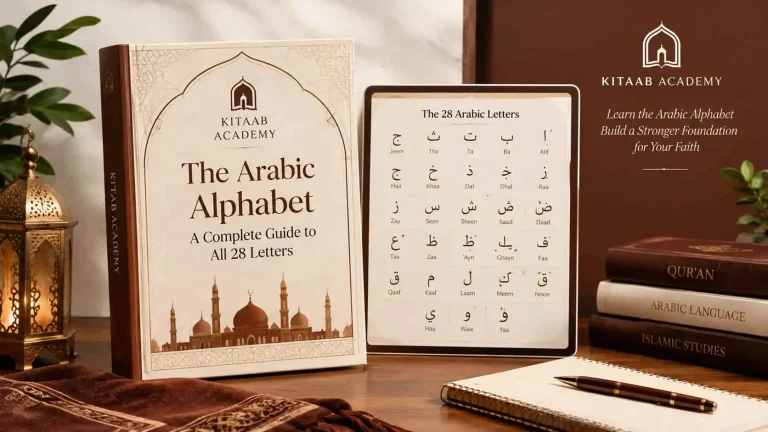
The Arabic alphabet itself is a two to three week task, not a months-long ordeal. It has only 28 letters with about 18 base shapes. The reputation is scarier than the reality. At Kitaab Academy, our students typically recognize all 28 letters within the first two weeks.
Intermediate: B1 to B2 (600 to 1,550 hours total)
Calendar time: 1.5 to 3 years at 30 to 60 minutes per day
What you can do at this stage:
- Follow everyday conversations at near-normal speed on familiar topics
- Express opinions, describe experiences, and explain plans
- Read Arabic news articles and short stories with moderate effort
- Understand the root system that powers Arabic vocabulary (one three-letter root unlocks 10 to 15 related words)
- Write paragraphs on various subjects
- Build vocabulary to 3,000 to 5,000 words
This is the stage where the Arabic root system becomes your biggest accelerator. The root ك-ت-ب (k-t-b, related to writing) generates كِتَاب (book), كَاتِب (writer), مَكْتَب (office), and مَكْتَبَة (library). Learning roots means one pattern unlocks entire word families instead of memorizing each word from scratch.
This stage often feels like a plateau, but it is also where real-world communication ability grows fastest.
Advanced: C1 to C2 (1,550 to 2,200+ hours total)
Calendar time: 3 to 5+ years at consistent daily study
What you can do at this stage:
- Understand complex Arabic texts including literature, scholarly articles, and religious scriptures
- Follow rapid colloquial speech between native speakers
- Express nuanced ideas with cultural awareness
- Navigate professional and academic contexts in Arabic
- Read unvowelled text fluently, inferring short vowels from context and grammar
The FSI’s 2,200-hour benchmark sits at approximately C1, which is professional working proficiency. True C2 (near-native mastery across all skills) takes significantly longer and is a level most learners never need.
How Long to Read the Qur'an with Comprehension?
For millions of Arabic learners worldwide, the primary goal is not diplomatic fluency but understanding the Qur’an. This goal has its own distinct timeline because the Qur’an uses a concentrated vocabulary that follows the Pareto Principle remarkably closely.
Qur'anic vocabulary statistics:
- Total words in the Qur’an: approximately 77,430 across 6,236 verses in 114 surahs
- Unique word forms: roughly 14,870
- The top 125 most frequent words cover approximately 50% of the entire text
- The top 300 to 500 root words cover approximately 80%
- The most common word, “Allah” (اللّه), appears over 2,600 times
Realistic Qur'anic Arabic timeline:
- Reading Arabic letters: 1 to 2 weeks
- Sounding out vowelized Qur’anic words: 2 to 4 weeks
- Recognizing the top 100 Qur’anic vocabulary words: 1 to 2 months
- Reading Qur’anic text with basic word recognition: 3 to 6 months
- Understanding the general meaning of common surahs: 6 to 12 months
- Reading with genuine comprehension (grammar + vocabulary): 1 to 2 years of structured study
Over 80% of the world’s nearly 2 billion Muslims cannot understand the Arabic they recite in daily prayer. Every day, millions recite Surah Al-Fatiha at least 17 times without comprehending the words. This is not a failure of devotion. It is a gap that structured Arabic education can close.
Kitaab Academy’s 7-level adult curriculum is designed around exactly this path: from recognizing your first Arabic letter to reading the Qur’an with genuine comprehension. For children, our personalized one-on-one Qur’an and Arabic program builds this foundation early.
MSA vs. Dialect: Which Should You Learn First?
This is one of the most debated questions in Arabic learning, and the answer depends entirely on your goal.
Start with MSA if:
- Your goal is reading the Qur’an, Hadith, or Islamic texts
- You want to read Arabic books, news, and formal writing
- You plan to study Arabic academically
- You want a foundation that transfers across all dialects
Start with a dialect if:
- Your primary goal is spoken conversation with a specific community
- You are moving to or living in a specific Arabic-speaking country
- You want to understand Arabic media from one region (Egyptian films, Levantine TV, etc.)
The practical recommendation for most Kitaab Academy learners: start with MSA. The Qur’an, Hadith, and virtually all Islamic scholarship are in MSA or Classical Arabic. MSA grammar is the superset from which dialects are simplified. Moving from MSA to a dialect is significantly easier than the reverse.
The major regional dialects:
- Egyptian: Most widely understood dialect due to Egypt’s dominance in film, music, and media. Spoken by 100+ million people.
- Levantine: Spoken across Syria, Lebanon, Jordan, and Palestine. Generally considered one of the “softer” sounding dialects.
- Gulf: Spoken in Saudi Arabia, UAE, Qatar, Kuwait, Bahrain, and Oman. Closer to MSA in many features.
- Maghrebi: Spoken in Morocco, Algeria, Tunisia, and Libya. The most distinct from MSA, heavily influenced by French and Berber.
Can You Learn Arabic Without Living in an Arabic-Speaking Country?
Yes. At Kitaab Academy, over 80% of our students learn Arabic entirely online from countries where Arabic is not spoken at all. Physical location matters far less than consistent, structured study.
What actually drives progress is daily listening to native Arabic audio, regular speaking practice with a qualified instructor, and structured reading of vowelized text. The FSI’s 2,200-hour estimate was developed in classroom settings, not immersion programs. A learner studying 30 minutes daily from London or Toronto accumulates the same hours as someone in Cairo.
Where immersion helps is involuntary listening: hearing Arabic at shops, in taxis, on television. You can replicate this by switching your phone language to Arabic, listening to Arabic podcasts during commutes, and following Arabic-language social media.
Kitaab Academy’s live online classes are built for this reality: certified native-speaking instructors, recorded lessons in the Kitaab Library for daily practice, no relocation required.
5 Factors That Waste the Most Time
Certain common mistakes add hundreds of unnecessary hours to the Arabic learning journey:
Mistake | Extra Hours Added | Why |
|---|---|---|
Using transliteration instead of learning the script | +200 to 400 | Must re-learn everything in actual Arabic letters |
Irregular study (binge then skip) | +300 to 500 | Constantly re-learning forgotten material due to the forgetting curve |
Skipping vowel marks (tashkeel) | +150 to 300 | Bad pronunciation habits must be unlearned |
Ignoring the root system | +200 to 350 | Memorizing each word individually instead of in families |
Only passive study (never writing, speaking, or testing yourself) | +100 to 200 | Cannot produce Arabic despite “knowing” it |
A learner who makes all five mistakes could add over 1,000 unnecessary hours to their journey. Avoiding them is as important as choosing good materials.
What Makes Arabic Genuinely Difficult (and What Does Not)
Arabic’s difficulty is real but concentrated in specific areas. Knowing where the difficulty sits helps you plan around it.
Harder than expected:
- Almost no shared vocabulary with English (Spanish gives you thousands of free cognates; Arabic gives you almost none)
- Diglossia: the formal written language (MSA) and everyday spoken language (dialects) are substantially different
- Unvowelled text requires vocabulary and grammar knowledge to read correctly
- Seven sounds with no English equivalent (the emphatic consonants, pharyngeal Ayn and Haa, and the uvular Qaf)
Easier than expected:
- The alphabet: only 28 letters with about 18 base shapes, learnable in two weeks
- Spoken dialect grammar: simpler than MSA grammar in many respects
- The root system: once you learn it, vocabulary acquisition accelerates dramatically
- Pronunciation: while some sounds are new, Arabic phonetics are consistent and rule-based (unlike English)
- Spelling: Arabic is far more phonetic than English. Words are spelled the way they sound.
FAQs
How long does it take to learn the Arabic alphabet?
Most learners recognize all 28 letters within 1 to 2 weeks of focused daily practice, which equals roughly 10 to 15 total hours. Each letter has up to 4 positional forms, but there are only about 18 base shapes.
Can I learn Arabic in 3 months?
In 3 months of daily study (30 to 60 minutes), you can learn the alphabet, recognize 500 to 800 common words, hold simple conversations, and read beginner vowelized text. That is roughly CEFR A1 to A2 level.
Is Arabic harder than Chinese or Japanese?
The FSI places all three in Category IV at approximately 2,200 hours. Arabic’s challenge is concentrated in diglossia, unfamiliar sounds, and the script. Chinese and Japanese have more complex writing systems but simpler spoken grammar in some respects. The overall difficulty is comparable.
How long does it take to understand the Qur'an in Arabic?
The top 125 most frequent Qur’anic words cover about 50% of the text, learnable in 1 to 2 months. Basic comprehension of common surahs takes 6 to 12 months. Genuine reading comprehension with grammar requires 1 to 2 years of structured study.
Should I learn MSA or a dialect first?
If your goal is the Qur’an, Islamic texts, or formal Arabic, start with MSA. If your goal is spoken conversation in a specific country, start with that dialect. For most Kitaab Academy learners, MSA is the stronger starting point.
How many hours a day should I study Arabic?
15 to 30 minutes daily is more effective than longer infrequent sessions. At 30 minutes per day, you accumulate about 180 hours per year. Consistency matters more than session length.