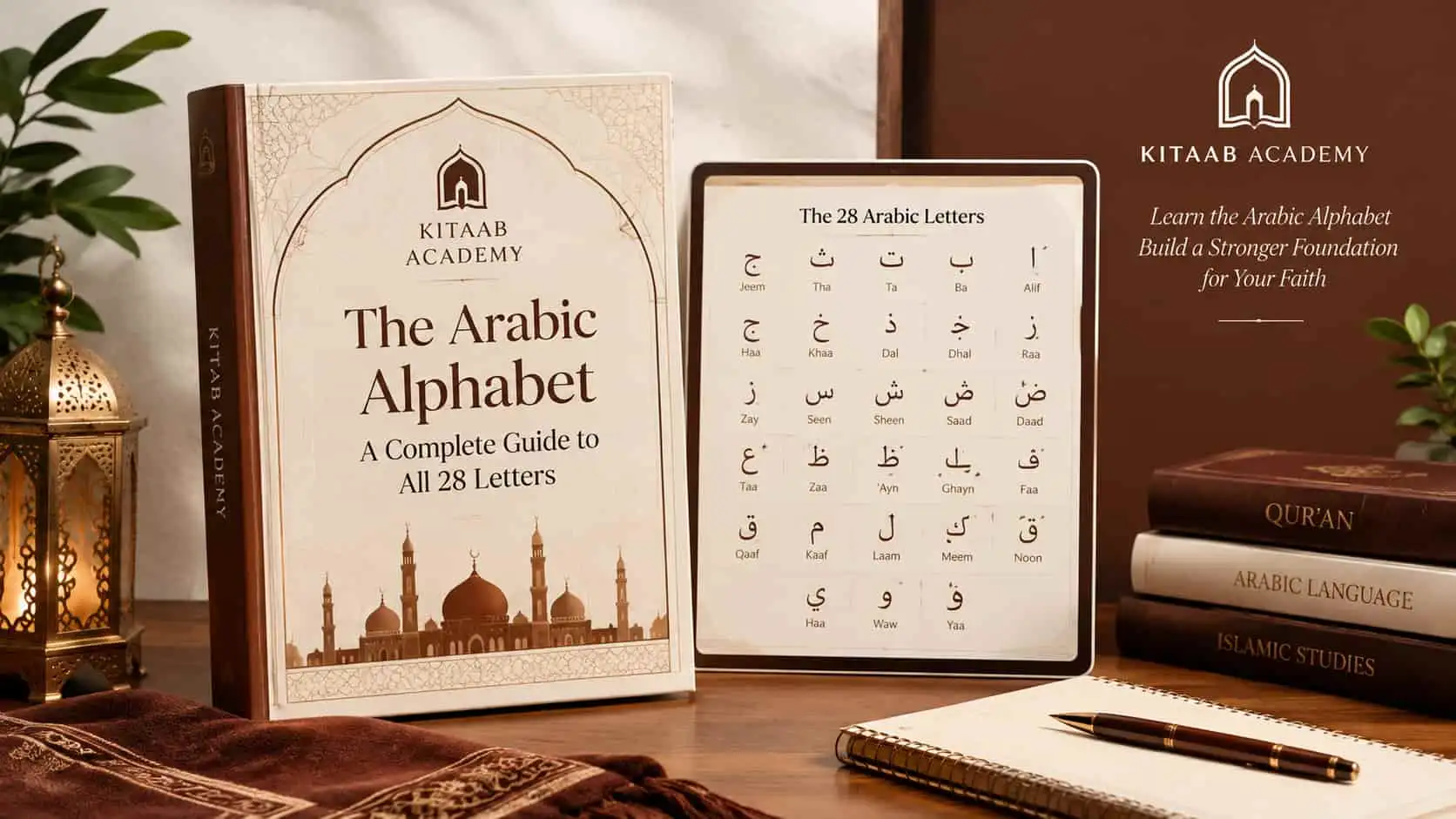
The Arabic Alphabet: A Complete Guide to All 28 Letters
The Arabic alphabet (الأبجدية العربية, al-abjadiyyah al-ʿarabiyyah) contains 28 letters, all representing consonants. It is written from right to left in a fully cursive style and ranks as the second most widely used writing system in the world after Latin, serving over 420 million native speakers across 22 countries and adapted by more than 30 additional languages worldwide, from Persian and Urdu to Pashto and Malay.
Whether you are an adult professional beginning your journey toward understanding the Qur’an or a parent seeking a structured Arabic foundation for your child, this guide covers everything you need, from letter shapes and sounds to the historical origins stretching back over 3,000 years.
Quick Facts: 28 consonant letters. Only ~18 base shapes (many differ only by dots). Each letter takes up to 4 positional forms. 6 letters are non-connectors. Short vowels are shown as diacritical marks, always included in the Qur’an, often omitted in everyday text. Most learners recognize all 28 letters within 7–14 days of focused practice.
What Is the Arabic Alphabet — and How Does It Work?
The Arabic alphabet is formally called al-abjadiyyah al-ʿarabiyyah, a name derived from the first four letters of the ancient Semitic order — Alif, Ba, Jim, Dal (أ ب ج د) — just as “alphabet” comes from Greek alpha-beta. In everyday Arabic, people simply call the letters al-huruf (الحروف).
Technically, Arabic is an abjad, not a true alphabet. The difference: alphabets like Latin write both consonants and vowels as full letters, while abjads primarily write consonants, with short vowels indicated optionally through small diacritical marks above or below the letters. This is why Arabic text can appear “vowel-less” to English speakers, the vowels exist, they are simply left unwritten for fluent readers who infer them from context.
Unlike Latin, Arabic has no uppercase or lowercase. Instead, each letter changes shape depending on its position in a word, isolated, initial, medial, or final. Six specific letters (ا د ذ ر ز و) are “non-connectors” that link only to the preceding letter, creating natural visual breaks within words that actually aid reading once you recognize them.
All 28 Arabic Letters: Chart with Pronunciation
Below is a complete reference of all 28 letters in their traditional hijā’ī order. Letters marked with * have no direct English equivalent.
# | Arabic | Name | English Sound | Example |
|---|---|---|---|---|
1 | ا | Alif | A (as in “father”) | أَسَد (asad) — lion |
2 | ب | Ba | B (as in “bat”) | بَيْت (bayt) — house |
3 | ت | Ta | T (as in “top”) | تُفَّاح (tuffah) — apple |
4 | ث | Tha | TH (as in “think”) | ثَلْج (thalj) — snow |
5 | ج | Jim | J (as in “jump”) | جَمَل (jamal) — camel |
6 | ح | Haa* | Breathy H* | حَلِيب (halib) — milk |
7 | خ | Kha | KH (Scottish “loch”) | خُبْز (khubz) — bread |
8 | د | Dal | D (as in “door”) | دَرْس (dars) — lesson |
9 | ذ | Dhal | TH (as in “this”) | ذَهَب (dhahab) — gold |
10 | ر | Ra | R (rolled) | رَجُل (rajul) — man |
11 | ز | Zay | Z (as in “zoo”) | زَهْرَة (zahra) — flower |
12 | س | Sin | S (as in “sun”) | سَمَاء (sama’) — sky |
13 | ش | Shin | SH (as in “ship”) | شَمْس (shams) — sun |
14 | ص | Sad* | Emphatic S* | صَبَاح (sabah) — morning |
15 | ض | Dad* | Emphatic D* | ضَوْء (daw’) — light |
16 | ط | Tta* | Emphatic T* | طِفْل (tifl) — child |
17 | ظ | Dtha* | Emphatic TH* | ظُهْر (dhuhr) — noon |
18 | ع | Ayn* | Voiced throat constriction* | عَيْن (ayn) — eye |
19 | غ | Ghayn | GH (French R sound) | غُرْفَة (ghurfa) — room |
20 | ف | Fa | F (as in “fan”) | فِيل (fil) — elephant |
21 | ق | Qaf* | Deep throat K* | قَمَر (qamar) — moon |
22 | ك | Kaf | K (as in “kite”) | كِتَاب (kitab) — book |
23 | ل | Lam | L (as in “lamp”) | لَيْل (layl) — night |
24 | م | Mim | M (as in “moon”) | مَاء (ma’) — water |
25 | ن | Nun | N (as in “name”) | نَجْم (najm) — star |
26 | ه | Ha | H (as in “hat”) | هِلَال (hilal) — crescent |
27 | و | Waw | W / long OO | وَرْد (ward) — roses |
28 | ي | Ya | Y / long EE | يَد (yad) — hand |
Arabic has seven sounds with no English equivalent, the emphatic consonants (ص ض ط ظ), the pharyngeal sounds (ح ع), and the uvular stop (ق). These require practice with native audio to master. The Kitaab Library offers recorded lessons where you can hear each letter pronounced by certified teachers and practice at your own pace.
Tips for Memorizing the Arabic Alphabet
1. Learn in shape groups, not alphabetical order.
Arabic has only ~18 base shapes, letters like ب ت ث are identical except for dots. Grouping by visual similarity reduces memorization time by up to 40% compared to learning sequentially.
2. Practice all four positional forms from day one.
Each letter changes shape at the start, middle, and end of a word. Write every new letter in all four forms immediately, isolated practice alone will not prepare you for real text.
3. Write by hand daily.
Research from Indiana University shows handwriting activates brain regions for language and memory far more than typing. Just 10–15 minutes a day builds the muscle memory that makes letter recognition automatic.
4. Listen to native pronunciation early.
Arabic has seven sounds with no English equivalent, including ض (Dad), so unique that Arabic is nicknamed “the language of Dhad” (لغة الضاد). You cannot learn these from text alone. The Kitaab Library includes native instructor audio for every letter.
5. Use spaced repetition flashcards.
Create cards with the letter on one side and its name, sound, and four forms on the other. Spaced repetition tools like Anki surface difficult cards more often and space out mastered ones, maximizing retention with minimal daily effort.
6. Read real words as soon as you know 5–6 letters.
Do not wait for all 28. Sound out simple words like بَاب (bāb — door) and بَيْت (bayt — house) immediately. This bridges the gap between abstract recognition and actual reading far faster than drilling isolated shapes.
7. Connect your learning to the Qur'an early.
Just 125 of the most frequent Qur’anic words cover roughly 50% of the entire text. Start identifying words like اللّه (Allah) and كِتَاب (Kitāb — Book) as soon as you can read basic letters, it transforms practice into purpose.
Learn Faster: Group Letters by Shape
Rather than memorizing 28 letters in alphabetical order, grouping by visual similarity reduces memorization time by approximately 40 percent. Arabic breaks down into 8 shape families, letters within each family share the same base shape and differ only by dots:
- Boat shape: ب ت ث — Ba (1 dot below), Ta (2 dots above), Tha (3 dots above)
- Hook shape: ج ح خ — Jim (1 dot below), Haa (no dots), Kha (1 dot above)
- Back-slant: د ذ — Dal (no dot), Dhal (1 dot above)
- Descending tail: ر ز — Ra (no dot), Zay (1 dot above)
- Three teeth: س ش — Sin (no dots), Shin (3 dots above)
- Looped: ص ض — Sad (no dot), Dad (1 dot above)
- Vertical loop: ط ظ — Tta (no dot), Dtha (1 dot above)
- Knot: ع غ — Ayn (no dot), Ghayn (1 dot above)
By learning 8 shape families instead of 28 individual characters, you reduce cognitive load by roughly 60 percent. At Kitaab Academy, our curriculum introduces letters in shape-based groups from day one, which is why our students typically recognize all 28 letters within the first two weeks.
Short Vowels, Hamza, and Special Marks
Arabic uses diacritical marks called tashkeel (تشكيل) to indicate short vowels:
- Fathah (َ) — short “a,” written above the letter
- Dammah (ُ) — short “u,” written above the letter
- Kasrah (ِ) — short “i,” written below the letter
Long vowels are formed by pairing these with Alif (ā), Waw (ū), or Ya (ī). Additional marks include Sukun (no vowel follows), Shaddah (consonant is doubled), and Tanween (final -n sound for grammatical case).
Why tashkeel matters: the same consonants can form entirely different words depending on vowels. The root letters ك ت ب produce كَتَبَ (kataba — “he wrote”), كُتُبٌ (kutubun — “books”), and كَاتِب (kātib — “writer”). Without vowel marks, beginners cannot distinguish between them.
Hamza (ء) represents the glottal stop, the sound in “uh-oh.” It can appear alone or carried by Alif (أ/إ), Waw (ؤ), or Ya (ئ), depending on surrounding vowels. Two other special forms are Taa Marbuta (ة), a feminine marker appearing only at word endings, and Alif Maqsura (ى), a spelling convention for words ending in a long ā sound.
When Lam (ل) meets Alif (ا), they merge into the mandatory ligature Lam-Alif (لا), the only required ligature in Arabic. You will see it constantly because “lā” means “no” and the definite article “al-” frequently precedes alif-initial words.
Sun Letters and Moon Letters — How "Al-" Works
The definite article “al-” (ال) is always written the same way, but pronounced differently depending on the first letter of the word it attaches to. Arabic divides its 28 letters into two groups:
Moon Letters (14):
ا ب ج ح خ ع غ ف ق ك م ه و ي — the “al-” is pronounced normally. Example: القَمَر (al-qamar — “the moon”).
Sun Letters (14):
ت ث د ذ ر ز س ش ص ض ط ظ ل ن — the “l” assimilates into the following consonant and disappears. Example: الشَّمْس (ash-shams, not al-shams — “the sun”).
The mnemonic is built into the names: “qamar” (moon) starts with a moon letter, “shams” (sun) starts with a sun letter. Saying “al-shams” instead of “ash-shams” is one of the most recognizable beginner mistakes.
The Arabic Alphabet and the Qur'an
For millions of Arabic learners worldwide, the primary motivation to learn this alphabet is the Qur’an, the central text of Islam, preserved in its original Classical Arabic for over 1,400 years.
The Qur’an contains approximately 77,430 total words across 6,236 verses in 114 surahs. Of these, roughly 14,870 are unique word forms, reducing to about 1,700–2,000 distinct trilateral roots. The distribution follows a remarkable application of the Pareto Principle:
- The top 125 most frequent words cover ~50% of the text
- The top 250 words cover ~75%
- 300–500 root words cover ~80% of the entire Qur’an
The most common word is “Allah” (اللّه), appearing over 2,600 times. You do not need to memorize thousands of words before the Qur’an starts making sense, a focused vocabulary of a few hundred words unlocks the vast majority of the text.
Yet over 80 percent of the world’s nearly 2 billion Muslims cannot understand the Arabic they recite in daily prayer. Learning the Arabic alphabet is the first step toward changing that. Kitaab Academy’s 7-level curriculum takes you from recognizing your first letter to reading the Qur’an with genuine comprehension. For younger learners, our children’s program builds this foundation early through personalized Tajweed and Qur’an instruction.
Why Do Arabs Write Numbers Like 7 and 3 in Text Messages?
If you have ever seen an Arabic speaker type “7abibi” or “mar7aba” in a chat, those numbers are not typos, they are letters. When Arabic speakers began chatting online using English keyboards in the early 2000s, certain Arabic sounds had no Latin letter equivalent. The solution was substituting numbers whose shapes visually resemble the missing Arabic letters. This informal system became known as Franco Arabic (also called Arabizi or Arabic chat alphabet).
Common Franco Arabic substitutions:
Number | Represents | Why It Looks Similar |
2 | ء (Hamza — glottal stop) | The 2 mirrors the shape of ء |
3 | ع (Ayn — throat sound) | The 3 resembles a reversed ع |
5 | خ (Kha) | The 5 loosely resembles خ |
6 | ط (Tta — emphatic T) | The 6 mirrors the curve of ط |
7 | ح (Haa — breathy H) | The 7 closely matches the shape of ح |
9 | ق (Qaf — deep throat K) | The 9 resembles the curve of ق |
So “7abibi” is حبيبي (habībi — my love), “3arab” is عرب (Arab), and “mar7aba” is مرحبا (marhaba — hello).
Franco Arabic was never standardized or recognized by any official language authority. The symbols vary from country to country, Egyptian Franco Arabic conventions differ slightly from Lebanese or Gulf ones. It was used almost exclusively for colloquial dialect, never for formal Modern Standard Arabic or religious texts. With the widespread availability of Arabic keyboards on smartphones today, Franco Arabic usage has declined significantly, though it still appears casually in social media and messaging across the Arab world.
A 3,000-Year History in Brief
The Arabic alphabet belongs to one of the oldest documented writing lineages on earth: Egyptian Hieroglyphs → Proto-Sinaitic (~1800 BCE) → Phoenician (~1050 BCE) → Aramaic (~800 BCE) → Nabataean (~150 BCE) → Arabic (~4th century CE).
The Nabataeans of Petra (modern Jordan) adapted Aramaic script with loops and ligatures for faster cursive writing. When Arabic needed 28 consonant sounds instead of Aramaic’s 22, the solution was adding dots to existing shapes, the same system still used today. The earliest Arabic inscription dates to the late 4th century CE from Jabal Ram, Jordan. Distinguishing dots first appear in the PERF 558 papyrus of 643 CE, and the modern diacritical system was finalized around 786 CE by the scholar al-Khalil ibn Ahmad al-Farahidi.
Arabic calligraphy, inscribed on UNESCO’s Intangible Cultural Heritage list in 202, developed six major styles: Kufic (angular, geometric, used in early Qur’anic manuscripts), Naskh (clear, rounded, used in ~95% of all printed Arabic today, including the Qur’an), Thuluth (ornamental, mosque inscriptions and decorative art), Diwani (flowing Ottoman court script), Ruq’ah (practical everyday handwriting taught in Arab schools), and Nastaliq (the lyrical script of Persian and Urdu literature). At Kitaab Academy, students learn in Naskh the same style used in every printed Qur’an and virtually all modern Arabic publications.
Why Do Arabs Write Numbers Like 7 and 3 in Text Messages?
If you have ever seen an Arabic speaker type “7abibi” or “mar7aba” in a chat, those numbers are not typos, they are letters. When Arabic speakers began chatting online using English keyboards in the early 2000s, certain Arabic sounds had no Latin letter equivalent. The solution was substituting numbers whose shapes visually resemble the missing Arabic letters. This informal system became known as Franco Arabic (also called Arabizi or Arabic chat alphabet).
Common Franco Arabic substitutions:
Number | Represents | Why It Looks Similar |
2 | ء (Hamza — glottal stop) | The 2 mirrors the shape of ء |
3 | ع (Ayn — throat sound) | The 3 resembles a reversed ع |
5 | خ (Kha) | The 5 loosely resembles خ |
6 | ط (Tta — emphatic T) | The 6 mirrors the curve of ط |
7 | ح (Haa — breathy H) | The 7 closely matches the shape of ح |
9 | ق (Qaf — deep throat K) | The 9 resembles the curve of ق |
So “7abibi” is حبيبي (habībi — my love), “3arab” is عرب (Arab), and “mar7aba” is مرحبا (marhaba — hello).
Franco Arabic was never standardized or recognized by any official language authority. The symbols vary from country to country, Egyptian Franco Arabic conventions differ slightly from Lebanese or Gulf ones. It was used almost exclusively for colloquial dialect, never for formal Modern Standard Arabic or religious texts. With the widespread availability of Arabic keyboards on smartphones today, Franco Arabic usage has declined significantly, though it still appears casually in social media and messaging across the Arab world.
FAQs
How many letters are in the Arabic alphabet?
28 consonant letters, with only ~18 base shapes. Many letters differ solely by dots.
Is the Arabic alphabet hard to learn?
Most learners recognize all 28 letters within 7–14 days at 20 minutes per day. Grouping by shape cuts memorization time by ~40%.
Is Arabic right to left?
Yes. The script is fully cursive and reads right to left. However, Arabic numerals are written left to right within the text.
How is Arabic connected to the Qur'an?
The Qur’an contains ~77,430 words, but only 300–500 root words make up about 80% of the text. Learning the alphabet is the essential first step to reading it directly.
How many languages use the Arabic script?
Over 30 languages, including Persian, Urdu, Pashto, Kurdish, Sindhi, and Uyghur, with over 2 billion potential users worldwide.
How long does it take to read the Qur'an in Arabic?
Letter recognition takes 1–2 weeks. Reading vowelized Qur’anic text with comprehension typically takes 6–12 months of structured study combining script, grammar, and vocabulary.