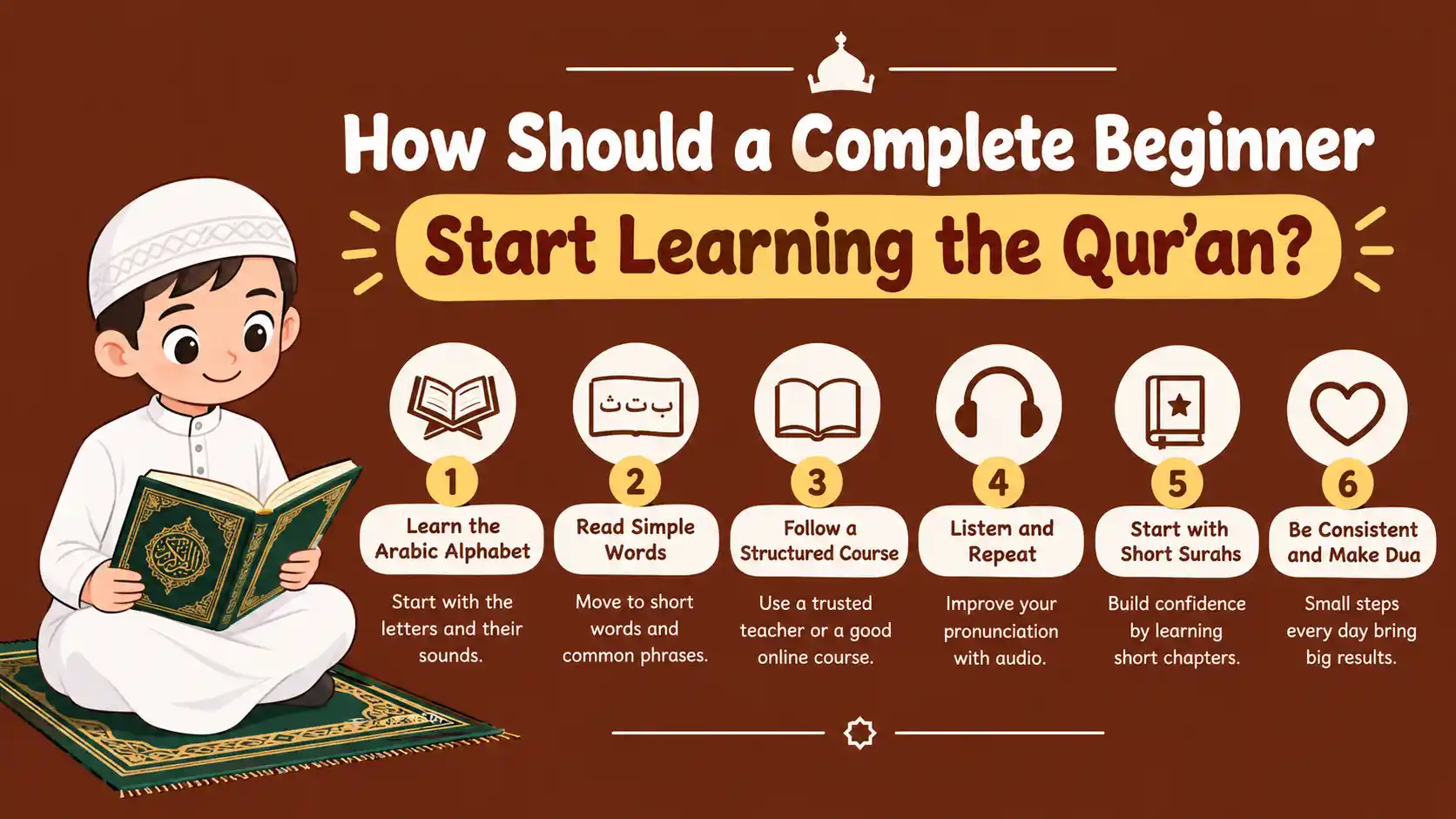
How Should a Complete Beginner Start Learning the Qur’an?
The desire to learn the Qur’an is one of the most common goals among Muslims worldwide, yet the path from complete beginner to confident reciter remains unclear for millions. A widely cited report from Indonesia’s MPR (People’s Consultative Assembly) found that roughly 72% of Indonesian Muslims could not read the Qur’an properly, despite Islam being central to daily life in the world’s largest Muslim-majority country. While that figure reflects one nation, it points to a universal challenge: most Muslims want to learn the Qur’an but lack a clear, structured method to get there.
The problem is not motivation. It is the absence of a realistic roadmap that accounts for how adults and children actually learn, how memory works, and what “learning the Qur’an” genuinely requires beyond basic letter recognition. This guide covers the stages every beginner moves through, the timelines you should expect, and what to look for in a program that produces real results.
What "Learning the Qur'an" Actually Means
Before starting, it helps to understand that learning the Qur’an is not a single skill. It is a set of layered abilities that build on each other:
Level 1: Reading the Arabic script.
Recognizing the 28 letters in all their connected forms, plus the vowel marks (harakat) that determine pronunciation.
Level 2: Applying Tajweed rules.
The pronunciation rules governing Qur’anic recitation. There are approximately 70 distinct rules, but beginners need roughly 15 to 20 core rules that cover the vast majority of scenarios.
Level 3: Fluent recitation.
Reading any page of the Qur’an at a natural pace with correct Tajweed, without frequent stopping or correction.
Level 4: Comprehension.
Understanding the meaning of what you are reciting. This is where most programs stop short, and where the biggest long-term gains are found.
Each level requires the one before it. Skipping ahead, which many eager beginners try, creates gaps that become harder to fix over time. A student who memorizes surahs without proper Tajweed will eventually need to unlearn incorrect pronunciations, a process that takes significantly more effort than learning them correctly the first time.
Stage 1: Learn the Arabic Alphabet (Weeks 1 to 6)
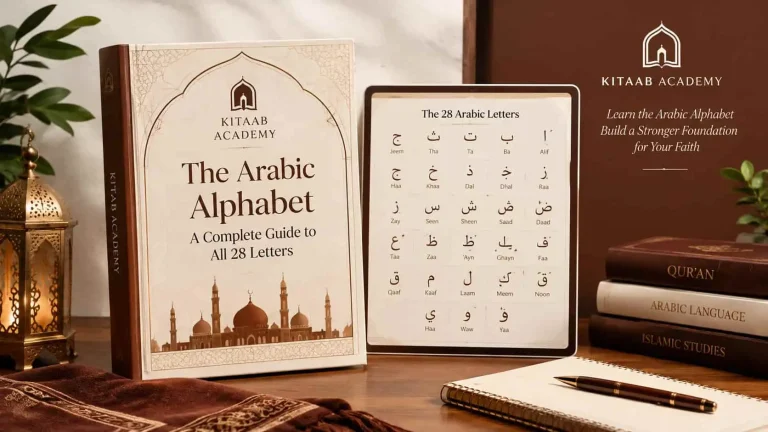
The Arabic alphabet has 28 letters, which is comparable to English’s 26. Most beginners can recognize all 28 letters within 7 to 14 days with daily practice of 20 to 30 minutes. The additional challenge is that Arabic letters change shape depending on their position in a word, giving each letter up to four forms.
The traditional tool for this stage is the Noorani Qaida, a primer that introduces letters, vowel marks, and basic combinations in a structured sequence. It has been the standard starting point for Qur’an education for generations, and for good reason: it builds skills in the correct order.
What to focus on during this stage:
Start by learning to identify each letter by its shape and the sound it produces. Pay particular attention to letters that have no English equivalent: ع (ayn), غ (ghayn), ح (ha), خ (kha), ص (sad), ض (dhad), ط (ta), and ظ (dha). These eight sounds are where most non-Arabic speakers struggle, and getting them right from the beginning prevents months of correction later.
Practice connecting letters into simple two and three-letter words. Arabic is written from right to left, and letters connect to each other in most cases. This connecting behavior is what makes Arabic script look intimidating at first glance, but the patterns become predictable within a few weeks of practice.
A qualified instructor is particularly important at this stage because pronunciation errors established early become deeply embedded. The difference between ح (a deep, breathy “h” from the throat) and ه (a regular “h”) changes the meaning of words entirely. An instructor who hears your pronunciation in real time catches these distinctions before they become habits.
Stage 2: Basic Tajweed and Short Surahs (Months 2 to 4)
Once you can read Arabic script at a basic level, the next stage introduces the core Tajweed rules alongside actual Qur’anic text. Starting with short surahs from Juz Amma (the 30th and final section of the Qur’an) gives you immediate, practical material to work with.
Begin with Surah Al-Fatiha, which every Muslim recites in every unit of prayer. Then move through the short surahs at the end of the Qur’an: Al-Ikhlas (4 verses), Al-Falaq (5 verses), An-Nas (6 verses), and Al-Kawthar (3 verses). These surahs are short enough to memorize naturally through repetition, giving you early confidence and immediate use in salah.
The Tajweed rules to learn first:
Do not try to learn all 70 Tajweed rules at once. Focus on the five rule categories that cover approximately 80% of recitation scenarios:
- Noon Sakinah and Tanween: Four sub-rules (Izhar, Idgham, Iqlab, Ikhfa) that govern how the letter Noon behaves when it carries a sukoon or a tanween. These rules appear on nearly every line of the Qur’an.
- Meem Sakinah: Three sub-rules governing the letter Meem with a sukoon. Less complex than Noon Sakinah but equally frequent.
- Madd (elongation): Several types of elongation that determine how long to hold a vowel sound. The most common are Madd Tabee’i (natural, 2 counts) and Madd Muttasil/Munfasil (4 to 5 counts).
- Qalqalah: A slight bouncing sound on five specific letters (ق ط ب ج د) when they carry a sukoon. This rule is straightforward but often overlooked by self-taught learners.
- Heavy and light letters: Arabic letters are classified as either heavy (tafkheem) or light (tarqeeq), which affects how the tongue is positioned. Confusing them changes the sound of recitation noticeably.
Why a teacher matters here:
Tajweed is fundamentally an oral tradition. It was transmitted person to person for fourteen centuries before any of it was written down. Reading about Tajweed rules is useful for understanding the theory, but applying them correctly requires a qualified listener who can identify errors in real time and demonstrate the correct articulation. Self-study apps and YouTube videos can supplement instruction, but they cannot replace the feedback loop of a live teacher.
Stage 3: Building Fluency (Months 4 to 12)
Fluency means reading unfamiliar Qur’anic text at a natural pace with correct Tajweed, without needing to stop and decode each word. This stage is where consistent daily practice matters most.
The 20-minute daily minimum.
Research on skill acquisition consistently shows that daily short sessions outperform weekly long sessions for building fluency. Twenty minutes of focused recitation every day is more effective than two hours on the weekend. The key is consistency: the neural pathways that support fluent reading strengthen through regular use and weaken through disuse.
How to practice effectively:
Read one quarter-page (rub’) of the Qur’an daily. Start slowly, prioritizing accuracy over speed. Read the same quarter-page for three consecutive days before moving to the next. This builds the repetition needed for Tajweed rules to become automatic rather than conscious.
Listen to a single reciter and follow along in the Mushaf. Slower reciters like Sheikh Al-Husary or Sheikh Al-Minshawi are ideal for learners because their deliberate pacing allows the brain to process each Tajweed application. Listening while reading engages both auditory and visual memory channels simultaneously, producing stronger retention than either alone.
Record yourself reciting and compare with the professional recitation. This catches errors that feel correct from inside your own mouth but sound different from outside.
Realistic timeline:
Most adult beginners who practice 20 to 30 minutes daily reach basic Tajweed fluency within 8 to 12 months. Children ages 7 to 12 often progress faster, typically reaching the same level in 6 to 9 months with consistent instruction.
Stage 4: Understanding What You Recite
This is the stage that most beginner programs skip entirely, and it is the single most impactful upgrade to your Qur’anic experience.
The Qur’an contains approximately 77,430 total words, but its vocabulary is remarkably concentrated. The 125 most frequently occurring words make up roughly 50% of the entire text, and just 300 root words cover approximately 80%. This concentration means a focused learner can begin understanding real verses within weeks of starting vocabulary study.
Why comprehension transforms everything:
Research on depth of processing shows that meaningful material is retained 5 to 10 times longer than material perceived as meaningless. A student who understands that “الرَّحْمَنِ الرَّحِيمِ” means “the Most Gracious, the Most Merciful” encodes Al-Fatiha as a meaningful prayer. A student who recites the same sounds without understanding treats them as arbitrary phonemes, which the brain discards far more readily.
This retention advantage compounds over time. Every word you understand makes the next surah easier to learn, because Arabic’s root system connects words into families. The root ع-ل-م (ayn-lam-mim) generates عَلِمَ (he knew), عِلْم (knowledge), عَالِم (scholar), مُعَلِّم (teacher), and تَعْلِيم (education). Learn one root and you unlock an entire family of related words across the Qur’an.
Kitaab Academy’s 7-level Classical Arabic curriculum is designed specifically for this stage, building Arabic grammar and Qur’anic vocabulary from the ground up so that students do not just recite the Qur’an but understand it. Each level covers specific grammar milestones, vocabulary targets, and reading comprehension skills taught by certified instructors through live Zoom classes.
What a Good Beginner Program Includes (and What It Costs)
The difference between a program that produces results and one that stalls after a few months comes down to five factors:
Qualified, consistent instructors. Not rotating tutors from a pool, but a dedicated teacher with an ijazah (chain of transmission) and formal training in both Tajweed and Arabic grammar who tracks your progress across months.
A defined curriculum with measurable milestones. You should know what Level 1 covers, what Level 2 covers, and how long each typically takes. If a program says “we customize for each student” without any underlying structure, there is no curriculum.
Arabic comprehension alongside recitation. Programs that teach recitation without meaning produce students who can pronounce Arabic but cannot understand it. This disconnect is the single biggest regret among adult Muslims who learned Qur’an as children.
Recorded sessions and supplementary resources. Live instruction is essential, but the ability to review recorded classes between sessions extends learning time without additional cost.
What Kitaab Academy Charges
Kitaab Academy uses a semester-based model rather than the monthly subscription model most online academies use:
Group Classical Arabic classes: $600 per 15-week semester. This includes 2 hours of live Zoom instruction per week, recorded sessions for review, office hours with the instructor, course materials, and access to a class WhatsApp group. That works out to approximately $40 per week or $20 per hour of live instruction.
This pricing reflects a fundamentally different product from the $35 to $80 per month academies that offer individual 30-minute recitation sessions with rotating tutors. Kitaab Academy’s program is a structured academic course with a 7-level curriculum, similar to a university language course, where each semester builds on the last.
For children, one-on-one classes cover Tajweed, Qur’an recitation, and Islamic studies with a dedicated instructor matched to each child.
For self-paced learners, the Kitaab Library offers recorded Arabic vocabulary drills, Islamic studies lectures, and course reviews at $9.99 per month, providing an affordable entry point for students exploring their options.
No registration fees, no material fees, no hidden charges. Students who withdraw before the 4th class of a semester receive a full refund.
For comparison, the broader online Qur’an education market ranges from $34 to $175 per month depending on frequency and format. Budget academies at the lower end typically offer 30-minute sessions with non-certified tutors and no structured curriculum.
Common Mistakes That Slow Beginners Down
Skipping the alphabet stage.
Jumping straight to surahs without solid letter recognition creates a shaky foundation. Invest the first 2 to 4 weeks in mastering all 28 letters and their connected forms before moving to Tajweed or memorization.
Relying entirely on transliteration.
Reading Qur’anic text in Roman letters (transliteration) is a crutch that, if used beyond the first week or two, prevents the development of Arabic reading fluency. Learners who depend on transliteration beyond the first month develop significantly slower reading speeds long-term.
Trying to learn without a teacher
Self-study resources are valuable supplements, but they cannot replicate the real-time correction that Tajweed demands. A teacher who hears your recitation identifies patterns in your errors that you cannot catch yourself, no matter how carefully you listen to recordings.
Inconsistent practice
The forgetting curve is relentless: research by Ebbinghaus showed that people forget approximately 67% of newly learned material within 24 hours without review. Twenty minutes daily is dramatically more effective than two hours once a week.
Prioritizing memorization over understanding
Memorizing Qur’anic verses without understanding their meaning is possible but far slower and more fragile. Even basic Arabic vocabulary covering the Qur’an’s most frequent words improves memorization speed and retention measurably.
FAQs
What is the best way for a complete beginner to start learning the Qur'an?
Start with the Arabic alphabet using a structured primer like Noorani Qaida, spending 20 to 30 minutes daily for the first 2 to 4 weeks. Once you can recognize all 28 letters and their connected forms, move to short surahs from Juz Amma while learning core Tajweed rules with a qualified instructor.
How long does it take a beginner to read the Qur'an?
Most adult beginners who practice 20 to 30 minutes daily reach basic recitation fluency in 8 to 12 months. Children ages 7 to 12 typically progress faster, reaching the same level in 6 to 9 months. Understanding the meaning of what you recite requires additional Arabic vocabulary study.
Can I learn the Qur'an without knowing Arabic?
You can learn to recite the Qur’an phonetically without understanding Arabic, and millions of Muslims do. However, learning even basic Arabic vocabulary transforms the experience from pronouncing sounds to understanding meaning. The Qur’an’s 125 most common words cover 50% of the text, so a small vocabulary investment produces significant comprehension gains.
Is it better to learn Qur'an online or in person?
Both formats work when the instructor is qualified and the curriculum is structured. Online learning offers scheduling flexibility, recorded sessions for review, and access to instructors regardless of geographic location. The key factor is not the format but the quality of instruction and the consistency of practice.
How much do online Qur'an classes cost?
Online Qur’an classes typically range from $34 to $175 per month depending on session frequency and format. Kitaab Academy charges $600 per 15-week semester for group Classical Arabic classes, which includes live instruction, recorded sessions, and office hours. The Kitaab Library offers self-paced recorded courses at $9.99 per month for learners on a tighter budget.