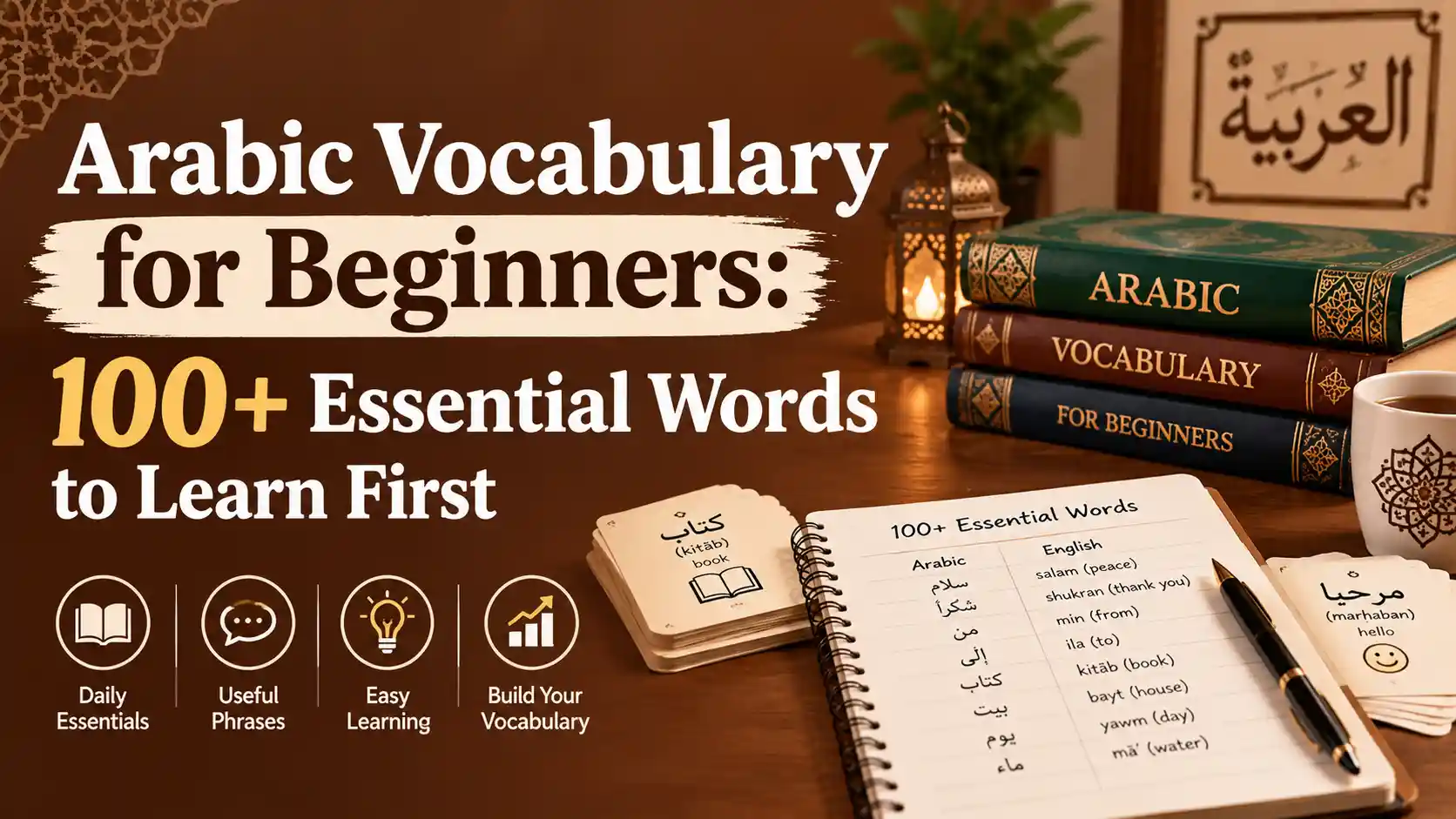
Arabic Vocabulary for Beginners: 100+ Essential Words to Learn First
Arabic is the fifth most spoken language in the world, with over 420 million native speakers across 22 countries. It is also the language of the Qur’an, a text that has been preserved in its original form for over 1,400 years. For beginners, the most effective strategy is not to memorize random word lists but to learn the highest-frequency words first, because a relatively small core vocabulary unlocks a disproportionately large share of both spoken and written Arabic.
Research consistently shows that learning the 100 most common words in any language covers roughly 50% of everyday speech, while 1,000 words covers approximately 85% of daily conversation. In Qur’anic Arabic specifically, just 125 of the most frequently occurring words make up about 50% of the entire text, and 300 root words cover approximately 80%. This means a focused beginner can start understanding real Arabic content far sooner than most people expect.
This guide organizes the essential vocabulary every beginner needs, grouped by category, with Arabic script, transliteration, and practical context for each word.
Why Vocabulary Order Matters
Not all words are equally useful. The Arabic word for “astronaut” (رائد فضاء) is a perfectly valid vocabulary item, but it appears in almost no daily conversation, prayer, or Qur’anic verse. Meanwhile, the word “الله” (Allah) appears over 2,600 times in the Qur’an alone, and basic function words like في (in), من (from), and على (on) appear thousands of times each.
The U.S. Foreign Service Institute classifies Arabic as a Category IV language, estimating 2,200 class hours for English speakers to reach professional proficiency. With that kind of time investment, starting with the wrong vocabulary wastes hundreds of hours. A frequency-first approach ensures every word you learn delivers maximum return immediately.
At Kitaab Academy, our 7-level curriculum is built on this principle: high-frequency vocabulary first, always taught within the context of real Qur’anic and conversational Arabic, never as isolated word lists.
Greetings and Common Expressions
These are the words you will use in every single Arabic interaction. Master them first.
English | Arabic | Transliteration |
|---|---|---|
Peace be upon you (formal greeting) | السلام عليكم | As-salamu alaykum |
And upon you peace (response) | وعليكم السلام | Wa alaykum as-salam |
Good morning | صباح الخير | Sabah al-khayr |
Good evening | مساء الخير | Masa’ al-khayr |
How are you? (m) | كيف حالك؟ | Kayfa haluk? |
How are you? (f) | كيف حالك؟ | Kayfa halik? |
Fine, praise be to God | بخير، الحمد لله | Bikhayr, alhamdulillah |
Please (m) | من فضلك | Min fadlak |
Please (f) | من فضلك | Min fadlik |
Thank you | شكراً | Shukran |
You’re welcome | عفواً | Afwan |
Yes | نعم | Na’am |
No | لا | La |
Goodbye | مع السلامة | Ma’a as-salamah |
God willing | إن شاء الله | In sha’ Allah |
What God has willed (admiration) | ما شاء الله | Ma sha’ Allah |
Note that Arabic distinguishes between masculine and feminine in the second person. “How are you?” and “please” change their final vowel depending on whether you are addressing a man or a woman. This gender distinction runs throughout the entire language, affecting verbs, adjectives, and pronouns.
Personal Pronouns
Arabic has 12 personal pronouns compared to English’s 7, because Arabic distinguishes gender in the second and third person and has a dual form for “you two” and “they two.”
English | Arabic | Transliteration |
|---|---|---|
I | أنا | Ana |
You (m. singular) | أنتَ | Anta |
You (f. singular) | أنتِ | Anti |
He | هو | Huwa |
She | هي | Hiya |
We | نحن | Nahnu |
You (m. plural) | أنتم | Antum |
You (f. plural) | أنتنّ | Antunna |
They (m.) | هم | Hum |
They (f.) | هنّ | Hunna |
You two (dual) | أنتما | Antuma |
They two (dual) | هما | Huma |
The dual form (for exactly two people) is unique to Arabic among major world languages. English has singular and plural; Arabic has singular, dual, and plural. This is one of the grammar features that makes Arabic structurally rich and why understanding it in its original form reveals precision that translations cannot capture.
Numbers (1-10)
Arabic uses two numeral systems: the Western Arabic numerals you already know (1, 2, 3) and Eastern Arabic-Indic numerals (١، ٢، ٣) used throughout the Middle East. Learn both.
Number | Arabic Word | Transliteration | Eastern Numeral |
|---|---|---|---|
1 | واحد | Wahid | ١ |
2 | اثنان | Ithnan | ٢ |
3 | ثلاثة | Thalatha | ٣ |
4 | أربعة | Arba’a | ٤ |
5 | خمسة | Khamsa | ٥ |
6 | ستة | Sitta | ٦ |
7 | سبعة | Sab’a | ٧ |
8 | ثمانية | Thamaniya | ٨ |
9 | تسعة | Tis’a | ٩ |
10 | عشرة | Ashara | ١٠ |
Arabic number grammar is famously complex. Numbers 3-10 take the opposite gender of the noun they modify (a rule that surprises every beginner), and numbers 11-99 follow yet another pattern. For beginners, simply memorizing 1-10 with correct pronunciation is the priority.
Essential Nouns: People, Places, and Things
Family and People
English | Arabic | Transliteration |
|---|---|---|
Man | رجل | Rajul |
Woman | امرأة | Imra’a |
Boy | ولد | Walad |
Girl | بنت | Bint |
Father | أب | Ab |
Mother | أم | Umm |
Brother | أخ | Akh |
Sister | أخت | Ukht |
Son | ابن | Ibn |
Daughter | بنت | Bint |
Friend (m) | صديق | Sadiq |
Friend (f) | صديقة | Sadiqa |
Teacher (m) | معلم | Mu’allim |
Teacher (f) | معلمة | Mu’allima |
Student (m) | طالب | Talib |
Student (f) | طالبة | Taliba |
Notice how many of these words form masculine-feminine pairs by adding a taa marbuta (ة) to the end: معلم becomes معلمة, طالب becomes طالبة. This pattern is one of Arabic’s most consistent grammar rules and applies to hundreds of nouns and adjectives.
Everyday Objects
English | Arabic | Transliteration |
|---|---|---|
Book | كتاب | Kitab |
Pen | قلم | Qalam |
House | بيت | Bayt |
Door | باب | Bab |
Water | ماء | Ma’ |
Food | طعام | Ta’am |
Bread | خبز | Khubz |
Car | سيارة | Sayyara |
Phone | هاتف | Hatif |
Table | طاولة | Tawila |
Chair | كرسي | Kursi |
Window | نافذة | Nafidha |
Time Words
English | Arabic | Transliteration |
|---|---|---|
Day | يوم | Yawm |
Night | ليل | Layl |
Morning | صباح | Sabah |
Evening | مساء | Masa’ |
Today | اليوم | Al-yawm |
Tomorrow | غداً | Ghadan |
Yesterday | أمس | Ams |
Week | أسبوع | Usbu’ |
Month | شهر | Shahr |
Year | سنة | Sana |
Hour | ساعة | Sa’a |
Now | الآن | Al-an |
Essential Verbs
Arabic verbs are built on a root system of three consonants (trilateral roots). The root ك-ت-ب (k-t-b), related to writing, generates كَتَبَ (he wrote), كِتَاب (book), كَاتِب (writer), مَكْتَب (office), and مَكْتَبَة (library). Learning one root unlocks 10-15 related words, making Arabic vocabulary acquisition exponentially faster once you understand the system.
English | Arabic | Transliteration | Root |
|---|---|---|---|
To write | كتب | Kataba | ك-ت-ب |
To read | قرأ | Qara’a | ق-ر-أ |
To go | ذهب | Dhahaba | ذ-ه-ب |
To come | جاء | Ja’a | ج-ي-أ |
To eat | أكل | Akala | أ-ك-ل |
To drink | شرب | Shariba | ش-ر-ب |
To sleep | نام | Nama | ن-و-م |
To speak | تكلم | Takallama | ك-ل-م |
To understand | فهم | Fahima | ف-ه-م |
To know | عرف | ‘Arafa | ع-ر-ف |
To want | أراد | Arada | ر-و-د |
To see | رأى | Ra’a | ر-أ-ي |
To hear | سمع | Sami’a | س-م-ع |
To sit | جلس | Jalasa | ج-ل-س |
To stand | وقف | Waqafa | و-ق-ف |
To open | فتح | Fataha | ف-ت-ح |
These verbs are shown in the past tense, third person masculine singular (he did), which is the base form used in Arabic dictionaries. Every Arabic verb you look up in a dictionary will appear in this form, so recognizing it is essential from day one.
Kitaab Academy’s curriculum teaches verb roots from the early levels, so learners begin thinking in root patterns rather than memorizing isolated words. This single strategy can reduce total vocabulary memorization time by 40-60%, because one root generates an entire word family.
Common Adjectives
English | Arabic | Transliteration |
|---|---|---|
Big | كبير | Kabir |
Small | صغير | Saghir |
New | جديد | Jadid |
Old | قديم | Qadim |
Good | جيد | Jayyid |
Bad | سيئ | Sayyi’ |
Beautiful | جميل | Jamil |
Hot | حار | Har |
Cold | بارد | Barid |
Fast | سريع | Sari’ |
Slow | بطيء | Bati’ |
Easy | سهل | Sahl |
Difficult | صعب | Sa’b |
Happy | سعيد | Sa’id |
Sad | حزين | Hazin |
In Arabic, adjectives follow the noun and must agree in gender, number, and definiteness. “A big house” is بيت كبير (bayt kabir), but “the big house” is البيت الكبير (al-bayt al-kabir), where both the noun and adjective take the definite article “al-.” This rule does not exist in English, and it is one of the patterns that becomes intuitive only through consistent practice.
Essential Prepositions and Question Words
Prepositions
These small words appear constantly in both spoken and Qur’anic Arabic. The preposition في (in) alone appears over 1,200 times in the Qur’an.
English | Arabic | Transliteration |
|---|---|---|
In | في | Fi |
On / Upon | على | Ala |
From | من | Min |
To / Toward | إلى | Ila |
With | مع | Ma’a |
Between | بين | Bayna |
Before | قبل | Qabla |
After | بعد | Ba’da |
Question Words
English | Arabic | Transliteration |
|---|---|---|
What? | ماذا؟ | Madha? |
Who? | من؟ | Man? |
Where? | أين؟ | Ayna? |
When? | متى؟ | Mata? |
How? | كيف؟ | Kayfa? |
Why? | لماذا؟ | Limadha? |
How many? | كم؟ | Kam? |
The Power of the Arabic Root System
This is the most important vocabulary strategy most beginners never learn. Arabic vocabulary is not a random collection of unrelated words. It is a system built on approximately 10,000 trilateral roots, where each root generates a family of related words through predictable patterns.
Consider the root ع-ل-م (‘a-l-m), related to knowledge:
Arabic | Transliteration | Meaning |
|---|---|---|
عَلِمَ | ‘Alima | He knew |
عِلْم | ‘Ilm | Knowledge/Science |
عَالِم | ‘Alim | Scholar/Knowledgeable |
مُعَلِّم | Mu’allim | Teacher |
تَعَلُّم | Ta’allum | Learning |
مَعْلُومَة | Ma’luma | Information |
One root, six words. The Qur’an’s entire vocabulary reduces to approximately 1,700-2,000 distinct roots, and mastering just 300-500 of them covers roughly 80% of the text. This is why Kitaab Academy integrates root-pattern awareness from the earliest levels rather than teaching words in isolation.
For children learning Arabic, this root system can be introduced through word family games where kids discover how كَتَبَ (he wrote), كِتَاب (book), and مَكْتَبَة (library) are all connected, making vocabulary feel like solving a puzzle rather than memorizing a list.
How to Practice Arabic Vocabulary Effectively
Research on the Ebbinghaus forgetting curve shows you lose approximately 70% of new vocabulary within 24 hours without review. Here are five evidence-based strategies:
Use spaced repetition. Review new words at increasing intervals (1 day, 3 days, 7 days, 14 days, 30 days). This combats the forgetting curve more effectively than any other technique. Apps like Anki are built on this principle.
Learn in context, not isolation. The word كِتَاب means “book,” but encountering it in الكِتَابُ الكَبِيرُ (the big book) or كُتُبٌ كَثِيرَة (many books) teaches you grammar simultaneously.
Write by hand. Studies in cognitive science show that handwriting activates motor memory pathways that typing does not. Write each new Arabic word by hand at least five times.
Connect to the Qur’an immediately. If your goal is Qur’anic comprehension, start identifying words you have learned in actual verses as soon as possible. Recognizing رَحْمَة (mercy) inside بِسْمِ اللَّهِ الرَّحْمَنِ الرَّحِيمِ transforms abstract vocabulary into living meaning.
Study 15-30 minutes daily. A meta-analysis in Language Learning found that distributed daily practice produces 20-30% better long-term retention than massed weekly sessions of equal total time. Consistency beats intensity every time.
The Kitaab Library offers recorded Arabic vocabulary lessons at $9.99/month that you can review at your own pace, applying spaced repetition to each lesson.
FAQs
How many Arabic words does a beginner need to know?
Research shows that 100 words covers roughly 50% of everyday speech in any language. For Qur’anic Arabic specifically, learning just 125 of the most common words covers about 50% of the entire text, and 300 root words cover approximately 80%. A focused beginner can start understanding real Arabic within weeks, not years.
Should I learn MSA or dialect vocabulary first?
Start with Modern Standard Arabic (MSA) vocabulary. MSA is understood across all 22 Arabic-speaking countries and shares 60-70% of its vocabulary with every major dialect. It is also the Arabic of the Qur’an, news, books, and formal communication. Once your MSA foundation is solid, picking up dialect-specific words becomes much easier.
What is the fastest way to build Arabic vocabulary?
Learn the root system. Arabic words are built on trilateral roots, where one three-letter root generates 10-15 related words. For example, the root ك-ت-ب (k-t-b) gives you “wrote,” “book,” “writer,” “office,” and “library.” This single strategy can reduce total memorization time by 40-60% compared to learning words individually.
Is Arabic vocabulary harder than other languages?
Arabic has a larger total vocabulary than most European languages, but its root system makes acquisition faster once you understand the patterns. The FSI classifies Arabic as Category IV (2,200 hours to proficiency), but focused vocabulary strategies like root-pattern learning and frequency-first approaches significantly shorten that timeline.
How long does it take to learn basic Arabic vocabulary?
With 15-30 minutes of daily practice, most learners can recognize all 28 Arabic letters within 2 weeks and build a functional vocabulary of 200-300 words within 2-3 months. Reaching 1,000 words, which covers approximately 85% of daily conversation, typically takes 4-6 months of consistent study.
Can I learn Arabic vocabulary without learning the script?
You can, but research shows it creates a hard ceiling. Learners who depend on transliteration beyond 8 weeks develop 40% slower reading skills. The Arabic alphabet has only 28 letters with approximately 18 base shapes, and most learners recognize them all within 7-14 days. Learn the script first, then build vocabulary on that foundation.