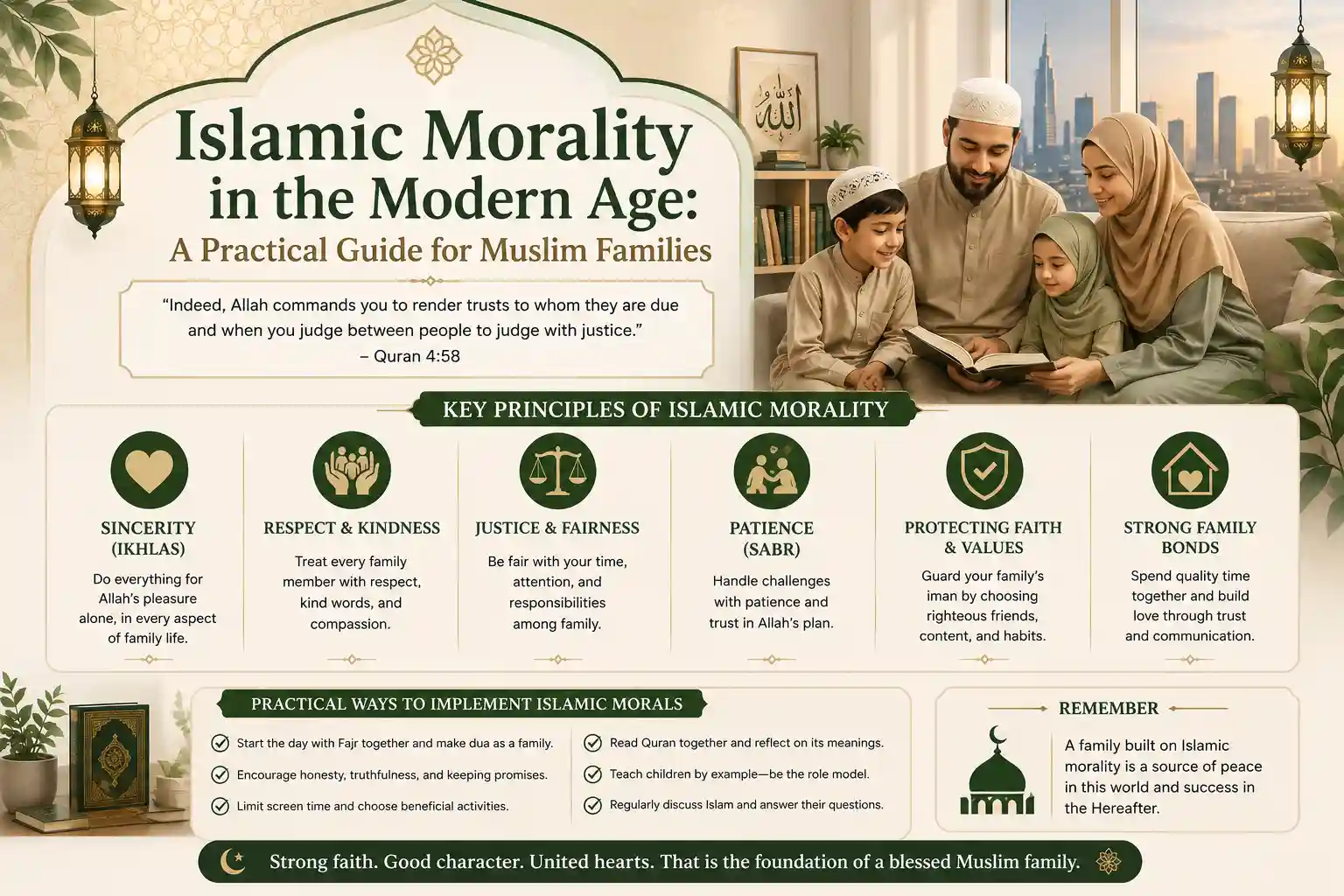
Islamic Morality in the Modern Age: A Practical Guide for Muslim Families
Islamic morality in the modern age means applying the Qur’an’s timeless principles to new situations. These principles include honesty, modesty, justice, and mercy. Today they guide choices about smartphones, social media, and secular schooling. The principles never change; only their application does. This simple idea answers a real question. Many Muslim parents and young adults ask it often. Can faith still guide a busy, noisy, modern life? It can, and this guide shows how.
This guide covers ten areas where Islamic morality meets modern life. These include the home, digital habits, and education. They also include moral vocabulary, community, and discipline. The guide then turns to work, the environment, health, and the future of the ummah.
What Islamic Morality Means Today
Islamic morality, or akhlaq, is the practice of good character. It is rooted in the Qur’an and the Sunnah of the Prophet ﷺ. Scholars across the major schools of thought, called madhabs, sometimes differ. They may disagree on how a principle applies to a new situation. They rarely disagree on the principle itself. Honesty, for example, is never disputed. Only its application to something new, like online advertising, gets debated.
Akhlaq draws on four sources:
- The Qur’an: The primary and final revelation.
- Authentic hadith: The recorded words and actions of the Prophet ﷺ.
- Ijma: Scholarly consensus on a ruling.
- Qiyas: Reasoned analogy applied to new situations the earlier sources did not name directly.
What separates Islamic morality from a personal code of ethics is accountability. A Muslim avoids dishonesty because Allah forbids it. It has nothing to do with what a survey says is popular this year. That standard does not shift when public opinion shifts. About 2 billion people around the world identify as Muslim today. This makes akhlaq one of the most widely practiced moral frameworks on earth. It is not a regional custom tied to one culture or one century.
Human nature has not changed since the Qur’an was revealed 14 centuries ago. People still want purpose, belonging, and justice. Screens replaced scrolls, and social feeds replaced marketplaces. But the deeper questions stayed the same.
Modern secular culture tends to treat personal feelings as the final authority on truth. Islam starts from a different idea. The self is a trust to be purified. It is not a judge whose feelings settle every question. The Qur’an puts it this way:
قَدْ أَفْلَحَ مَن زَكَّاهَا ﴿٩﴾ وَقَدْ خَابَ مَن دَسَّاهَا ﴿١٠﴾
“He has succeeded who purifies it, and he has failed who corrupts it.” (Surah Ash-Shams 91:9–10)
That verse reframes a modern debate. It is the debate between self-expression and self-discipline. In the Islamic view, freedom is not doing whatever one desires. It means mastering desire so it no longer controls the person. There is a real question buried here. How should a fixed moral standard adapt to new social conditions? Recent scholarship on Islam and moral objectivism studies this question closely. That research reaches a similar conclusion: the principles hold steady while their real-world application keeps moving.
Three modern problems this framework answers directly:
- Moral confusion: It anchors right and wrong to revelation, not to shifting opinion.
- Loneliness: It places each person inside family and community duties, instead of leaving them to cope alone.
- Compulsive habits: It trains self-mastery through prayer and fasting. It does not treat willpower as something a person has or lacks.
The Family: The First Classroom of Morality
Children absorb character before they can even define it. A child learns what mercy looks like by watching a father speak to a mother. A lecture about kindness rarely teaches the same lesson. The home runs a quiet curriculum all day long. This happens well before formal religious classes ever begin.
The Prophet ﷺ described this weight of responsibility directly. He said: “Every one of you is a shepherd, and every one of you will be asked about his flock.” (Sahih al-Bukhari 2554)
A few habits build a morally grounded household:
- Share meals: Even once a day, this creates the unplanned talks where values transfer.
- Recite a few verses of Qur’an aloud: This gives the house a rhythm children link with peace, not obligation.
- Repair conflict openly: Children who watch a parent apologize learn resolution faster. Children who only hear abstract rules about honesty learn it slower.
Working parents often outsource religious formation entirely to a weekend class. A more durable approach pairs structured instruction with the daily home habits above. This is the approach Kitaab Academy builds its programs around. For adults, that structure can look like Arabic for Busy Adults. For children, it can look like dedicated Qur’an and Islamic studies classes. Either way, classroom learning then reinforces what the household already models.
The smartphone is the defining moral test of this generation. It delivers knowledge and temptation through the very same small screen. It rewards whatever earns attention, not whatever actually builds character.
A concrete example helps more than a general warning. Suppose a parent notices a child spending three hours a night on short-form video. The conversation that works is rarely “put the phone down.” It works better to ask a specific question first. Try this: “What did you watch tonight that you’d be comfortable showing me?” That question does two things a blanket rule cannot do. It invites the child to self-audit, and it signals that the real concern is content and character, not the device itself.
Two habits protect a child’s moral footing online:
- Fixed screen-free windows, especially around Fajr and family time, keep devices from competing directly with prayer.
- Naming the pull of distraction for what Islamic tradition calls it, waswasa, gives a child language for an urge, instead of leaving it unexamined.
Parents cannot filter content forever, since a child eventually carries the internet in their own pocket, unsupervised. Internal conscience, not blocking software alone, is the filter that travels with them everywhere.
Islamic Education: Building Knowledge and Wisdom Together
Modern schooling often produces sharp minds without forming good hearts. Students learn to code and calculate long before anyone teaches them how to choose well under pressure. Islamic education exists to close that gap. It explains the reasoning behind a command, not only the command itself. This is the same territory covered in research on the foundation of morality in the Qur’an and hadith for building the Islamic generation. That research links character formation to how deeply a student understands scripture, not to how much they can recite from memory.
An Arabic-First Curriculum
An Arabic-First Curriculum
A frequency analysis of the Qur’an’s roughly 77,000 words shows something striking. Around 300 unique words make up close to 80% of the whole text. A learner who masters that core vocabulary moves from reciting sounds to understanding revelation directly. No translator has to stand between them and the text. The Kitaab Library applies this same approach to self-paced study. It works well for anyone who wants to build that vocabulary on their own schedule.
What Makes Islamic Education Effective
- A sequential curriculum instead of scattered lessons with no clear progression.
- A consistent instructor who tracks a student’s growth over months, not a rotating cast of tutors.
- Explanation before instruction, so the student understands why a rule exists before being asked to follow it.
One of the quieter losses in modern Muslim households is language itself. Words like haya (modesty), amanah (trust), and tazkiyah (purification) are slowly disappearing from daily speech. When a word fades from use, the concept behind it tends to fade too.
This loss is reversible in small, steady ways. A child who hears bismillah before meals absorbs something important. So does a child who hears astaghfirullah after a mistake, or jazakAllahu khayran in gratitude. Together these words build a moral vocabulary rooted in sincerity, not sarcasm. One practical exercise works well here. Pick a single virtue word each week. Then connect it at dinner to something that actually happened that week. Saying “that was sabr” carries more weight than a generic “good job.” It names the exact quality the child showed.
Community and Mosques: The Support System for Moral Life
No family preserves Islamic morality alone. Children need to see their values reflected outside the home too. They need peers, teachers, and mentors who share the same framework. A mosque that only functions as a prayer hall is doing just half its job.
Youth programs matter, especially ones that address real pressures like peer pressure or digital addiction through a faith lens rather than avoiding them. Mentors matter too, since those who build trust with a young person before correcting them tend to succeed where lectures alone fail. Relationship precedes influence. Interfaith and cross-community dialogue plays a role as well, clarifying misconceptions about Islam and giving young Muslims practice explaining their own values respectfully to people outside their community.
Faith that stays private and unshared tends to fade by the second generation, however sincere the first generation was. Faith practiced communally tends to hold much longer.
Islamic morality holds law and mercy in tension, on purpose. Too much leniency produces neglect, while too much harshness produces rebellion and secrecy. The Prophet ﷺ modeled the balance well. He corrected wrongdoing firmly, but he never humiliated anyone in front of others.
One hadith captures this method well. A young man once asked the Prophet ﷺ for permission to commit a major sin. The Prophet ﷺ did not scold him publicly. Instead, he drew the young man closer. He asked whether the man would accept that same act toward his own mother, sister, or daughter. The young man said no each time. He left the conversation changed, not shamed. Dialogue rooted in empathy tends to outperform fear-based correction. It appeals to conscience, not just punishment.
Fear restrains a person for a while. Love of Allah sustains a person for life. A heart that only fears punishment hides sin from view. A heart that loves Allah avoids sin even in private, where no one else is watching.
Akhlaq does not stop at the mosque door. It shapes how a Muslim negotiates a contract, treats a coworker, spends money, and interacts with the natural world.
At Work
Three habits matter most at work: honesty in every transaction, fairness in every negotiation, and reliability in every commitment. Together they build a professional reputation that grows over an entire career. That reputation ends up mattering far more than any single short-term gain.
In Society: Gender and Scholarship
Gender relations in Islam rest on shared spiritual worth, not on a competing hierarchy. The Qur’an teaches that men and women share one origin:
يَا أَيُّهَا النَّاسُ اتَّقُوا رَبَّكُمُ الَّذِي خَلَقَكُمْ مِنْ نَفْسٍ وَاحِدَةٍ وَخَلَقَ مِنْهَا زَوْجَهَا
“O mankind, fear your Lord, who created you from one soul and created from it its mate.” (Qur’an 4:1)
The Qur’an also teaches that men and women carry equal religious accountability:
فَاسْتَجَابَ لَهُمْ رَبُّهُمْ أَنِّي لَا أُضِيعُ عَمَلَ عَامِلٍ مِّنكُم مِّن ذَكَرٍ أَوْ أُنثَىٰ ۖ بَعْضُكُم مِّن بَعْضٍ
“So their Lord answered them: I will not allow the deed of any worker among you to be lost, whether male or female. You are from one another.” (Qur’an 3:195)
Islamic history offers many examples of this equal standing in practice. Women scholars across the centuries taught hadith, issued legal rulings, and trained generations of students. Islamic scholarship never truly excluded women from serious study.
With the Environment
The Qur’an assigns humanity the role of steward, not owner. The Prophet ﷺ discouraged waste even while performing ablution beside a flowing river. This teaches that abundance never excuses excess. A few habits put that stewardship into daily practice:
- Avoid waste in water and food.
- Favor businesses with ethical practices where a real choice exists.
- Resist the pressure to define self-worth through purchases.
Health and Well-Being Through an Islamic Lens
Islam treats health as spiritual and physical at once.
Health and Well-Being Through an Islamic Lens
The five daily prayers structure the day around fixed checkpoints for reflection. A purely secular schedule does not build this automatically. Fasting during Ramadan trains discipline over appetite. That discipline tends to carry over into other areas of self-control. Still, this pattern is worth discussing with a qualified counselor. It should not be treated as a guaranteed clinical outcome.
Mental health receives direct attention in Islamic tradition, not dismissal. Dhikr, community support, and structured prayer all function as recognized coping practices. They work alongside professional care, not instead of it, whenever professional care is genuinely needed. Consistency in worship, prayer after prayer, builds the same discipline that protects emotional stability across a demanding week.
Nutrition and Moderation
Nutrition follows the same logic of moderation over restriction. The Prophet ﷺ taught balance in eating and drinking. He treated the body as a trust that deserves neither neglect nor excess.
Muslims often discuss morality defensively, as though protecting a fragile custom under threat. That framing sells the message short. Islamic morality is really a vision of human flourishing. It predates most modern institutions entirely. Marriage as partnership, chastity as self-respect, and family as emotional safety all stand on their own terms. They are not just reactions to secular critique.
Globalization puts Muslims in daily contact with different cultures and technologies. It also brings shared global challenges, like poverty and climate change. Islamic morality does not require withdrawing from that connected world. It simply asks believers to engage it with justice and compassion. These are the same qualities behind historical Muslim contributions to medicine, astronomy, and governance.
Conclusion: Passing on Conviction, Not Just Rules
A child does not remember every rule a parent enforced. They remember whether faith looked joyful or exhausting in their own home. Building that impression takes daily, small choices. A shared meal, an honest apology, and one Arabic word explained at dinner matter more than any single grand gesture. What matters most is repeating them for years, not performing them once.
Kitaab Academy builds toward that same goal. Its live, structured classes move learners from reciting Arabic to truly understanding it. Book a free consultation to get matched with a certified instructor and start this week.
FAQs
Is Islamic morality the same as Islamic law (Shariah)?
No, Shariah covers formal legal rulings, while akhlaq covers character and conduct that often go beyond what law can enforce. Kindness to a stranger, for example, is a moral good with no legal requirement attached to it.
Do different Islamic schools of thought disagree on morality?
The major madhabs agree on core moral principles like honesty, justice, and modesty. Disagreement usually concerns how a principle applies to a specific modern situation. It rarely concerns whether the principle itself still holds.
Can Islamic morality really guide decisions about social media and technology?
Yes, through general principles rather than specific rulings on each app. Islam’s guidance on gossip, honesty, wasted time, and lowering the gaze applies directly to online behavior. This holds even though the Qur’an never mentions smartphones by name.
How do I start rebuilding these habits in a busy household?
Start with one habit, not five. Most families see more change from reciting a few verses together nightly for a month. A full moral overhaul attempted in a single week rarely sticks.