The Five Keys to Spiritual and Emotional Resilience
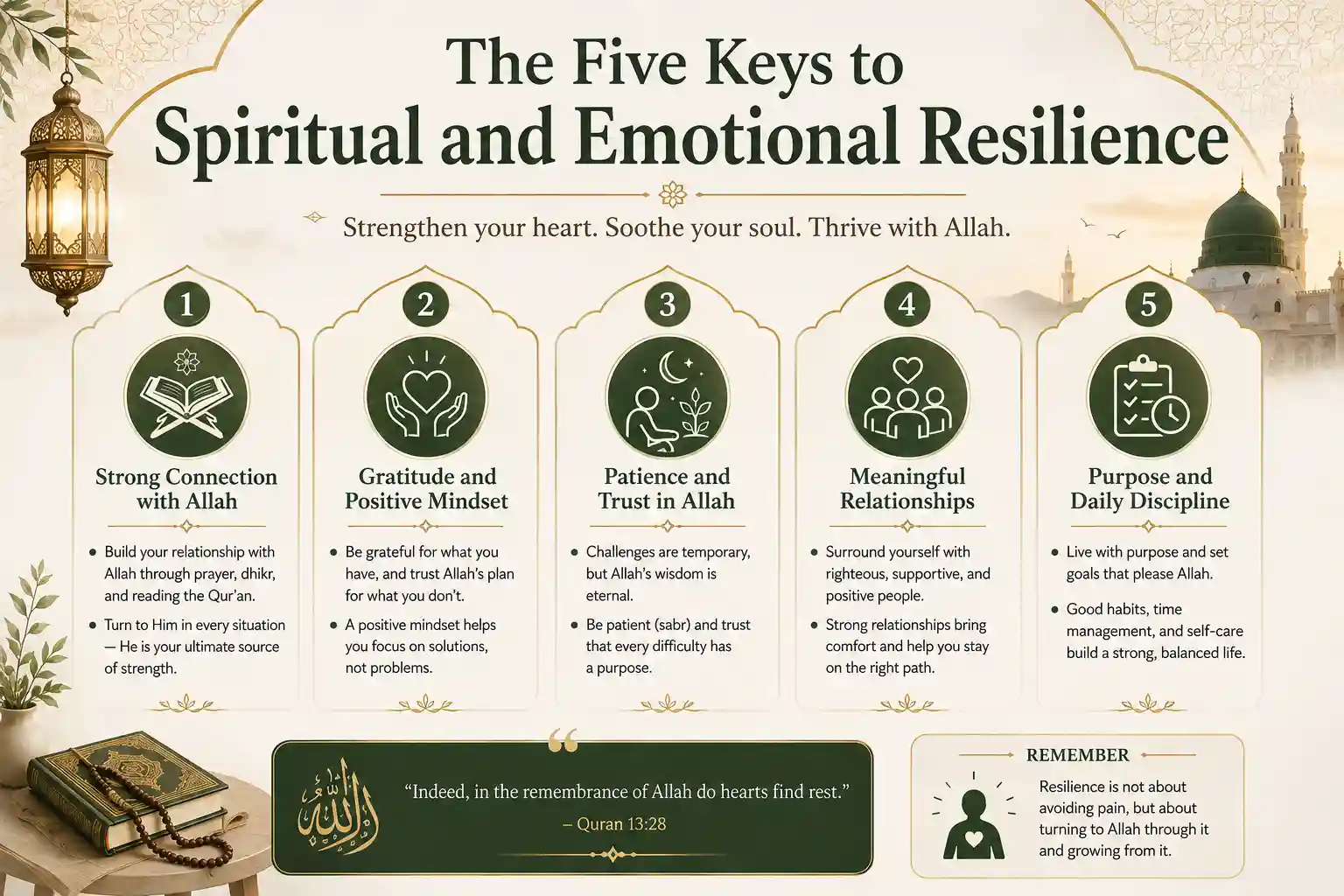
The 5 keys to spiritual and emotional resilience are accepting your humanness, channeling emotions toward worship, connecting with the Qur’an, practicing gratitude, and seeking help from others. These principles come directly from the Qur’an, the Prophetic tradition, and the lived example of the Companions.
A peer-reviewed study in the European Journal of Investigation in Health, Psychology and Education confirmed what Islamic scholarship has taught for centuries: spirituality directly strengthens resilience, which in turn raises overall well-being.
What Spiritual and Emotional Resilience Actually Looks Like
Resilience is not one thing. It is two processes running at the same time:
- Emotional regulation: How a person manages grief, anger, and anxiety in real time
- Spiritual steadiness: How stable a believer’s relationship with Allah remains when circumstances shift
The Arabic word that captures both is sabr. English translates it as “patience,” but sabr is broader, it includes restraint when something hurts, consistency when things are comfortable, and persistence in obedience regardless of how it feels. The Qur’an references sabr and its related forms over 90 times.
The Prophet Muhammad ﷺ summarized the concept in one hadith: the affair of the believer is entirely good, gratitude follows ease, patience follows hardship, and both are good for the one who holds them (Sahih Muslim 2999).
The Qur’an draws clear portraits of 3 different relationships with worship, and each one predicts how a person handles difficulty.
Worship Only During Hardship
هُوَ الَّذِي يُسَيِّرُكُمْ فِي الْبَرِّ وَالْبَحْرِ ۖ حَتَّىٰ إِذَا كُنتُمْ فِي الْفُلْكِ وَجَرَيْنَ بِهِم بِرِيحٍ طَيِّبَةٍ وَفَرِحُوا بِهَا جَاءَتْهَا رِيحٌ عَاصِفٌ وَجَاءَهُمُ الْمَوْجُ مِن كُلِّ مَكَانٍ وَظَنُّوا أَنَّهُمْ أُحِيطَ بِهِمْ دَعَوُا اللَّهَ مُخْلِصِينَ لَهُ الدِّينَ لَئِن أَنجَيْتَنَا مِنْ هَـٰذِهِ لَنَكُونَنَّ مِنَ الشَّاكِرِينَ ﴿٢٢﴾ فَلَمَّا أَنجَاهُمْ إِذَا هُمْ يَبْغُونَ فِي الْأَرْضِ بِغَيْرِ الْحَقِّ
“He is the One who lets you travel by land and sea, until — when you are in ships, sailing on with a favorable wind, rejoicing in it — a violent gale strikes and waves close in from every side, and the travelers are certain they are lost. Then they call out to Allah, sincere in faith to Him alone: ‘If You save us from this, we will surely be grateful.’ Yet the moment He saves them, they return to wrongdoing on the earth without right.” (Surah Yunus, 10:22–23)
The sincerity during the crisis is real. It just doesn’t survive the calm that follows.
Worship Only During Ease
وَمِنَ النَّاسِ مَن يَعْبُدُ اللَّهَ عَلَىٰ حَرْفٍ ۖ فَإِنْ أَصَابَهُ خَيْرٌ اطْمَأَنَّ بِهِ ۖ وَإِنْ أَصَابَتْهُ فِتْنَةٌ انقَلَبَ عَلَىٰ وَجْهِهِ خَسِرَ الدُّنْيَا وَالْآخِرَةَ
“And among the people is he who worships Allah on the edge — content if good comes his way, but he turns away completely the moment a trial touches him, losing both this world and the next.” (Surah Al-Hajj, 22:11)
The unspoken assumption behind this pattern: faith should guarantee comfort, and any disruption of comfort means something has gone wrong.
Worship Through Both
الَّذِينَ إِذَا أَصَابَتْهُم مُّصِيبَةٌ قَالُوا إِنَّا لِلَّهِ وَإِنَّا إِلَيْهِ رَاجِعُونَ
“Those who, when a calamity strikes them, say: ‘Indeed we belong to Allah, and indeed to Him we will return.’” (Surah Al-Baqarah, 2:156)
No conditions. No bargaining. Just a settled return to the One who sent the trial and the relief alike. The 5 keys below are the tools for moving into this third pattern, and staying there.
The 5 Pillars of Spiritual and Emotional Strength
Key 1: Accept Your Humanness
One of the most damaging ideas in Muslim communities is the belief that strong faith eliminates emotional pain. The Qur’an itself disproves this through one of the most honored women in its pages.
فَأَجَاءَهَا الْمَخَاضُ إِلَىٰ جِذْعِ النَّخْلَةِ قَالَتْ يَا لَيْتَنِي مِتُّ قَبْلَ هَـٰذَا وَكُنتُ نَسْيًا مَّنسِيًّا
“And the pains of childbirth drove her to the trunk of a palm tree. She cried out: ‘I wish I had died before this, and been forgotten completely.’” (Surah Maryam, 19:23)
Maryam is not a woman of weak faith. She is arguably the most honored woman in the Qur’an, and even she reached a moment of unbearable pain. What happened next matters more than her cry:
فَنَادَاهَا مِن تَحْتِهَا أَلَّا تَحْزَنِي قَدْ جَعَلَ رَبُّكِ تَحْتَكِ سَرِيًّا
“So a voice called out to her from below: ‘Do not grieve. Your Lord has placed a stream beneath you.’” (Surah Maryam, 19:24)
Allah did not rebuke her. He responded with provision and reassurance, woven together. That same compassion showed up for the Companions when they came to the Prophet ﷺ troubled by intrusive thoughts so disturbing they were ashamed to describe them. He told them that their distress at having those thoughts was itself clear evidence of faith (Sahih Muslim 132). Grief, fear, anxiety, and anger are part of being human. They become destructive only when they go unnamed, unprocessed, and unredirected.
Key 2: Channel Your Emotions Toward Worship
Secular resilience says: manage your emotions. Islamic resilience says: use them. Every emotional state has a corresponding act of worship waiting for it, and the Qur’an models this through three very different men in three very different moments.
Prophet Ya’qub lost his son Yusuf for years. His grief turned his eyes white from weeping, yet his words stayed precise:
قَالَ إِنَّمَا أَشْكُو بَثِّي وَحُزْنِي إِلَى اللَّهِ وَأَعْلَمُ مِنَ اللَّهِ مَا لَا تَعْلَمُونَ
“He said: ‘I only complain of my anguish and my grief to Allah, and I know from Allah what you do not know.’” (Surah Yusuf, 12:86)
He didn’t suppress the grief. He poured every ounce of it into the one conversation that could actually hold it. That is not suppression. That is redirection. The Prophet ﷺ did something similar at the lowest point of his mission, chased out of Ta’if with stones, having just lost Khadijah and Abu Talib.
He turned to Allah and laid out his weakness, his lack of resources, and the humiliation he had faced, closing with the line that as long as Allah was not angry with him, nothing else mattered. That dua turned the worst day of his life into one of the most powerful acts of worship in the Seerah.
Ease requires the same redirection. Prophet Sulayman ruled humans, animals, and jinn, yet his response to that power was not entitlement:
فَتَبَسَّمَ ضَاحِكًا مِّن قَوْلِهَا وَقَالَ رَبِّ أَوْزِعْنِي أَنْ أَشْكُرَ نِعْمَتَكَ الَّتِي أَنْعَمْتَ عَلَيَّ وَعَلَىٰ وَالِدَيَّ
“He smiled, amused at her words, and said: ‘My Lord, enable me to be grateful for Your favor which You bestowed upon me and upon my parents.’” (Surah An-Naml, 27:19)
Ease tests a person as much as hardship does. Sulayman’s instinct was not to enjoy the power silently, it was to ask for the discipline to stay grateful for it.
Key 3: Connect With the Qur’an Daily
There is a difference between believing the Qur’an is a source of guidance and actually experiencing it as one. Most believers respect the Book and recite it occasionally, but do not carry it into the ordinary moments where resilience is built or broken.
الَّذِينَ آمَنُوا وَتَطْمَئِنُّ قُلُوبُهُم بِذِكْرِ اللَّهِ ۗ أَلَا بِذِكْرِ اللَّهِ تَطْمَئِنُّ الْقُلُوبُ
“Those who believe, and whose hearts find rest in the remembrance of Allah — truly, it is in the remembrance of Allah that hearts find rest.” (Surah Ar-Ra’d, 13:28)
يَا أَيُّهَا النَّاسُ قَدْ جَاءَتْكُم مَّوْعِظَةٌ مِّن رَّبِّكُمْ وَشِفَاءٌ لِّمَا فِي الصُّدُورِ وَهُدًى وَرَحْمَةٌ لِّلْمُؤْمِنِينَ
“O mankind, there has come to you an admonition from your Lord, a healing for what is in the hearts, and guidance and mercy for the believers.” (Surah Yunus, 10:57)
These are functional claims, not poetic ones, the Qur’an does something measurable to a heart that engages with it consistently. A cross-national study in Adversity and Resilience Science confirmed the clinical side: spiritual engagement, including recitation and contemplation, was significantly associated with higher resilience and greater life satisfaction.
Making the connection practical comes down to a few habits: reading with meaning rather than speed, since ten minutes with translation does more for the heart than thirty minutes of rapid recitation without understanding; sitting with verses that match the current state rather than rushing through a fixed portion; and protecting a consistent daily window rather than relying on sporadic sessions triggered only by crisis.
Roughly 80% of the world’s Muslims do not speak Arabic, which means most believers encounter the Qur’an without grasping what it says. Bridging that gap, learning enough Classical Arabic to read with comprehension rather than just recitation, is one of the most impactful investments a believer can make. Kitaab Academy built its adult program around exactly this gap.
Key 4: Practice Gratitude Consistently
Gratitude in Islam is not a feeling. It is a discipline with three parts: the heart recognizing the blessing, the tongue expressing it, and the limbs using it in obedience.
وَإِذْ تَأَذَّنَ رَبُّكُمْ لَئِن شَكَرْتُمْ لَأَزِيدَنَّكُمْ ۖ وَلَئِن كَفَرْتُمْ إِنَّ عَذَابِي لَشَدِيدٌ
“And remember when your Lord declared: ‘If you are grateful, I will surely increase you, but if you are ungrateful, then My punishment is severe.’” (Surah Ibrahim, 14:7)
That promise creates a self-reinforcing cycle, gratitude triggers increase, and increase generates more gratitude. A harder companion idea sits nearby in Surah Al-Baqarah:
وَعَسَىٰ أَن تَكْرَهُوا شَيْئًا وَهُوَ خَيْرٌ لَّكُمْ ۖ وَعَسَىٰ أَن تُحِبُّوا شَيْئًا وَهُوَ شَرٌّ لَّكُمْ ۗ وَاللَّهُ يَعْلَمُ وَأَنتُمْ لَا تَعْلَمُونَ
“Perhaps you dislike something which is good for you, and perhaps you love something which is bad for you. Allah knows, and you do not know.” (Surah Al-Baqarah, 2:216)
Gratitude requires trusting that principle even when the evidence is still hidden. When difficulty strikes, the mind naturally fixates on what has gone wrong, and left unchecked, that fixation spirals into despair. Gratitude interrupts it, not by denying the pain, but by placing it inside a larger frame of faith, family, shelter, and the simple ability to make dua.
A daily practice that sticks:
- After Fajr: List a few specific blessings from the previous day
- Say Alhamdulillah with intention: Slowly enough to mean it.
- Connect each blessing to a name of Allah: Health to Ash-Shafi, provision to Ar-Razzaq, guidance to Al-Hadi.
Key 5: Seek Help Without Hesitation
There is a quiet belief in some Muslim communities that strong faith means suffering alone. The Qur’an and the Sunnah teach the opposite. The Prophet ﷺ compared the ummah to a single body where pain in one part triggers a response in every other (Sahih Muslim 2586), and he modeled this himself, consulting Abu Bakr during the Hijra, seeking Khadijah’s comfort after the first revelation, and taking counsel from his Companions during the Battle of the Trench.
A resilient believer draws on three types of support. From scholars and teachers, when doubt about worship or faith starts looping and a clear answer resolves it faster than personal searching alone. From community, through accountability partners, study circles, and congregational prayer, which stay structural rather than optional when personal willpower runs low.
And from professionals, since the Prophet ﷺ stated that Allah sent no illness without also sending its cure, when anxiety disrupts worship or grief prevents basic functioning for months, a therapist and a scholar work as complementary authorities rather than competing ones.
Why Allah Allows Hardship
A question that silently erodes resilience when it goes unanswered: why is this happening to me? Islam answers head-on.
وَلَنَبْلُوَنَّكُم بِشَيْءٍ مِّنَ الْخَوْفِ وَالْجُوعِ وَنَقْصٍ مِّنَ الْأَمْوَالِ وَالْأَنفُسِ وَالثَّمَرَاتِ ۗ وَبَشِّرِ الصَّابِرِينَ
“And We will surely test you with something of fear, hunger, and loss of wealth, life, and crops — but give good news to those who patiently endure.” (Surah Al-Baqarah, 2:155)
- Trials are not punishment: They are mechanisms of spiritual growth, purification, and elevation in rank.
- Intensity reflects capacity: The most severely tested people are the prophets, then those closest to them in righteousness (Sunan At-Tirmidhi 2398) — a harder test signals a stronger vessel, not divine displeasure.
- Relief is promised alongside the test: The same ayah above delivers good news specifically to those who respond with patience.
- Hidden outcomes are real: The Treaty of Hudaybiyah looked like a humiliating compromise to the Companions. They could not see the victory hidden inside it, but their trust in Allah’s plan changed the trajectory of the entire ummah.
Difficulty does not mean something has gone wrong between a believer and Allah. It often means something is being built that the believer cannot see yet.
There is no use talking about spiritual resilience while ignoring the body that performs every act of worship. Poor sleep makes it harder to concentrate in salah, skipped meals make it harder to regulate emotions, and a sedentary lifestyle drains the energy needed to show up for family, community, and worship. The Prophet ﷺ told his Companions to rest (Sahih Al-Bukhari), and the Qur’an describes the body as a trust. Protecting physical health is what allows a believer to guard even the hardest prayer of the day.
Build a Community Around You
Resilience grows faster inside a community than in isolation. The book Resilient Ministry by Burns, Chapman, and Guthrie, based on 7 years of research across the United States — found that community connection was among the essential factors for sustaining long-term spiritual service. The people who lasted were not the toughest. They were the most connected.
What makes a measurable difference:
- Congregational prayer: Attend regularly, standing in rows together creates a bond individual worship cannot replicate
- Weekly study groups: Working through recorded Islamic courses with others builds a rhythm that solo study cannot match
- Checking on others: Reach out to a few people each week who might be struggling
- Family foundation: Parents who enroll children in structured Quranic education through programs like Kitaab Academy build the resilience of the whole household
Seeking professional mental health support is not a departure from faith. It is an extension of it. Cognitive Behavioral Therapy restructures negative thought patterns, and Islam teaches a parallel principle through husn al-dhann billah, maintaining a good opinion of Allah regardless of circumstances. A skilled therapist and a knowledgeable scholar address different layers of the same person.
The signs that professional help is needed are worth naming clearly: persistent anxiety that disrupts daily worship, grief that prevents basic functioning for months, and intrusive spiritual doubts that consume hours of the day. There is not a single hadith or ayah that forbids seeking treatment. The Prophet ﷺ affirmed the opposite.
A Daily Routine for Building Resilience
The 5 keys work best when they run together every day, not one at a time during crisis:
- After Fajr: Read one page of Qur’an with translation. Sit with any verse that speaks to your current state (Key 3). List a few blessings from yesterday (Key 4).
- Morning: Name how you feel, without judging it. Let it exist without calling it weakness (Key 1).
- Midday: Reach out to one person in your circle: a text, a call, a check-in (Key 5).
- Asr: Move your body. Walk, stretch, exercise.
- Maghrib: Take one thing that hurt you today. Turn it into a specific dua (Key 2).
- Isha: Close the day with adhkar. Resilience is built in ordinary moments, repeated consistently enough to reshape the heart.
FAQs
What are the 5 keys to spiritual and emotional resilience?
The 5 keys are accepting your humanness, channeling emotions toward worship, connecting with the Qur’an daily, practicing gratitude consistently, and seeking help from others.
Is emotional pain a sign of weak faith in Islam?
No. The Qur’an records intense emotional distress from Maryam, Ya’qub, and the Prophet Muhammad ﷺ, all among the most faithful people in history.
How does the Qur’an build emotional resilience?
The Qur’an names the diseases of the heart, provides an active cure through reflection and recitation, offers guidance for daily practice, and promises mercy to those who stay consistent. Surah Yunus 10:57 names all four functions in a fixed sequence.
Does Islam support seeking therapy for mental health?
Yes. The Prophet ﷺ stated that Allah sent no illness without also sending its cure. Professional help and spiritual practice address different layers of the same person.
What is the difference between sabr and suppression?
Sabr acknowledges difficulty, redirects the emotional response toward Allah, and maintains worship throughout. Suppression denies emotion entirely, which weakens resilience over time.
What is the difference between Sunni and Shia beliefs?
Sunni and Shia Muslims hold identical core beliefs; their disagreement is about who should have led the Muslim community after Muhammad’s death, not about God, the Quran, or the afterlife.
How does gratitude strengthen resilience?
Gratitude interrupts the mental spiral that follows hardship by placing pain inside a larger frame of blessings. Surah Ibrahim (14:7) promises that gratitude brings increase from Allah.
What role does community play in spiritual resilience?
Community provides accountability, emotional support, and practical help. The Prophet ﷺ compared believers to a single body that responds collectively to pain. Isolation weakens resilience; connection strengthens it.