How to Make Dua According to the Quran and Sunnah
Dua is a Muslim’s most direct act of worship, a private conversation with Allah that requires no intermediary, no fixed time, and no specific language. The Prophet ﷺ called it “the essence of worship” (Jami At-Tirmidhi 3371, graded hasan by At-Tirmidhi). Yet many Muslims struggle with how to structure their dua, which etiquettes to follow, and what to say during moments like sujood, after salah, or on Laylat al-Qadr.
This guide walks through every aspect of dua: the proper etiquettes from authentic hadith, a practical step-by-step method, the best times for acceptance, specific supplications for istikhara, marriage, exams, travel, and illness, prophetic examples from the Quran, and a habit-building plan grounded in scholarly guidance.
What Is Dua in Islam?
Dua literally means “to call upon” or “to invoke.” In Islamic practice, it refers to asking Allah directly for anything, including forgiveness, provision, guidance, healing, or gratitude, in your own words or through prophetic supplications.
Unlike salah, dua carries no fixed structure. A Muslim does not need to stand, bow, or recite in Arabic. Dua happens on a park bench, in a hospital waiting room, during a morning commute, or at 3 AM when the house is quiet. Allah placed no barriers between Himself and the one who calls upon Him.
The Quran makes this explicit:
وَإِذَا سَأَلَكَ عِبَادِي عَنِّي فَإِنِّي قَرِيبٌ ۖ أُجِيبُ دَعْوَةَ الدَّاعِ إِذَا دَعَانِ
“And when My servants ask you concerning Me, indeed I am near. I respond to the invocation of the supplicant when he calls upon Me.” (Quran 2:186)
These three acts of worship overlap but serve distinct purposes. Imam Ibn al-Qayyim (rahimahullah) wrote in Al-Jawab al-Kafi that dhikr softens the heart, salah disciplines the body, and dua connects both to Allah’s mercy.
Aspect | Dua | Salah | Dhikr |
Definition | Personal supplication to Allah | Structured obligatory prayer | Remembrance of Allah |
Language | Any language | Arabic only | Primarily Arabic phrases |
Structure | No fixed format | Specific postures and recitations | Repetitive phrases |
Obligation | Highly recommended | Obligatory five times daily | Recommended throughout the day |
Timing | Anytime, anywhere | Five prescribed times | Anytime, especially morning and evening |
Purpose | Requesting from Allah | Fulfilling commanded worship | Glorifying and remembering Allah |
Posture | None required | Standing, bowing, prostrating | None required |
Examples | “O Allah, forgive me” | Fajr, Dhuhr, Asr, Maghrib, Isha | SubhanAllah, Alhamdulillah, Allahu Akbar |
A Muslim who combines all three builds a relationship with Allah that runs through every part of their day.
Why Dua Matters
The Prophet ﷺ did not treat dua as optional. He said: “Dua is worship” (Sunan Abi Dawud 1479, graded sahih by Al-Albani). In another narration, he warned: “Whoever does not ask Allah, Allah becomes angry with him” (Jami At-Tirmidhi 3373, graded hasan).
وَقَالَ رَبُّكُمُ ادْعُونِي أَسْتَجِبْ لَكُمْ ۚ إِنَّ الَّذِينَ يَسْتَكْبِرُونَ عَنْ عِبَادَتِي سَيَدْخُلُونَ جَهَنَّمَ دَاخِرِينَ
“Call upon Me; I will respond to you. Those who disdain My worship will enter Hell humiliated.” (Quran 40:60)
Imam Al-Nawawi (rahimahullah) commented on this verse in his Al-Adhkar, noting that the word “worship” (ibadah) in this ayah directly equates dua with worship itself. Not merely a part of it, but the thing itself.
The 6 reasons dua holds this weight in Islam:
- Obedience: Allah commanded it in the Quran (40:60) and made neglecting it a cause of His displeasure.
- Access: Dua requires no intermediary, no appointment, and no specific location—any Muslim, anywhere, at any time.
- Destiny: The Prophet ﷺ confirmed that dua carries the power to alter divine decree: “Nothing repels divine decree except dua” (Jami At-Tirmidhi 2139, graded hasan).
- Protection: Every dua receives one of three responses: Granted now, stored as reward for the Hereafter, or an equivalent harm diverted (Musnad Ahmad, graded sahih by Al-Albani).
- Relationship: Regular supplication builds a daily connection with Allah, not just a crisis reaction.
- Evidence: A 2025 study in the Journal of Religion and Health examining 1,164 Muslim adults found consistent positive associations between regular supplication and trust in God, prayer importance, and overall religiosity. The researchers identified seven dimensions of dua practice, confirming it functions as a multi-layered spiritual exercise.
Dua can happen anywhere, anytime, in any state. But preparation elevates it. The Sunnah outlines several recommended (not obligatory) steps before supplicating.
Perform Wudu
The Prophet ﷺ performed wudu before supplicating after the Battle of Hunain (Sahih Al-Bukhari 4323). Wudu is not a requirement for dua, but physical cleanliness creates a mental shift. It signals to the heart: this moment matters.
Find a Quiet Place and Remove Distractions
The Quran instructs:
ادْعُوا رَبَّكُمْ تَضَرُّعًا وَخُفْيَةً ۚ إِنَّهُ لَا يُحِبُّ الْمُعْتَدِينَ
“Call upon your Lord in humility and privately. Indeed, He does not like transgressors.” (Quran 7:55)
Focus improves when the phone is silent, the door is closed, and the mind is not splitting attention between Allah and a notification.
Set Your Intention
Intentions judge the hadith “Actions” (Sahih Al-Bukhari 1, Sahih Muslim 1907) applies to dua as much as any other act of worship. Before raising your hands, clarify internally: I am about to speak to the Creator.
The Etiquettes of Dua According to the Quran and Sunnah
Islamic scholars, including Imam Al-Nawawi in Al-Adhkar and Ibn al-Qayyim in Al-Da’ wal-Dawa’, documented the etiquettes that make dua more likely to reach acceptance. These are conversation protocols: the way a servant should address the King of all kings.
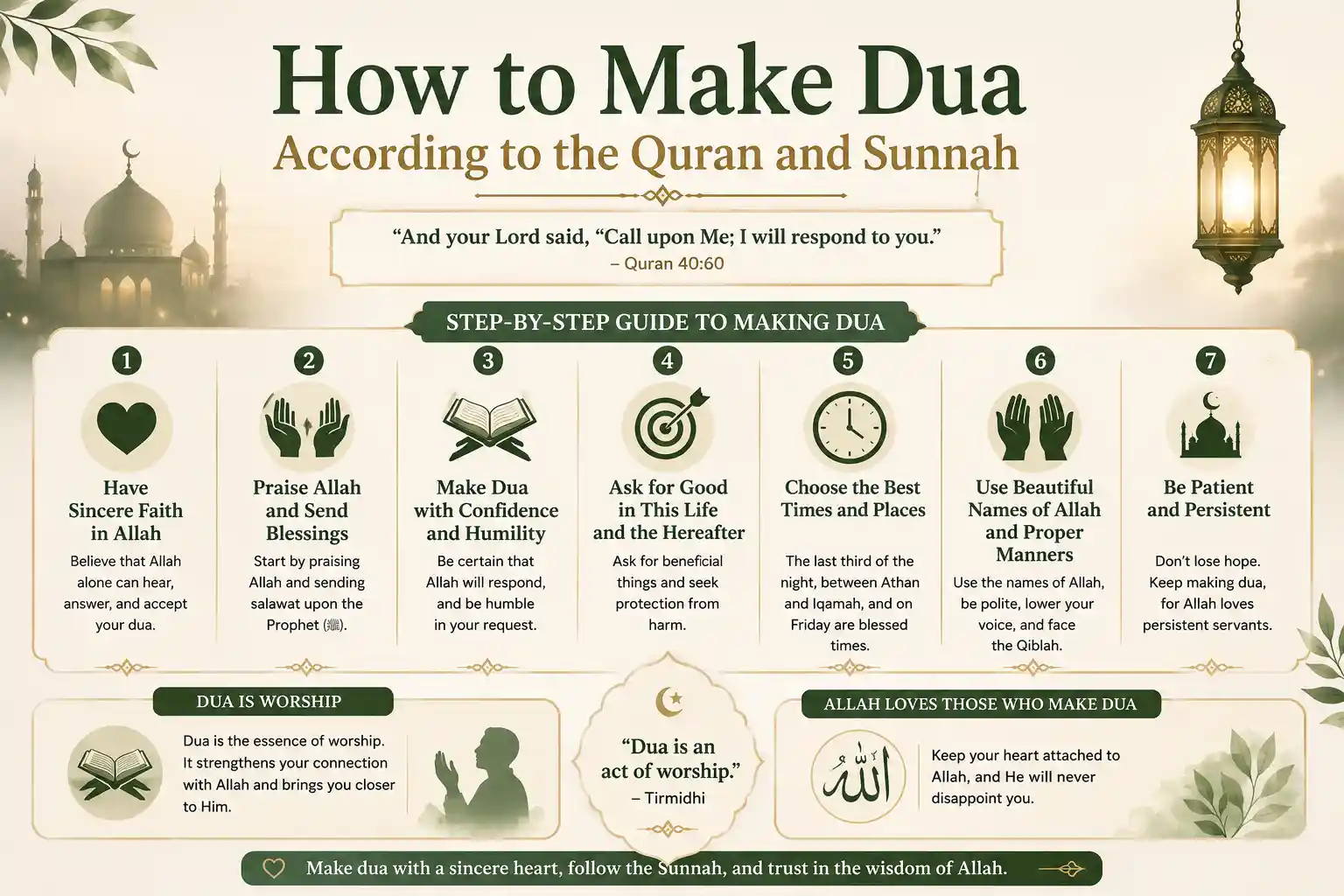
Begin with Praise, Salawat, and Allah’s Beautiful Names
The Prophet ﷺ heard a man jump straight into asking without praising Allah or sending salawat, and said: “This man rushed” (Jami At-Tirmidhi 3477, graded sahih by Al-Albani). The proper sequence begins with hamd (praise), then salawat, then the request.
Start with phrases like Alhamdulillahi Rabbil ‘alamin. Follow with Allahumma salli ala Muhammad wa ala aali Muhammad.
Then invoke Allah by the Name that matches your need. The Quran commands:
وَلِلَّهِ الْأَسْمَاءُ الْحُسْنَىٰ فَادْعُوهُ بِهَا
“Allah has the Most Beautiful Names, so invoke Him by them.” (Quran 7:180)
- Al-Ghaffar: When seeking forgiveness.
- Ar-Razzaq: When requesting provision.
- Ash-Shafi: When praying for healing.
- Al-Hadi: When seeking guidance.
The hadith on salawat is direct: “Every dua is kept back until you send blessings upon the Prophet” (graded sahih by Al-Albani in Sahih Al-Jami 4431). Salawat is not a formality. It is the mechanism that lifts your dua from being held to being heard.
Ask with Sincerity, Certainty, and Humility
- Sincerity (ikhlas): Making dua for Allah’s sake alone, not for an audience or the appearance of piety.
- Certainty: Avoiding tentative language. The Prophet ﷺ specifically prohibited saying “O Allah, forgive me if You wish.” Nothing burdens Allah, and hesitation contradicts the purpose of dua.
- Humility: Recognizing who you are speaking to. Imam Ibn Taymiyyah (rahimahullah) noted in Majmu’ al-Fatawa that the best dua balances raja’ (hope) and khawf (reverence): Neither entitled nor despairing.
The Prophet ﷺ warned: “Allah does not answer a dua from a negligent, inattentive heart” (Jami At-Tirmidhi 3479, graded hasan). A two-minute dua with full focus outweighs a twenty-minute supplication made on autopilot.
Face the Qiblah and Raise Your Hands
The Prophet ﷺ faced the Qiblah when supplicating for rain (Sahih Al-Bukhari 6343). He raised his hands during dua so consistently that the Companions documented it across multiple narrations: “Your Lord is Shy and Most Generous. He is shy when His servant raises his hands to Him to turn them away empty” (Sunan Abi Dawud 1488, graded sahih by Al-Albani).
Hold your palms facing upward, close together. This is recommended, not obligatory. Dua made without raised hands remains valid.
Speak in a Low Voice
Allah is not far. The Quran reminds:
وَاذْكُر رَّبَّكَ فِي نَفْسِكَ تَضَرُّعًا وَخِيفَةً وَدُونَ الْجَهْرِ مِنَ الْقَوْلِ
“Remember your Lord inwardly with humility and reverence, without loudness in words.” (Quran 7:205)
The Prophet ﷺ reinforced this when the Companions raised their voices during a journey: “You are not calling upon a deaf or an absent one” (Sahih Al-Bukhari 6384, Sahih Muslim 2704).
Quiet supplication carries an additional benefit: it protects sincerity. A dua that no one else hears is harder to perform for show.
Seek Forgiveness Before Asking
Istighfar clears the path. The Prophet ﷺ himself sought forgiveness over seventy times daily (Sahih Al-Bukhari 6307), and he had no sins to atone for. For the rest of us, seeking forgiveness before making requests removes spiritual barriers between a Muslim and Allah’s response.
A short, powerful dua for this purpose:
رَبِّ اغْفِرْ لِي وَتُبْ عَلَيَّ إِنَّكَ أَنْتَ التَّوَّابُ الرَّحِيمُ
Rabb-ighfir li, wa tubb ‘alayya, innaka Antat-Tawwabur-Rahim
“My Lord, forgive me and accept my repentance. You are the Accepting of Repentance, the Merciful.” (Riyad As-Salihin 1872, graded sahih)
Make Dua for Others and Conclude with Ameen
Praying for someone in their absence activates a specific angelic response: “No Muslim servant supplicates for his brother behind his back but that an angel says, ‘And for you the same’” (Sahih Muslim 2733). Every dua you make for another person returns to you through an angel’s prayer.
Include your parents, children, teachers, and Muslims facing hardship around the world. Be specific: name the people, name the regions.
Then seal it. The Prophet ﷺ confirmed: “If he ends it with Ameen, it will be so” (Sunan Abi Dawud 938, graded sahih by Al-Albani). Some scholars recommend wiping the hands gently over the face afterward, though this practice carries a weaker chain of narration (Jami At-Tirmidhi 3346, graded da’if by several muhaddithin). Ibn Taymiyyah considered it permissible but not established as a strong Sunnah.
The etiquettes above can feel overwhelming when listed separately. In practice, the Prophet’s ﷺ method follows a natural conversational flow across 4 stages.
Step 1: Prepare Your Body and Mind
Perform wudu. Find a quiet space. Silence your phone. Face the Qiblah. Take a breath and set your intention: I am about to speak to the Creator.
Step 2: Open with Praise and Salawat
Begin with Alhamdulillahi Rabbil ‘alamin. Send blessings upon the Prophet ﷺ. Invoke one or two of Allah’s Beautiful Names relevant to what you are about to ask.
Step 3: Make Your Request Clearly
State what you need with specificity. “O Allah, grant me a job that allows me to provide for my family and still pray on time” is more focused than “O Allah, bless me.” Prioritize spiritual requests (guidance, forgiveness, strong iman) before worldly ones (income, health, marriage). Then include others: your family, your community, Muslims in Palestine, Sudan, and Myanmar.
Step 4: Close with Gratitude and Ameen
Thank Allah for hearing you. Send salawat upon the Prophet ﷺ one final time. Say “Ameen.” Lower your hands. Trust that your supplication has been heard. The Prophet ﷺ guaranteed: “Allah does not reject the dua of a servant as long as he does not pray for something sinful or for the severing of family ties” (Sahih Muslim 2735).
What to Say When Making Dua
Prophetic Supplications for Daily Life
The Prophet ﷺ had specific duas for nearly every situation. Three that every Muslim benefits from memorizing:
- Sayyid al-Istighfar: The master supplication for seeking forgiveness. The Prophet ﷺ said: “Whoever recites this during the day with firm belief and dies that evening enters Paradise” (Sahih Al-Bukhari 6306). Scholars across all madhabs recommend it for daily morning and evening recitation.
- Overall goodness:
رَبَّنَا آتِنَا فِي الدُّنْيَا حَسَنَةً وَفِي الْآخِرَةِ حَسَنَةً وَقِنَا عَذَابَ النَّارِ
Rabbana atina fid-dunya hasanatan wa fil-akhirati hasanatan wa qina adhaban-nar
“Our Lord, give us good in this world and good in the Hereafter, and protect us from the punishment of the Fire.” (Quran 2:201)
Anas ibn Malik (RA) reported this was the Prophet’s ﷺ most frequent dua (Sahih Al-Bukhari 4522, Sahih Muslim 2690).
- Worry and grief:
Allahumma inni a’udhu bika minal-hammi wal-hazan, wal-‘ajzi wal-kasal, wal-jubni wal-bukhl, wa dala’id-dayni wa ghalabatir-rijal
“O Allah, I seek refuge in You from worry and grief, from inability and laziness, from cowardice and miserliness, from being overwhelmed by debt and overpowered by men.” (Sahih Al-Bukhari 6369)
This comprehensive dua covers 8 categories of distress in a single breath.
The Dua of Yunus (AS)
The Prophet ﷺ singled out one supplication above others:
لَّا إِلَٰهَ إِلَّا أَنتَ سُبْحَانَكَ إِنِّي كُنتُ مِنَ الظَّالِمِينَ
La ilaha illa anta, subhanaka, inni kuntu minaz-zalimin
“There is no deity except You; exalted are You. I have been of the wrongdoers.” (Quran 21:87)
He said: “No Muslim makes dua with this supplication for anything except that Allah answers it” (Jami At-Tirmidhi 3505, graded sahih by Al-Hakim).
Yunus (AS) made this dua from inside the belly of a whale, in complete darkness, with no human help available. Allah responded.
- Sincerity (ikhlas): Making dua for Allah’s sake alone, not for an audience or the appearance of piety.
- Certainty: Avoiding tentative language. The Prophet ﷺ specifically prohibited saying “O Allah, forgive me if You wish.” Nothing burdens Allah, and hesitation contradicts the purpose of dua.
- Humility: Recognizing who you are speaking to. Imam Ibn Taymiyyah (rahimahullah) noted in Majmu’ al-Fatawa that the best dua balances raja’ (hope) and khawf (reverence): Neither entitled nor despairing.
The Prophet ﷺ warned: “Allah does not answer a dua from a negligent, inattentive heart” (Jami At-Tirmidhi 3479, graded hasan). A two-minute dua with full focus outweighs a twenty-minute supplication made on autopilot.
Not every moment carries the same spiritual weight. The hadith literature identifies specific windows when dua is more likely to be accepted. Not because Allah is absent at other times, but because certain moments carry heightened divine attention.
The Last Third of the Night
This is the single most emphasized time for dua in the entire Sunnah. The Prophet ﷺ said: “Our Lord descends every night to the lowest heaven when the last third of the night remains, and He says: ‘Who calls upon Me so that I may answer? Who asks of Me so that I may give? Who seeks My forgiveness so that I may forgive?’” (Sahih Al-Bukhari 1145, Sahih Muslim 758).
The last third begins approximately one-third of the way through the night hours between Isha and Fajr. A Muslim who wakes for tahajjud and makes dua during this window accesses the most powerful time for supplication in Islam.
During Sujood
The Prophet ﷺ said: “The closest a servant is to his Lord is while he is in prostration, so increase your dua therein” (Sahih Muslim 482). Sujood during voluntary (nafl) prayers provides the most freedom. No congregation waiting, no time pressure, no limit on how long you remain with your forehead on the ground.
Between the Adhan and Iqamah
“A dua made between the adhan and iqamah is not rejected” (Sunan Abi Dawud 521, Jami At-Tirmidhi 212, graded sahih by Al-Albani). This window occurs five times every day, a built-in opportunity that most Muslims walk past without using.
On Fridays
There is an hour on Friday when any Muslim making dua is granted what they ask (Sahih Al-Bukhari 935, Sahih Muslim 852). Scholars differ on the exact time. Some place it during the khutbah, others between Asr and Maghrib.
During Ramadan and on Laylat al-Qadr
Ramadan amplifies every act of worship. The Prophet ﷺ said that the fasting person’s dua is not rejected (Sunan Abi Dawud, graded hasan). The peak of Ramadan, and arguably the peak of the entire Islamic year, is Laylat al-Qadr.
Aisha (RA) asked the Prophet ﷺ what she should say if she found Laylat al-Qadr. He taught her:
اللَّهُمَّ إِنَّكَ عَفُوٌّ تُحِبُّ الْعَفْوَ فَاعْفُ عَنِّي
Allahumma innaka ‘afuwwun tuhibbul-‘afwa fa’fu ‘anni
“O Allah, You are the Pardoner, You love to pardon, so pardon me.” (Jami At-Tirmidhi 3513, graded sahih by Al-Albani)
While Fasting, Traveling, or During Rain
The Prophet ﷺ grouped three people whose dua carries special weight: the fasting person, the traveler, and the parent praying for their child (Sunan Abi Dawud, graded hasan). A separate narration adds rain: “Two supplications are not rejected: the supplication at the call to prayer and the supplication during rain” (graded sahih by Al-Albani in Sahih Al-Jami 3078).
Travel strips away comfort. Fasting weakens the body and strengthens the spirit. Rain is a sign of Allah’s mercy descending. Each condition aligns the heart toward humility, and humility is the posture Allah rewards.
On the Day of Arafah and During Hajj
The Prophet ﷺ said: “The best dua is the dua of the Day of Arafah” (Jami At-Tirmidhi 3585, graded hasan by At-Tirmidhi). This applies to every Muslim worldwide, not only those performing Hajj. Standing on Arafah is the moment when Allah boasts about His servants to the angels (Sahih Muslim 1348).
Hajj creates total spiritual vulnerability. Distant from home, stripped of status markers, dressed identically, focused entirely on Allah. Dua during tawaf, between Safa and Marwa, and while drinking Zamzam all carry distinct blessings documented in the Sunnah.
Dua After Salah: What to Recite and When
The moments immediately following the salam of each prayer are among the most valuable windows for supplication. The Prophet ﷺ followed a structured sequence of post-salah adhkar before making personal dua.
The Post-Salah Adhkar Sequence
The sequence begins with istighfar, saying Astaghfirullah three times, followed by Allahumma antas-salam wa minkas-salam, tabarakta ya dhal-jalali wal-ikram (Sahih Muslim 591). Then the standard dhikr:
- SubhanAllah: 33 times.
- Alhamdulillah: 33 times.
- Allahu Akbar: 33 times.
- Completion: La ilaha illallahu wahdahu la sharika lah, lahul-mulku wa lahul-hamd, wa huwa ‘ala kulli shay’in qadir to complete 100 (Sahih Muslim 597).
The sequence begins with istighfar, saying Astaghfirullah three times, followed by Allahumma antas-salam wa minkas-salam, tabarakta ya dhal-jalali wal-ikram (Sahih Muslim 591). Then the standard dhikr:
- SubhanAllah: 33 times.
- Alhamdulillah: 33 times.
- Allahu Akbar: 33 times.
- Completion: La ilaha illallahu wahdahu la sharika lah, lahul-mulku wa lahul-hamd, wa huwa ‘ala kulli shay’in qadir to complete 100 (Sahih Muslim 597).
The Special Place of Ayat-ul-Kursi
The Prophet ﷺ said: “Whoever recites Ayat-ul-Kursi after every obligatory prayer, nothing prevents him from entering Paradise except death” (An-Nasa’i in As-Sunan al-Kubra, graded sahih by Al-Albani in Sahih Al-Jami 6464). This single ayah (Quran 2:255) describes Allah’s sovereignty, knowledge, and power, serving as both dhikr and protection.
The Window for Personal Dua
After completing the adhkar, the window opens for personal supplication. The post-Fajr and post-Maghrib windows are especially emphasized in scholarly tradition.
Dua for Istikhara (Seeking Allah’s Guidance in Decisions)
Istikhara is the dua a Muslim makes when facing a decision such as marriage, a job offer, a move, or a business venture. The Prophet ﷺ taught this dua with the same care he taught the Quran (Sahih Al-Bukhari 1162).
The process: pray two rak’at of voluntary prayer. After the salam, recite the istikhara dua:
Allahumma inni astakhiruka bi ‘ilmika, wa astaqdiruka bi qudratika, wa as’aluka min fadlika al-‘azim. Fa innaka taqdiru wa la aqdir, wa ta’lamu wa la a’lam, wa anta ‘allamul-ghuyub…
“O Allah, I seek Your guidance by Your knowledge, and I seek ability by Your power, and I ask of Your great bounty. You are capable, and I am not. You know, and I do not. And You are the Knower of the unseen…”
Istikhara is not a dream or a feeling. It is a dua of surrender: “I do not know what is best. You do. Decide for me.”
Dua for Marriage
The Quran provides the direct dua:
رَبَّنَا هَبْ لَنَا مِنْ أَزْوَاجِنَا وَذُرِّيَّاتِنَا قُرَّةَ أَعْيُنٍ وَاجْعَلْنَا لِلْمُتَّقِينَ إِمَامًا
Rabbana hab lana min azwajina wa dhurriyyatina qurrata a’yunin waj’alna lil-muttaqina imama
“Our Lord, grant us from our spouses and offspring comfort to our eyes, and make us leaders of the righteous.” (Quran 25:74)
This dua covers both finding a spouse and building a family after marriage. It asks not for beauty or wealth but for qurrata a’yun, the cooling of the eyes, a deep Arabic expression for contentment and joy.
Dua for Exams and Studies
The Quran records Musa’s (AS) request before confronting Pharaoh:
رَبِّ اشْرَحْ لِي صَدْرِي وَيَسِّرْ لِي أَمْرِي وَاحْلُلْ عُقْدَةً مِّن لِّسَانِي يَفْقَهُوا قَوْلِي
Rabbi ishrah li sadri, wa yassir li amri, wahlul ‘uqdatan min lisani, yafqahu qawli
“My Lord, expand my chest, ease my task, and untie the knot from my tongue so they may understand my speech.” (Quran 20:25–28)
Students making dua before exams can use this supplication directly. It asks for calm (expanded chest), ease (simplified difficulty), and clarity (coherent expression). Exactly what an exam demands.
Dua for Travel
The Prophet ﷺ taught a specific travel dua:
سُبْحَانَ الَّذِي سَخَّرَ لَنَا هَٰذَا وَمَا كُنَّا لَهُ مُقْرِنِينَ وَإِنَّا إِلَىٰ رَبِّنَا لَمُنقَلِبُونَ
SubhanAlladhi sakhkhara lana hadha wa ma kunna lahu muqrinin, wa inna ila Rabbina la-munqalibun
“Glory to Him who has subjected this to us, and we could not have otherwise subdued it, and to our Lord we will surely return.” (Quran 43:13–14, narrated in Sahih Muslim 1342)
This dua acknowledges that every vehicle, from a camel to an airplane, moves only by Allah’s permission.
Dua for Someone Who Is Sick
The Prophet ﷺ taught:
أَسْأَلُ اللَّهَ الْعَظِيمَ رَبَّ الْعَرْشِ الْعَظِيمِ أَنْ يَشْفِيَكَ
As’alullaha al-‘Azeem, Rabbal-‘Arshil-‘Azeem, an yashfiyak
“I ask Allah the Magnificent, Lord of the Magnificent Throne, to cure you.”
He instructed Muslims to recite this 7 times when visiting or praying for someone who is ill (At-Tirmidhi 2083, graded hasan).
Combine the prophetic dua with a personal, heartfelt request. Mention the person’s name and their exact condition.
Dua for the Muslim Ummah
The Prophet ﷺ regularly prayed for the entire Muslim community. The hadith confirms: “Whoever seeks forgiveness for believing men and believing women, Allah writes for him a good deed for every believing man and believing woman” (At-Tabarani, graded hasan by Al-Albani in Sahih Al-Jami 6026). Given that billions of Muslims have lived and will live, the math of this reward is extraordinary.
When making dua for the Ummah, name specific regions: Palestine, Sudan, Myanmar, Syria, Kashmir, the Uyghur community. Ask for unity among Muslim leaders. Pray for those who recently accepted Islam and are navigating their faith without family support.
How to Make Dua in Sujood
Sujood offers the closest physical and spiritual proximity to Allah. The Prophet ﷺ explicitly encouraged dua during prostration (Sahih Muslim 482).
Enter prostration with full body contact: forehead, nose, palms, knees, and toes on the ground. Recite Subhana Rabbiyal A’la to complete the required dhikr. Then speak. Ask in any language. Prolong the prostration. The longer you stay, the deeper the connection.
Sujood during voluntary prayers provides the most freedom because there is no congregation or time constraint. Some scholars recommend dedicating an entire late-night prayer session to extended sujood with personal dua, especially during the last third of the night, when sujood and the optimal dua window overlap.
How to Make Dua for Someone You Love
The angelic response to praying for others makes this one of the highest-return acts of worship available. Every time you say “O Allah, grant my mother health,” an angel responds: “And for you the same” (Sahih Muslim 2733).
Make it personal. Use the person’s name. Ask for both their dunya and akhirah: “O Allah, protect Ahmad from every harm and make his path to Jannah easy.” “O Allah, grant Fatima shifa’ and restore her strength.” Specific, named supplications carry more emotional weight than generic requests like “bless my family.”
Conditions That Strengthen or Weaken Your Dua
Halal Income: The Hadith of the Dusty Traveler
The Prophet ﷺ described a man who checks every box for an accepted dua: he is traveling, he is dusty and disheveled, and he raises his hands to the sky saying “O Lord, O Lord.” Then the Prophet ﷺ revealed the problem: “His food is haram, his drink is haram, his clothing is haram, and he has been nourished by haram. How can his dua be accepted?” (Sahih Muslim 1015).
This is one of the most sobering hadith in the entire corpus of dua-related narrations. A Muslim who earns, eats, and wears from halal sources removes one of the strongest documented barriers to acceptance.
Good Deeds Carry Your Words Upward
إِلَيْهِ يَصْعَدُ الْكَلِمُ الطَّيِّبُ وَالْعَمَلُ الصَّالِحُ يَرْفَعُهُ
“To Him do good words ascend, and righteous action uplifts them.” (Quran 35:10)
The relationship is direct. Charity, kindness, patience, and forgiveness act as vehicles that carry dua from the lips to the heavens.
Patience and Persistence
The Prophet ﷺ identified impatience as the primary reason duas go unanswered: “The dua of any one of you is answered as long as he does not become impatient and say, ‘I made dua, but it was not answered’” (Sahih Al-Bukhari 6340, Sahih Muslim 2735). He also modeled repetition, making the same dua three times in a single sitting (Sahih Muslim).
Allah responds to every dua in one of three ways: granting it now, storing its reward for the Hereafter, or diverting an equivalent harm (Musnad Ahmad, graded sahih by Al-Albani in Sahih Al-Jami 5637). Imam Ibn al-Qayyim noted that the third category means a Muslim who makes dua is never actually denied. The response takes a form they may not recognize.
Common Mistakes That Weaken Dua
The Sunnah identifies several patterns that undermine the effectiveness of supplication. Avoiding these 5 mistakes strengthens every dua a Muslim makes:
- Absent heart: Making dua while the mind is elsewhere. The Prophet ﷺ said: “Allah does not answer a dua from a negligent, inattentive heart” (Jami At-Tirmidhi 3479, graded hasan). The body is present, the lips move, but the connection is missing.
- Impatience: Giving up after repeated attempts. The Prophet ﷺ described the person who abandons dua and called this impatience the very thing that blocks the response (Sahih Al-Bukhari 6340).
- Crisis-only supplication: Making dua only during hardship. The Prophet ﷺ said: “Know Allah in times of ease, and He will know you in times of difficulty” (Musnad Ahmad, graded sahih by Al-Albani in Sahih At-Targhib 1637). A daily practice arrives at hardship with a connection already established.
- Uncertain language: Saying “O Allah, forgive me if You want.” The Prophet ﷺ prohibited this phrasing explicitly. Nothing is difficult for Allah. Ask with certainty.
- Imbalanced requests: Neglecting the balance between dunya and akhirah. The Prophet ﷺ spent more time asking for spiritual goods such as guidance, forgiveness, and steadfastness than material ones. Begin with the akhirah, address the dunya afterward.
Can Dua Change Destiny?
This question appears repeatedly because it touches a sensitive theological nerve. The answer, grounded in hadith, is direct: dua is itself part of the divine decree.
The Prophet ﷺ said: “Nothing repels divine decree except dua” (Jami At-Tirmidhi 2139, graded hasan). Imam Ibn Taymiyyah explained this by analogy: just as food repels hunger and water repels thirst without contradicting the decree that ordained the hunger and thirst, dua repels calamity without contradicting the decree that ordained it.
A Muslim does not sit passively and say “whatever is decreed will happen.” They make dua because the dua itself was decreed as the means of changing the outcome.
Making Dua in Your Own Language
Allah understands every language ever spoken. A heartfelt dua in Urdu, English, Malay, Hausa, or Turkish reaches Allah just as a dua in Arabic does.
Arabic carries a unique advantage because the Quran was revealed in it, and prophetic supplications were spoken in it. A Muslim who recites Rabbana atina fid-dunya hasanatan connects to the same words the Prophet ﷺ used, and that connection carries its own spiritual weight.
For Muslims who want to bridge the gap between heartfelt expression and Quranic language, studying Arabic opens a layer of dua that translation alone cannot access. Kitaab Academy’s Arabic curriculum progresses through 7 levels, from foundational grammar to independent hadith reading, equipping learners to understand what they recite rather than repeating sounds without comprehension.
A 2026 study in Psychology and Behavioral Sciences found that prayer practices which involve understanding, not mechanical repetition, produce stronger emotional regulation and reduced psychological stress.
Prophetic Examples of Dua in the Quran
The Quran records the duas of the prophets not as historical curiosities but as models. Each one demonstrates a different dimension of supplication: repentance, persistence, desperation, quiet longing, spontaneous need, and full surrender.
Adam (AS): The Template for Repentance
Adam (AS) stood before Allah after the first human sin and said:
رَبَّنَا ظَلَمْنَا أَنفُسَنَا وَإِن لَّمْ تَغْفِرْ لَنَا وَتَرْحَمْنَا لَنَكُونَنَّ مِنَ الْخَاسِرِينَ
“Our Lord, we have wronged ourselves, and if You do not forgive us and have mercy upon us, we will be among the losers.” (Quran 7:23)
This is the template for every tawbah dua that followed. Accountability first, then a plea for mercy.
Nuh (AS): Persistence Through 950 Years
Nuh (AS) called his people for 950 years. Nearly a millennium of rejection, and his dua never stopped. His persistence redefines what “patience in dua” actually means.
Ibrahim (AS): Asking for Worship Itself
Ibrahim (AS) modeled submission:
رَبِّ اجْعَلْنِي مُقِيمَ الصَّلَاةِ وَمِن ذُرِّيَّتِي ۚ رَبَّنَا وَتَقَبَّلْ دُعَاءِ
“My Lord, make me an establisher of prayer, and from my descendants. Our Lord, accept my dua.” (Quran 14:40)
He did not ask for worldly success. He asked for worship itself, the ability to maintain salah and pass it to his children.
Yunus (AS): Calling from Triple Darkness
Yunus (AS) called out from the belly of the whale in triple darkness: the darkness of the night, the darkness of the sea, and the darkness of the whale’s stomach. His dua:
لَّا إِلَٰهَ إِلَّا أَنتَ سُبْحَانَكَ إِنِّي كُنتُ مِنَ الظَّالِمِينَ
carried no elaborate phrasing, just raw acknowledgment of Allah’s oneness and his own wrongdoing. Allah responded by splitting the whale open and restoring him to dry land.
Zakariyya (AS): A Whispered Request Against All Odds
Zakariyya (AS) whispered privately, not loudly, not publicly, and said:
رَبِّ لَا تَذَرْنِي فَرْدًا وَأَنتَ خَيْرُ الْوَارِثِينَ
“My Lord, do not leave me alone, and You are the best of inheritors.” (Quran 21:89)
He was elderly, his wife was barren, and every logical indicator said fatherhood was impossible. Allah granted him Yahya (AS).
Musa (AS): Spontaneous Dua with Nothing but Sincerity
Musa (AS) arrived in Madyan as a fugitive, exhausted, hungry, and alone. He sat under a tree and said:
رَبِّ إِنِّي لِمَا أَنزَلْتَ إِلَيَّ مِنْ خَيْرٍ فَقِيرٌ
“My Lord, I am in need of whatever good You send down to me.” (Quran 28:24)
This spontaneous, unplanned dua, not preceded by wudu or qiblah or raised hands, led to shelter, employment, and marriage.
The Role of Ayat-ul-Kursi and Protective Supplications
Ayat-ul-Kursi (Quran 2:255) is the greatest ayah in the Quran according to the Prophet ﷺ (Sahih Muslim 810). Its recitation after every obligatory prayer carries the promise of Paradise (graded sahih by Al-Albani in Sahih Al-Jami 6464). Its recitation before sleep protects through the night (Sahih Al-Bukhari 5010).
The ayah is a statement of Allah’s absolute sovereignty. His knowledge encompasses everything, His dominion never diminishes, and neither drowsiness nor sleep overtakes Him. Reciting it is simultaneously dhikr (remembrance), iman (affirming belief), and dua (seeking protection).
Alongside Ayat-ul-Kursi, the morning and evening adhkar (Surah Al-Ikhlas, Surah Al-Falaq, Surah An-Nas, each recited 3 times, and the prophetic supplications documented in Hisn al-Muslim) form a protective framework that scholars like Ibn al-Qayyim considered essential to a Muslim’s daily spiritual routine.
Building a Consistent Dua Practice
The difference between Muslims who experience dua as a powerful force and those who find it empty usually comes down to consistency. A daily practice, even a brief one, builds the spiritual muscle that makes dua feel natural, focused, and alive.
- Week 1: Start with one fixed time. After Fajr is the most consistently available window; set aside 5 minutes. Choose 3 requests: 2 personal, 1 for someone else. Recite them with the etiquette described above. Do this for one week without adding anything.
- Week 2: Add a dua journal. Write down your 3 daily requests. Note the date. Leave space for any signs of response. This discipline converts the act from an abstract exercise into a documented practice you can review.
- Week 3: Deepen the practice. Learn one new prophetic dua from a hadith collection. Dedicate one session to sujood-based dua. After saying Ameen, sit quietly for 60 seconds and reflect on what you asked for. This pause strengthens the presence of the heart more than additional words.
- Week 4: Expand outward. Add 3 specific people by name to your daily dua. Share one supplication with a family member. By the end of this week, the habit is embedded, not as a temporary exercise but as a permanent part of how you move through your days.
Kitaab Academy’s self-paced library includes courses on Islamic spirituality and Quranic study that complement a growing dua practice by deepening the understanding behind the words.
Final Thoughts
Dua is the simplest and most powerful act of worship in Islam. It requires no building, no congregation, no equipment, and no specific language. Every prophet in the Quran relied on it during their most difficult moments, and every Muslim today has access to the same direct line to Allah that they used.
The etiquettes give it structure. The prophetic examples give it depth. The best times give it strategic advantage. The conditions (halal income, good deeds, patience) give it lift.
Start today. Pick one prophetic dua. Set a time. Remove distractions. Raise your hands. Speak.
Allah is listening. He has always been listening.
وَقَالَ رَبُّكُمُ ادْعُونِي أَسْتَجِبْ لَكُمْ
“Call upon Me; I will respond to you.” (Quran 40:60)
FAQs
What is the correct way to make dua?
To make dua properly, begin with praising Allah and sending salawat upon the Prophet ﷺ. State your request clearly and sincerely. Include dua for others. End with Ameen. Performing wudu, facing the Qiblah, and raising your hands are recommended but not required.
What is the best time to make dua?
The last third of the night carries the strongest emphasis in the Sunnah. Allah descends to the lowest heaven and asks: “Who calls upon Me so that I may answer?” (Sahih Al-Bukhari 1145). Other recommended windows include during sujood, between the adhan and iqamah, on Fridays, while fasting, during Ramadan, and on the Day of Arafah.
Can I make dua in English, Urdu, or any language other than Arabic?
Yes. Allah understands every language. Arabic duas carry the blessing of being the Prophet’s ﷺ own words, but a heartfelt dua in your mother tongue is fully valid.
Can dua change destiny (qadr)?
The Prophet ﷺ said: “Nothing repels divine decree except dua” (Jami At-Tirmidhi 2139). Dua does not contradict predestination. It is part of the decree. Allah may have written a calamity for you, and also written your dua as the means of averting it.
What do Muslims believe happens after death?
Muslims believe the soul is judged after death, then every person is resurrected on the Day of Judgment to be judged on their deeds. Allah assigns each person to Jannah (Paradise) or Jahannam (Hell) based on that judgment.
What is the difference between Sunni and Shia beliefs?
Sunni and Shia Muslims hold identical core beliefs; their disagreement is about who should have led the Muslim community after Muhammad’s death, not about God, the Quran, or the afterlife.
Do Muslims believe in Jesus?
Yes. Muslims believe Jesus was a prophet born of a virgin who performed miracles, but they don’t believe he was divine or that he died on the cross.
How many Muslims are there in the world today?
Islam is the world’s second-largest religion, with roughly 2 billion followers globally, according to Pew Research Center’s demographic studies. Muslim communities span every continent, with the largest populations concentrated in Asia and Africa.