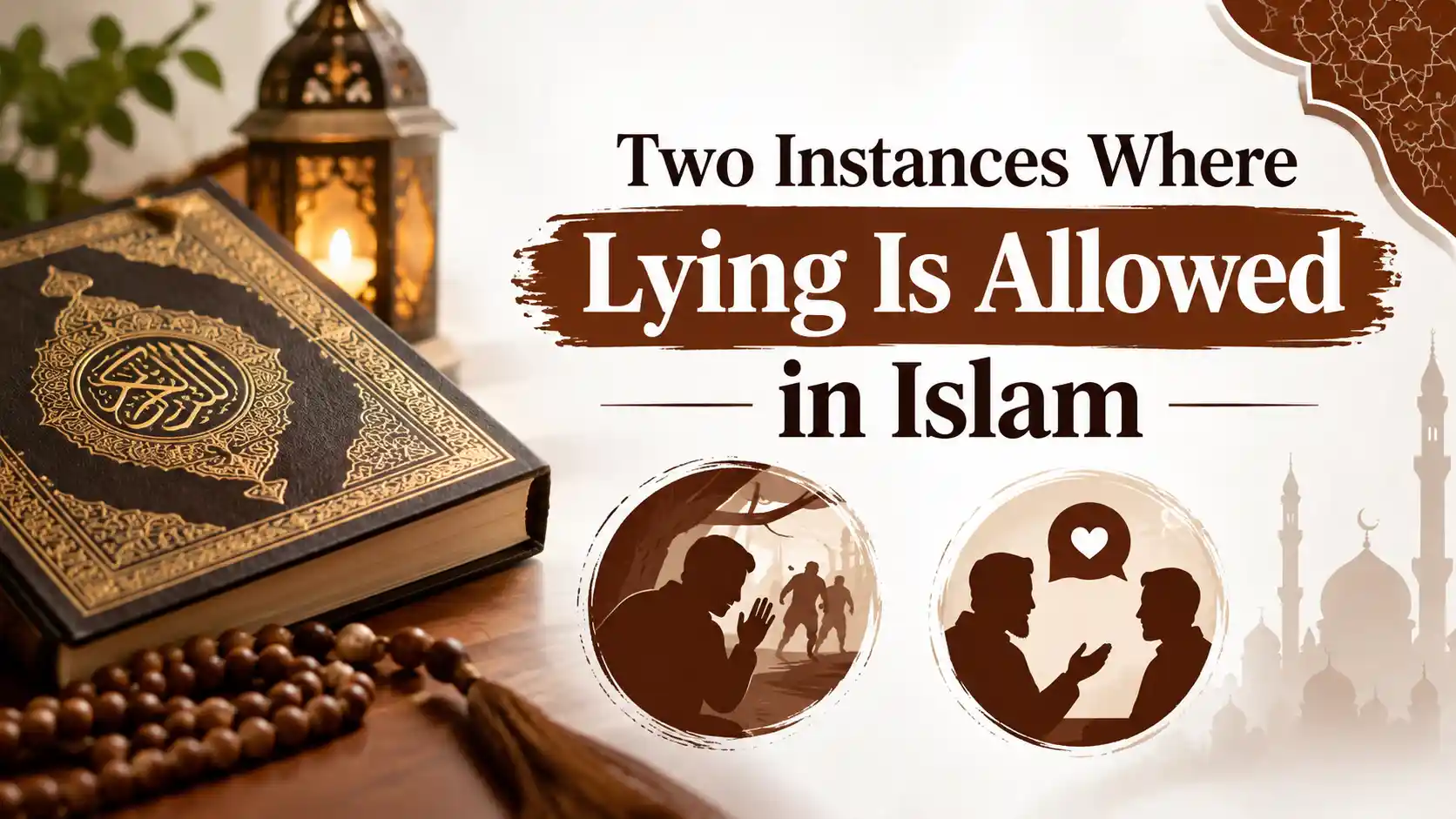
Two Instances Where Lying Is Allowed in Islam
Two Instances Where Lying Is Allowed in Islam
Islam permits lying in 2 broad instances. The first is to reconcile people whose relationship has broken down. The second is to prevent serious harm out of real necessity. Classical hadith texts name 3 specific applications of these 2 principles: reconciling between people, speech between spouses, and deception in war. Outside these narrow cases, deception remains one of the gravest sins a Muslim can commit. What follows covers exactly where each boundary sits.
Reviewed for accuracy against classical hadith sources by Kitaab Academy’s Arabic and Islamic studies instructors, each formally trained in Tajweed and Qur’anic sciences.
Yes, as a general rule. The Prophet Muhammad ﷺ tied lying directly to what happens after death, in a hadith agreed upon by both Bukhari and Muslim:
إِنَّ الصِّدْقَ يَهْدِي إِلَى الْبِرِّ، وَإِنَّ الْبِرَّ يَهْدِي إِلَى الْجَنَّةِ… وَإِنَّ الْكَذِبَ يَهْدِي إِلَى الْفُجُورِ، وَإِنَّ الْفُجُورَ يَهْدِي إِلَى النَّارِ
“Truthfulness leads to righteousness, and righteousness leads to Paradise… Lying leads to wickedness, and wickedness leads to Hell.” (Sahih al-Bukhari 6094, Sahih Muslim 2607)
A’ishah (may Allah be pleased with her) said no trait was more hateful to the Companions than lying. She also said the Prophet ﷺ would remain visibly upset with anyone caught in a lie until he knew they had repented. Against that backdrop, the 2 exceptions below aren’t loopholes. They’re narrow, clearly bounded concessions. Scholars derived them from specific texts, not from a general license to lie.
The 2 Instances Where Lying Is Permitted
1. Reconciling Between People
The primary text behind this exception comes from Umm Kulthum bint Uqbah. She reported the Prophet ﷺ saying:
لَيْسَ الْكَذَّابُ الَّذِي يُصْلِحُ بَيْنَ النَّاسِ فَيَنْمِي خَيْرًا أَوْ يَقُولُ خَيْرًا
“The one who reconciles between people is not considered a liar when he conveys good or says good things.” (Sahih al-Bukhari 2692, Sahih Muslim 2605)
Islah bayn al-nas, or reconciling between people, works by softening what each side hears. Say A has said something harsh about B. A mediator isn’t required to repeat it accurately. They may instead tell B that A spoke well of them, even if that isn’t literally true. Once the relationship is repaired, the mediator returns to plain honesty. The concession was tied to that one broken relationship, not to the mediator in general.
Between Spouses:
A narration from Asma bint Yazid extends the same principle into marriage. A husband may speak to his wife, or a wife to her husband, to smooth over friction and preserve affection. Ibn Hazm, in Al-Fasl fil-Milal, notes that the Prophet ﷺ permitted this. A man could say things to his wife that made her love him more, even where those words weren’t strictly accurate.
Imam al-Nawawi comments on this hadith in his Sharh Sahih Muslim, and he limits the scope further. What’s meant is showing affection and making promises that aren’t strictly binding. Telling a spouse “you mean everything to me” in a moment of tension is one example. Using the same concession to dodge a duty falls outside it entirely. Denying money owed to the other spouse is one clear example, and scholarly consensus, as Nawawi records it, rules that out.
2. Preventing Harm Out of Necessity
The second instance covers situations where telling the truth would expose someone, or someone else, to serious and otherwise avoidable harm. Imam al-Ghazali, in Ihya Ulum al-Din, puts the test this way. If a goal is itself obligatory, such as protecting a Muslim’s life, and that goal cannot be achieved without lying, then that same act becomes obligatory too. If the goal is merely permissible, the lie is permissible on the same terms. But if the truth would cause only minor, avoidable trouble, telling it remains the required course.
Ibn Hazm records something close to scholarly consensus on one specific case. If an oppressive ruler demands to know where another Muslim is hiding, so he can kill him unjustly, telling the truth is itself sinful. The same logic extends to smaller, everyday situations too, such as denying you’re carrying money to someone threatening you for it.
War:
The most specific application of this principle is combat. Abu Hurairah reported that the Prophet ﷺ said:
الْحَرْبُ خَدْعَةٌ
“War is deceit.” (Sahih al-Bukhari 3029)
This permission is narrow on purpose. It covers tactical deception of an active combatant during hostilities, such as concealing troop movements or feigning retreat. It does not cover everyday dealings with non-Muslims in peacetime. Some jurists restrict it further still, treating it as a description of how war naturally unfolds rather than a standing legal permission. A handful of polemical writers conflate this battlefield-specific ruling with general interpersonal honesty. That reading has no basis in the hadith itself.
Before reaching for either exception, classical scholars recommend tawriya, meaning deliberate ambiguity. This is a technically true statement, but understood differently by the listener than the literal wording suggests. It isn’t classified as a lie at all.
A commonly cited example: someone asks whether you have money, and you reply, “My pockets are empty.” That’s true even if your wallet is full, since the money isn’t literally in your pocket. Umar ibn al-Khattab is reported to have said that ambiguous words can help a person avoid falsehood altogether.
Contemporary fatwa bodies have narrowed tawriya into a concrete test, rather than leaving it as a loose principle. Sheikh Muhammad Salih al-Munajid, in an Islam Q&A ruling, sets 2 conditions. First, the words used must truly fit the hidden meaning the speaker intends. Second, the statement must not be used to take someone’s rights or cause an injustice. A technically true statement that still cheats someone out of what’s theirs doesn’t pass this test, even though it isn’t a lie in the strict sense.
Scholars don’t fully agree on how far the 2 exceptions actually stretch. The majority of hadith scholars, or muhaddithun, hold a stricter reading. Even in reconciliation, marriage, and war, they say a Muslim should still use tawriya rather than an outright falsehood. The hadith’s wording describes an outcome, they argue, not a green light for literal lies. In this view, the exception describes someone who softens or reframes the truth, not someone who states the opposite of it.
Many jurists, or fuqaha, take the more permissive position, including how Imam al-Nawawi reads the hadith in his commentary. Within these narrow cases, they hold that an outright false statement is allowed, not just an ambiguous one.
Al-Ghazali’s own ruling reflects a middle position. He urges tawriya first, but permits literal falsehood once ambiguity genuinely can’t achieve the same protective goal. In daily practice, this difference matters. A Muslim following the stricter view would still reach for tawriya, even inside a permitted exception. One following the more permissive reading would not need to.
What These 2 Exceptions Do Not Cover
A single test bounds both instances: they exist to prevent harm, not to secure an advantage. That test rules out 3 situations people often assume are covered:
- Using either exception to gain wealth, status, or sympathy is not covered, even if the lie is small. A hadith records the Prophet ﷺ describing a woman who falsely claimed her husband gave her gifts. She did this purely to make a co-wife jealous. He described her as wearing “two garments of falsehood.”
- Lying to escape a legitimate debt, contract, or court obligation is not covered either. The exception protects against unjust harm, but it doesn’t erase a right someone else is owed.
- Lying out of vague social anxiety doesn’t meet the threshold of real necessity. Inflating a child’s exam score to guard against envy is one example contemporary fatwa bodies like Islam Q&A rule out.
A Common Misconception: Taqiyya and Lying to Non-Muslims
Some polemical writers describe Islam as sanctioning a general, permanent doctrine of deceiving non-Muslims, often citing the term taqiyya. This goes far beyond what the sources actually say. Taqiyya’s textual basis is Quran 16:106. This verse addresses a Muslim forced under life-threatening coercion to renounce their faith, while their heart remains firm verbally:
إِلَّا مَنْ أُكْرِهَ وَقَلْبُهُ مُطْمَئِنٌّ بِالْإِيمَانِ
“Except one who is compelled [to renounce Islam] while his heart is firmly secure in faith.” (Quran 16:106)
This verse was revealed regarding Ammar ibn Yasir, a Companion tortured by the Quraysh until he outwardly recanted Islam to save his life. The concession is about survival under active, mortal coercion. It isn’t a standing invitation to mislead non-Muslims in ordinary daily interactions. Shia jurisprudence developed a wider doctrine of taqiyya in response to long periods of persecution. Even there, though, the principle stays tied to protecting life and safety, rather than functioning as habitual dishonesty. Reducing either the Sunni or Shia position to “Muslims are taught to lie to outsiders” misreads a narrow survival clause as a general ethic.
Both instances rest on a single maxim in Islamic legal theory: al-darurat tubih al-mahzurat, “necessities permit the prohibited.” A peer-reviewed framework for how Islamic law balances these conflicting texts, published in the Journal of Law and Religion, describes this kind of concession as a rukhsa. It’s grounded in maslaha, meaning welfare, and mafsada, meaning harm, rather than in the literal text alone. It also notes that any such ruling expires the moment the necessity that justified it disappears. That’s why neither instance here survives past the situation that triggered it.
Even where lying is technically permitted, classical scholars advise against treating it as a default option. Al-Ghazali warns that opening this door even slightly creates a real risk of lying in situations where no genuine need exists at all. The recommended approach is simple. Lean on tawriya first, use these 2 exceptions only when necessary, and return to complete honesty the moment the need passes.
Reading these rulings in their original Arabic makes that boundary much clearer, rather than reading them through a translated summary. So much of the nuance sits in specific legal terms like darura and maslaha.
Arabic classes for busy adults at Kitaab Academy build exactly that kind of reading ability. The program moves through a structured 7-level curriculum, from the alphabet to independent comprehension of primary Islamic texts. Some readers may want to study the hadith sciences and classical fiqh behind rulings like these at their own pace. The self-paced Kitaab Library covers Arabic, Tafsir, and Islamic history in the same depth.
FAQs
Is it a sin to lie in Islam?
Yes, in almost every circumstance. Lying is classified among the major sins in Islamic ethics, and hadith directly ties habitual dishonesty to punishment in the Hereafter. Only the 2 narrow instances covered above, reconciliation and necessity, carry a specific exemption.
Can a Muslim lie to protect someone else, not just themselves?
Yes. The necessity exception explicitly covers protecting another person’s life, wealth, or safety from an oppressor, not only the speaker’s own. A common example is denying knowledge of a fugitive’s location to someone who intends to harm them unjustly.
Is lying to a spouse always allowed?
No. The exception covers statements meant to preserve affection and smooth over friction. It doesn’t cover lies that conceal a spouse’s legitimate rights, such as finances, infidelity, or a major decision that affects the marriage.
What’s the difference between tawriya and lying?
Tawriya is a literally true statement, but understood differently by the listener than its plain wording suggests. That’s why it isn’t classified as lying at all. An actual lie asserts something the speaker knows to be false, with no true reading available.
Does the “war is deceit” hadith mean Muslims can lie to non-Muslims generally?
No. That hadith addresses tactical deception of an active combatant during hostilities, such as misleading an enemy about troop movements. It does not extend to ordinary social, business, or personal dealings with non-Muslims outside of armed conflict.
Can these exceptions be used to avoid a legal or financial obligation?
No. Both instances exist to prevent unjust harm, not to escape a debt, break a contract, or dodge a legitimate court proceeding. Scholars are explicit that lying to withhold someone’s rightful due falls outside either exception.
Are white lies or jokes exempt from Islam’s rules on lying?
No. Neither size nor humor creates its own exception. When companions asked the Prophet ﷺ whether he joked with them, he replied, “Verily, I do not say anything but the truth” (Sunan al-Tirmidhi 1990). In a separate hadith, he warned, “Woe to one who tells lies to make people laugh. Woe to him! Woe to him!” (Sunan Abi Dawud 4990). A joke built on a false claim still counts as a lie, unless it falls within the 2 instances above.
Does an honest mistake count as lying in Islam?
No. Lying requires knowingly saying something false. It’s defined by intent, not by whether the statement turns out to be inaccurate. Someone who repeats information they truly believed to be true and later learns it was wrong hasn’t sinned by lying. Kadhib, in Islamic ethics, describes a deliberate falsehood, not an honest error.