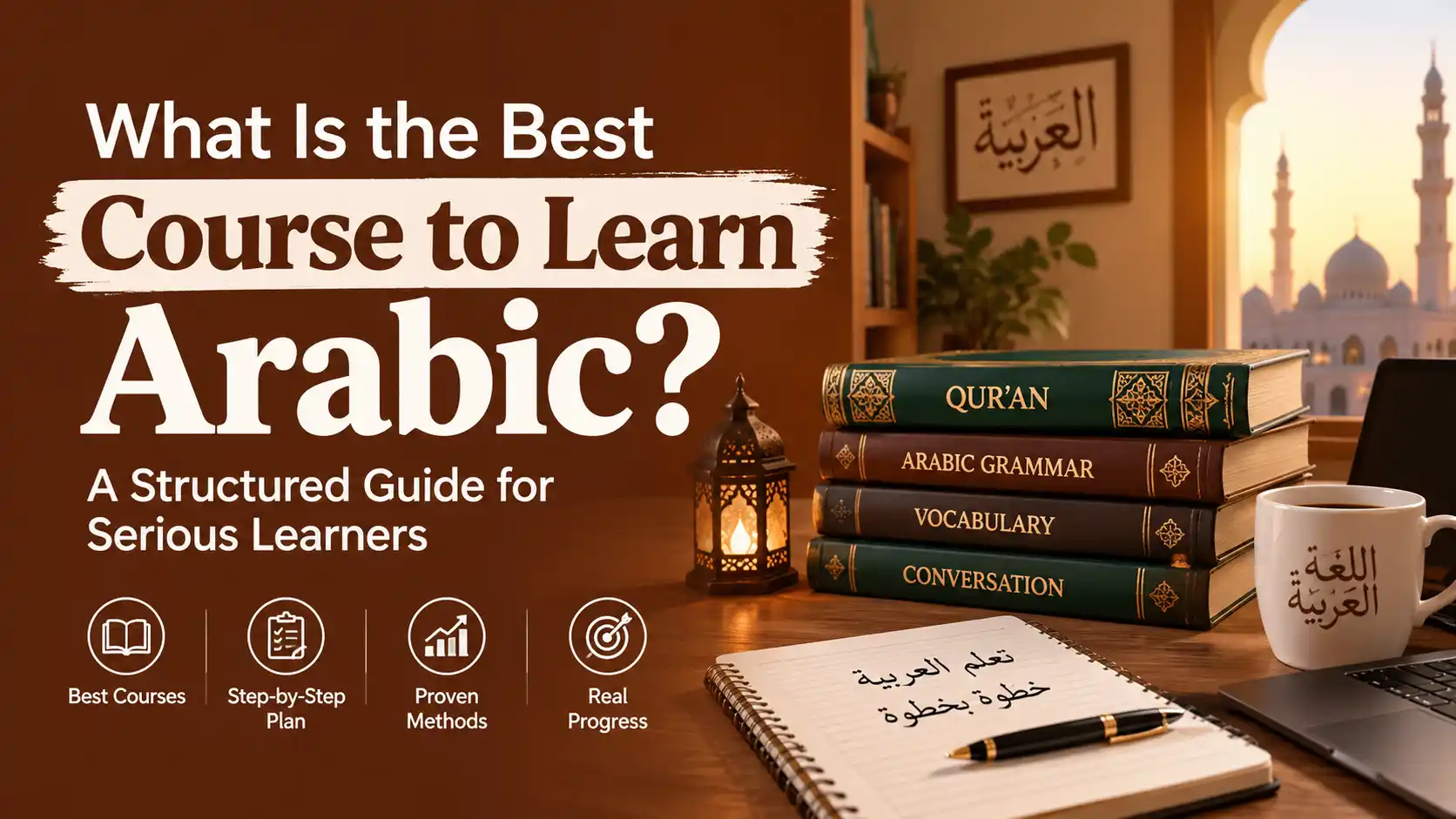
What Is the Best Course to Learn Arabic? A Structured Guide for Serious Learners
The online language learning market is projected to reach $44.9 billion by 2031, growing at a CAGR of 19.5%. Arabic is one of the fastest-growing segments within that market. There are now hundreds of Arabic courses available online, ranging from free apps to university-accredited programs, and that volume makes the choice harder, not easier.
Most “best Arabic course” articles list 8 to 22 programs, give each a paragraph, and leave you to figure out which one fits. That approach fails because Arabic is not one language with one goal. A learner who wants to read the Qur’an in its original Arabic needs a fundamentally different course than someone preparing for a diplomatic posting in Cairo or a business trip to Dubai.
This guide explains what actually matters in an Arabic course, what separates programs that produce results from those that waste months, and why Kitaab Academy’s structured curriculum was built to address the exact gaps most Arabic courses leave open.
Why Most Arabic Courses Fail Learners
The U.S. Foreign Service Institute classifies Arabic as a Category IV language, estimating 2,200 class hours for English speakers to reach professional working proficiency. That is roughly three times the hours required for Spanish (600 hours) or French (750 hours). With that kind of time investment, the cost of choosing the wrong course is not a wasted week. It is wasted months or years.
Most Arabic courses fail in one of five ways:
They teach vocabulary without the root system.
Arabic words are not random. They are built on trilateral roots, where one three-letter root generates 10 to 15 related words. The root ك-ت-ب (k-t-b) produces كَتَبَ (he wrote), كِتَاب (book), كَاتِب (writer), مَكْتَب (office), and مَكْتَبَة (library). A course that teaches these as five separate vocabulary items instead of one root family is tripling your workload. Research on Qur’anic word frequency shows that just 300 root words cover approximately 80% of the Qur’an. Courses that skip the root system make that statistic invisible to learners.
They skip short vowels (tashkeel)
Arabic writing typically omits short vowels, which means the word كتب could be kataba, kutub, or kutiba depending on context. The Qur’an, children’s textbooks, and learning materials include these diacritical marks. Apps and courses that remove them from day one force beginners into guessing, which builds bad habits that take months to undo.
They offer no live interaction
Language acquisition research consistently shows that active output (speaking, writing) produces faster proficiency gains than passive input (listening, reading) alone. A meta-analysis in Language Learning journal found that interactive instruction produces 20 to 30% better outcomes than self-study at equivalent time investment. Apps that offer zero speaking practice cannot close this gap regardless of how polished their interface is.
They ignore the MSA-dialect gap
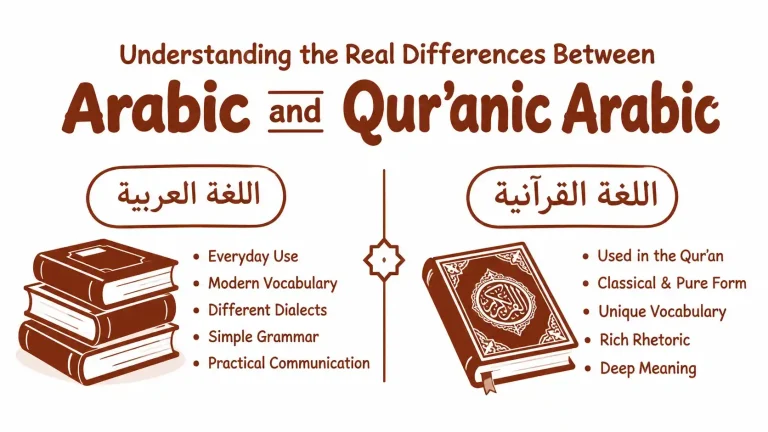
Modern Standard Arabic (MSA) is used in writing, news, and formal settings. Regional dialects (Egyptian, Levantine, Gulf, Maghrebi) are used in daily conversation. No one speaks MSA as a first language. A course that teaches only MSA without acknowledging this reality leaves learners unable to follow a basic conversation in any Arabic-speaking country. Conversely, a course that teaches only a dialect leaves learners unable to read a newspaper, a sign, or a Qur’anic verse.
They rotate instructors
Many online platforms assign a different tutor every session based on availability. This means no single teacher tracks your progress, identifies your specific weaknesses, or builds on what you learned last week. For a language as structurally complex as Arabic, continuity of instruction is not a luxury. It is a prerequisite for systematic progress.
What to Look for in an Arabic Course
Before comparing specific platforms, establish your criteria. A course worth your time should meet at least five of these seven benchmarks:
1. Structured Curriculum with Clear Levels
Arabic is not a language you can learn by browsing random lessons. A quality course provides a defined progression from absolute beginner to a measurable endpoint, with each level building on the previous one. Kitaab Academy uses a 7-level curriculum that takes learners from zero Arabic knowledge to reading the Qur’an with comprehension, with each level designed around specific grammar, vocabulary, and reading milestones.
2. Root-Based Vocabulary Instruction
Any course that teaches Arabic vocabulary without explaining the root system is teaching you to carry water in a bucket when a pipeline is available. The Arabic root system is the single most powerful vocabulary acquisition tool in the language. A good course introduces it from Level 1.
3. Live Instruction with Consistent Teachers
Self-paced content has its place, but it cannot replace a qualified teacher who corrects your pronunciation of ع (ayn) and ق (qaf) in real time, identifies patterns in your mistakes, and adjusts the pace to your learning curve. Kitaab Academy matches each student with a dedicated instructor who tracks their progress from enrollment through completion, with classes running 2 hours per week on a flexible schedule.
4. Tashkeel (Diacritics) from Day One
Short vowel marks should be present in every text a beginner reads. Removing them prematurely creates a reading deficit that compounds over time. The Qur’an is always written with full tashkeel, which means learners aiming for Qur’anic comprehension need a course that treats diacritics as foundational, not optional.
5. Grammar Taught Systematically
Arabic grammar is highly inflected but remarkably systematic. Verbs follow one of ten standard patterns (awzan). Nouns follow predictable case endings. Adjectives agree with their nouns in gender, number, definiteness, and case. A good course teaches these patterns as patterns, not as a list of exceptions. This systematic approach is what makes Arabic grammar feel logical rather than overwhelming once the foundations are in place.
6. Qur'anic Integration (for Religious Learners)
For the millions of Muslims learning Arabic specifically to understand the Qur’an, a course must connect classroom vocabulary to actual Qur’anic verses. The Qur’an contains approximately 77,430 total words with around 14,870 unique word forms. The 125 most frequently occurring words make up about 50% of the entire text. A course designed for Qur’anic comprehension should prioritize these high-frequency words and connect them to the verses learners already recite in prayer.
7. Supplementary Self-Paced Resources
Live classes provide accountability and correction. Recorded content provides review and reinforcement. The best learning systems combine both. The Kitaab Library offers recorded Arabic vocabulary drills, Islamic studies content, and course reviews at $9.99/month, giving learners a way to reinforce live instruction between sessions without needing to schedule additional class time.
How Popular Arabic Course Formats Compare
Not all courses are built the same way. Understanding the format helps you evaluate whether a course’s structure matches your learning style and goals.
Language Learning Apps
Apps like Duolingo and AlifBee offer gamified vocabulary practice, often for free or at low cost. Duolingo’s Arabic course covers roughly 50 lessons in MSA. AlifBee offers 10 levels with over 6,500 words and includes harakat (diacritics).
Where they work: Building a basic vocabulary habit, learning the alphabet, and getting daily exposure to Arabic script.
Where they fall short: No live speaking practice, no personalized feedback, no root system instruction, and no grammar depth beyond basic patterns. A study by the City University of New York found that Duolingo users averaged only novice-level proficiency even after completing entire courses. Apps build recognition, not production
Self-Paced Video Courses
Platforms like Coursera offer structured content from accredited institutions. The Arabic for Beginners specialization from Khalifa University, for example, includes 3 courses totaling about 23 hours, with a 4.6/5 rating from over 15,000 enrolled learners.
Where they work: Gaining foundational knowledge at your own pace, often with university-backed credibility and certificates.
Where they fall short: No live interaction, no pronunciation correction, and limited accountability. Completion rates for online courses average below 15% industry-wide, according to research published by MIT and Harvard. Without a teacher or schedule, most learners stop before reaching functional proficiency.
Tutor Marketplaces
Platforms like iTalki connect learners with tutors, offering over 400 Arabic tutors at rates ranging from $10/hour (community tutors) to $50+/hour (certified professionals). Some platforms like Arab Academy offer structured programs with one-on-one instruction starting around $69/month.
Where they work: Getting live conversation practice, especially for learners who already have some foundation and need speaking time.
Where they fall short: Tutor quality varies enormously. Most marketplaces do not verify credentials, and the learner is responsible for choosing materials, setting goals, and tracking progress. There is no curriculum unless you bring one.
Immersion Programs Abroad
Programs in countries like Morocco, Jordan, Lebanon, and Palestine offer intensive Arabic in an immersive environment, typically for 1 week to several months. These can range from volunteer-based community programs to university summer intensives like the American University of Beirut’s 7-week program.
Where they work: Rapid progress through total immersion, cultural exposure, and forced daily use of the language.
Where they fall short: Cost (travel, accommodation, and tuition combined), time commitment (weeks to months away from work and family), and geographic limitation. They are also typically suited for intermediate learners, not absolute beginners, and most teach MSA or a single dialect, not both.
Structured Online Academies
This is the model Kitaab Academy operates. A defined multi-level curriculum, live classes with a dedicated instructor, supplementary recorded content, and a clear progression from beginner to Qur’anic comprehension.
Where this model works: Learners who want structured progress with accountability, personalized instruction, and the flexibility of online learning without the randomness of tutor marketplaces or the isolation of self-paced apps. Kitaab Academy’s approach combines the rigor of a structured curriculum with the convenience of online delivery, serving over 1,000 learners across 10+ countries.
What makes it different: The curriculum is Arabic-first, meaning it builds toward reading Classical Arabic with comprehension rather than teaching transliterated phrases. Root-pattern awareness is introduced from Level 1. Each student works with the same instructor throughout their program, ensuring continuity. And for children, one-on-one classes cover Tajweed, Qur’an recitation, and age-appropriate Islamic studies with the same consistency.
How to Choose the Right Course for Your Goal
Your goal determines your course. Here is a practical framework:
If your goal is Qur'anic comprehension:
You need a course that teaches Classical Arabic grammar, high-frequency Qur’anic vocabulary, and the root system. Apps and dialect-focused courses will not get you there. Kitaab Academy’s 7-level curriculum is built specifically for this outcome, connecting every lesson to the Arabic of the Qur’an from the earliest stages.
If your goal is conversational fluency:
You need live speaking practice in a specific dialect (Egyptian, Levantine, Gulf, or Maghrebi) combined with an MSA foundation. MSA shares 60 to 70% of core vocabulary with every major dialect, so starting with MSA for 3 to 6 months before adding a dialect is the most efficient path.
If your goal is professional or academic Arabic:
You need MSA at an advanced level, which means grammar depth, formal register, and reading fluency. University courses or structured academies with clear level progression are the right fit. Apps and casual tutoring will plateau too early.
If your goal is basic travel Arabic:
A short app-based course or a few tutor sessions focused on greetings, directions, numbers, and common phrases may be sufficient. This is the one scenario where a structured multi-level course may be more than you need.
FAQs
What is the best course to learn Arabic for beginners?
The best beginner course provides a structured curriculum with clear levels, live instruction from a consistent teacher, and root-based vocabulary from the start. Kitaab Academy’s 7-level program begins from zero and builds toward Qur’anic comprehension with dedicated instructors and recorded review content through the Kitaab Library.
Can I learn Arabic from an app alone?
Apps help with alphabet recognition and basic vocabulary, but they cannot correct your pronunciation of sounds like ع and ق or build real speaking skills. Research shows interactive instruction produces 20 to 30% better outcomes than passive self-study, so apps work best as supplements, not primary resources.
How long does it take to learn Arabic with a structured course?
With 30 minutes of daily practice, most learners recognize all 28 letters within 2 weeks and hold basic conversations within 3 to 6 months. Learners focused on Qur’anic comprehension can understand roughly 50% of the text within 3 to 4 months by prioritizing the 125 most common words.
Is it better to learn MSA or a dialect first?
Start with MSA. It is understood across all 22 Arabic-speaking countries, shares 60 to 70% of vocabulary with every major dialect, and is the Arabic of the Qur’an, literature, and media.
Are free Arabic courses worth it?
Free courses like Duolingo or Language Transfer can supplement structured learning, but they should not be your primary resource. They lack live interaction, personalized feedback, and curriculum depth. Think of them as warm-up exercises, not the workout itself.
What makes Kitaab Academy different from other Arabic courses?
Kitaab Academy assigns each student a dedicated instructor, introduces root-pattern vocabulary from Level 1, and follows a 7-level curriculum built specifically for Qur’anic comprehension. The Kitaab Library ($9.99/month) provides recorded content for self-paced review between live sessions.