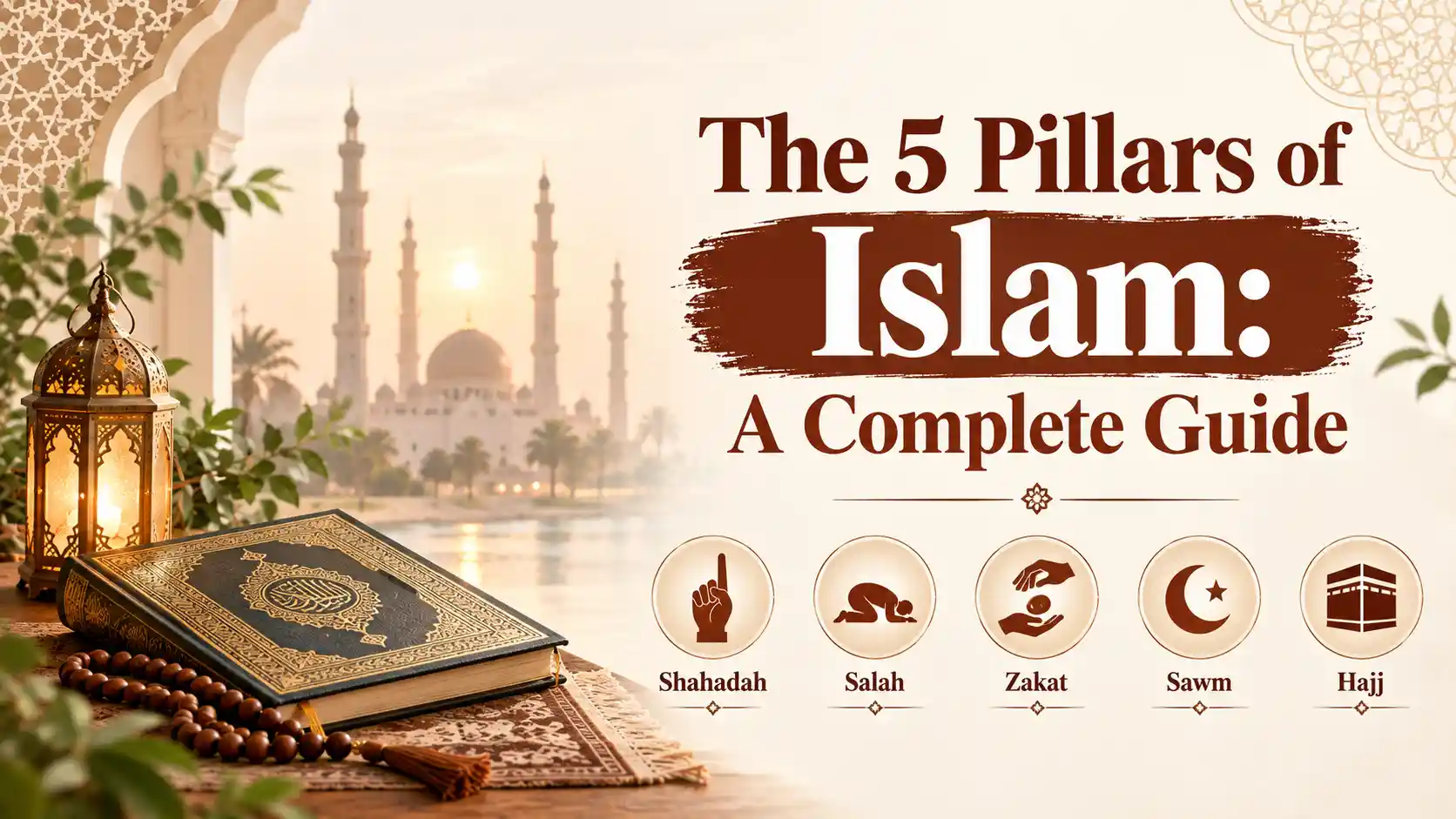
The 5 Pillars of Islam: A Complete Guide
The 5 Pillars of Islam: A Complete Guide
The 5 Pillars of Islam are Shahada, Salah, Zakat, Sawm, and Hajj: the 5 obligatory acts of worship that every capable Muslim performs throughout their lifetime. Together, Islamic scholars call them Arkan al-Islam, and the Prophet Muhammad ﷺ named all 5 directly in a single hadith recorded by both Imam al-Bukhari and Imam Muslim. Each one covers a different obligation: belief, prayer, wealth, fasting, and travel.
Below is a full breakdown: what each one requires, why they carry this order, who is exempt, and what the numbers say about how Muslims actually practice them today.
1. Shahada: The Declaration of Faith
Shahada is the sentence that formally makes someone a Muslim: “La ilaha illallah, Muhammadur rasulullah” (“There is no god but Allah, and Muhammad is His messenger”). It carries 2 acknowledgments at once: the oneness of Allah, and Muhammad’s ﷺ role as His final messenger.
Muslims repeat this testimony inside every prayer, hear it whispered into their ears at birth, and aim to speak it as their final words before death.
2. Salah: The 5 Daily Prayers
Salah consists of 5 obligatory prayers, each named for its window of time:
- Fajr: before sunrise, 2 obligatory rakats
- Zuhr: just after midday, 4 obligatory rakats
- Asr: mid-afternoon, 4 obligatory rakats
- Maghrib: right after sunset, 3 obligatory rakats
- Isha: once darkness sets in, 4 obligatory rakats
That totals 17 obligatory rakats a day. Each prayer combines fixed physical movements with recited verses from the Quran, all performed facing the Kaaba in Mecca.
3. Zakat: Purifying Wealth Through Charity
Zakat obligates a Muslim to give 2.5% of surplus wealth to those in need every year, once that wealth clears the nisab, the minimum threshold of wealth that triggers the obligation. Classical hadith literature, examined in detail in BYU’s Studia Antiqua journal, sets out precise minimums for when Zakat becomes due: nothing is owed on fewer than 5 camels or 5 wasqs of grain, and agricultural produce watered naturally carries a tenth, while produce watered by artificial means, such as irrigation by camel, carries only a twentieth.
Even the nisab threshold itself isn’t calculated identically across the madhabs. For cash and mixed assets, the Hanafi school applies the lower silver standard, roughly 612 grams of silver in value, on the reasoning that a lower threshold benefits more people experiencing poverty. The Maliki, Shafi’i, and Hanbali schools instead default to the gold standard, roughly 87 grams of gold, which sets a noticeably higher bar before Zakat becomes due. The obligation only applies to wealth earned honestly; income from unlawful sources cannot fulfill it.
4. Sawm: Fasting Through Ramadan
Sawm requires healthy adult Muslims to abstain from food, drink, and marital relations from dawn until sunset throughout Ramadan, the ninth month of the Islamic calendar. The Quran commands this obligation directly in Surah Al-Baqarah, verse 183:
يَا أَيُّهَا الَّذِينَ آمَنُوا كُتِبَ عَلَيْكُمُ الصِّيَامُ كَمَا كُتِبَ عَلَى الَّذِينَ مِن قَبْلِكُمْ لَعَلَّكُمْ تَتَّقُونَ
“O believers! Fasting is prescribed for you, as it was for those before you, so perhaps you will become mindful [of Allah].” (Quran 2:183)
The month begins and ends by lunar sighting rather than a fixed date, which is why Ramadan shifts roughly 11 days earlier on the Gregorian calendar every year. Travelers, the sick, and menstruating or pregnant women may postpone the fast and make up the missed days later, once the reason for the exemption passes.
5. Hajj: The Pilgrimage to Mecca
Hajj is the pilgrimage to Mecca that every Muslim who reaches istita’ah, meaning physical and financial capability, must complete once in a lifetime. It falls in Dhul Hijjah, the final month of the Islamic calendar, and moves pilgrims through a sequence of rites tied to the Kaaba and the story of Ibrahim (AS), including Tawaf (circling the Kaaba 7 times), Sa’i (the run between Safa and Marwah), and standing at Arafat.
The 5 Pillars at a Glance
Pillar | Arabic Name | What It Requires |
1. Declaration of Faith | Shahada | A verbal testimony of belief in one God and Muhammad’s ﷺ prophethood |
2. Prayer | Salah | 5 daily prayers, performed facing Mecca |
3. Charity | Zakat | 2.5% of surplus wealth given annually to those in need |
4. Fasting | Sawm | Abstaining from food, drink, and marital relations from dawn to sunset during Ramadan |
5. Pilgrimage | Hajj | A journey to Mecca, required once in a lifetime for those who meet istita’ah |
The Arabic word rukn, plural arkan, refers to the corner of a building, the physical element that keeps a structure standing. Applied to Islam, arkan describes the load-bearing elements a believer’s practice rests on.
This framework traces back to a specific encounter: the Angel Jibril appeared to the Prophet ﷺ in the form of a man and asked him to define Islam. His answer named the 5 obligations directly, and scholars now call this exchange the Hadith of Gabriel. Because rukn more precisely means a foundational element than a decorative column, some scholars translate the phrase as the “5 principles of Islam.” However “5 pillars” remains the far more common English rendering.
The 5 obligations move in a deliberate sequence, and the demand each one places on a Muslim grows heavier as the list goes on.
Shahada: A Single Sentence
Shahada takes only a sincere sentence to fulfill. It requires no schedule, no wealth, and no physical effort, which is exactly why it comes first: nothing else in Islam is possible without it.
Salah: A Daily Habit
Salah turns that belief into repetition. It asks for the same act 5 times before the next day begins, building a rhythm around the obligation that came before it.
Zakat and Sawm: Annual and Monthly Commitments
Zakat raises the stakes further by asking for a portion of wealth once a year. Sawm asks for something different: not money, but a full month of sustained discipline over food, drink, and comfort.
Hajj: The Final Test
Hajj sits at the far end of this scale, since it demands time, money, and physical endurance together, in a single undertaking. A new or returning Muslim isn’t handed all 5 obligations at once under this structure; the sequence gives their practice room to grow.
Who Is Exempt From the 5 Pillars?
Islamic law builds specific exemptions into 3 of the 5 pillars, each triggered by a different condition. Sawm’s exemptions were covered above, and the same “postpone, don’t skip” principle carries through the other 2: Zakat only applies once wealth clears the nisab threshold described earlier, so it never obligates someone without surplus assets, and Hajj only applies within istita’ah, described in its own section above.
Someone physically incapable of the journey, or in debt, is exempt from Hajj, though families sometimes arrange Badal Hajj, where a capable Muslim performs the pilgrimage on another’s behalf. Shahada and Salah carry no such exemptions, since belief and prayer remain possible, in adapted form, even during illness.
Global observance varies sharply across the 5. A Pew Research Center survey of more than 38,000 Muslims across 39 countries found the following global medians:
Obligation | Global Median Observance |
Shahada (belief) | 97% |
Sawm (fasting) | 93% |
Zakat (charity) | 77% |
Salah (prayer) | 63% |
Hajj (completed) | 9% |
The steep drop-off toward Hajj reflects how few Muslims reach full istita’ah within a lifetime, not a difference in how seriously the obligation is held.
Why the Numbers Diverge So Sharply by Region
The global medians hide a more revealing pattern once Pew’s country-level data is broken apart. Zakat holds up in regions where Salah collapses almost entirely. In Kazakhstan, only 2% of Muslims say they perform all 5 daily prayers, yet 36% still report giving Zakat that same year, a 34-point gap between the two in a single country. Bosnia-Herzegovina (81%), Kyrgyzstan (77%), and Uzbekistan (73%) show similarly high Zakat participation despite daily prayer rates far below the global median in the same countries.
That gap points to a structural difference between the two obligations rather than a difference in devotion. Salah depends on a private habit repeated 5 times a day, which decades of state-enforced secularism in Central Asia’s Soviet era made difficult to sustain openly. Zakat, by contrast, functions more like an annual social obligation tied to community and family, one that survives even where daily personal practice has eroded.
Hajj completion follows a different logic entirely: geography, not piety. A median of 17% of Muslims in the Middle East and North Africa have completed Hajj, compared with 13% in sub-Saharan Africa, 8% in Southeast Asia, 6% in South Asia, and just 3% across Central Asia and Southern and Eastern Europe. Distance from Mecca, and the travel cost that comes with it, explains most of that spread far more than regional differences in commitment.
Sunni and Shia: The Same Pillars?
Sunni and Shia Muslims share the same 5 acts of worship, but Shia scholarship organizes them differently. Twelver Shia Islam groups these obligations under Furu al-Din, 10 branches of practice that include Salah, Sawm, Zakat, and Hajj alongside additional obligations such as Khums, a one-fifth tax on annual profit, Jihad, and Amr bil ma’ruf, the duty to enjoin good. Ismaili Shia communities follow a separate structure known as the Seven Pillars, where Shahada functions as a foundation rather than a numbered one.
This kind of structural variation isn’t limited to the Sunni-Shia divide, either. Even within Sunni fiqh, the 4 madhabs disagree on details like which nisab standard applies to Zakat, covered above. Despite these differences in structure and calculation, every branch of Islam agrees on the same core acts: testimony of faith, prayer, charity, fasting, and pilgrimage.
Each one left a visible mark on Islamic art and architecture across centuries, and each object below was made for practical use inside one of the 5 pillars, not as decoration for its own sake. The Shahada appears carved or painted across mosque walls, minbars, and the covers of countless Qurans. Salah shaped the mihrab, the niche built into every mosque wall to mark the direction of prayer, and gave rise to the portable prayer rug, woven with an arch motif recalling that same niche.
Hajj produced its own genre of illustrated pilgrimage manuals, guiding travelers through the Kaaba’s 7 circuits, the run between Safa and Marwah, and the symbolic stoning of the devil at Mina. These rites fall on the 8th and 12th days of Dhul Hijjah each year.
What If a Muslim Neglects a Pillar?
Once a Muslim understands an obligation, knowingly neglecting it carries real weight in Islamic law, since these acts form the floor of religious duty rather than optional extras.
Islamic scholarship draws a clear line between struggle and rejection, though. A new Muslim still learning to pray, or someone easing back into practice after years away, is treated with patience, not condemnation. What Islamic law treats seriously is deliberate, informed refusal, not the gradual, honest process of building a habit.
Rebuilding a habit around any of the 5 works best as a gradual process, not an all-at-once overhaul.
Start With One Prayer
Add a single daily Salah before attempting all 5, and let the rest follow once that habit holds. Trying to jump straight to 5 prayers a day after months or years away usually collapses within a week. One consistent prayer, kept up for a few weeks, builds the routine the other 4 can attach to.
Anchor Zakat to a Date
Tie Zakat to a fixed point each year, such as Ramadan or the Day of Arafah, instead of leaving it open-ended. An open-ended “sometime this year” plan tends to slip past the lunar year without being paid. A fixed date also makes it easier to calculate nisab consistently, since wealth is checked at the same point every time.
Name the Actual Obstacle
Whatever concretely blocks a prayer or a fast, whether that’s a work schedule, an unclear ruling, or simple unfamiliarity with the steps, is usually worth solving directly rather than working around indefinitely. A vague sense of “I should pray more” rarely changes behavior on its own. Naming the specific blocker turns a vague intention into a solvable problem.
Use Short Daily Adhkar
Brief remembrances of Allah keep the underlying goal close even on days when a full prayer or fast isn’t possible. A few minutes of dhikr costs far less than a missed prayer feels like it demands, which makes it easier to sustain on hard days. Over time, this small habit tends to pull the larger obligations back into reach rather than replacing them.
Each one delivers a distinct benefit alongside its religious obligation.
Shahada: Anchors Identity
It gives a Muslim a fixed point of belief to return to during doubt, especially in moments when circumstances make faith feel harder to hold onto. Because the sentence is short and memorized early, it stays accessible even during grief, illness, or crisis, when longer forms of worship are harder to sustain.
Salah: Builds Discipline
Its fixed daily schedule structures a believer’s day around 5 set pauses, each one arriving whether or not the rest of the day went as planned. That regularity builds a kind of consistency that carries over into other areas of life, from work habits to how a person manages time generally.
Zakat: Purifies Wealth
It redistributes surplus wealth toward those in need, easing economic gaps within the community rather than letting wealth sit idle in one place. Giving a fixed percentage also checks attachment to money itself, since a Muslim has to let go of a portion every single year actively.
Sawm: Strengthens Self-Control
Removing food, drink, and comfort for a full month builds a level of restraint that’s hard to reach any other way, since the fast applies to something as basic as thirst rather than an occasional temptation. Muslims who complete Ramadan often describe carrying that same discipline into habits well beyond the month itself.
Hajj: Dissolves Status
It places every pilgrim in identical white garments, a physical statement of equality before Allah regardless of wealth or background. A CEO and a laborer perform the same rites, in the same clothing, standing in the same crowd, which is precisely the point: nothing about Hajj allows status to show.
Teaching the 5 Pillars to Children
Children absorb these 5 best through repetition and hands-on practice rather than abstract explanation. Shahada can start as a simple phrase repeated at bedtime, while Salah can begin with wudu, the ritual washing before prayer, taught step by step before a child attempts a full prayer cycle.
Zakat becomes concrete when a child sets aside a small portion of their own allowance to give away, and Sawm can start with a half-day fast before a child works toward a full one. This kind of gradual, personalized teaching is exactly what shapes Kitaab Academy’s approach to its children’s Qur’an classes, where one instructor works with one child at a pace that fits their age and attention span.
Reciting the Shahada, praying Salah, or fasting Sawm carries more weight once a Muslim understands the Arabic words behind each act rather than only their English translation.
Kitaab Academy builds that understanding through Arabic classes for busy adults, a structured 7-level path from the alphabet to independent comprehension of the Quran, and through the self-paced Kitaab Library, where Arabic, Tafsir, and Islamic history can be studied on your own schedule.
FAQs
What are the 5 Pillars of Islam in order?
The 5 Pillars of Islam in order are Shahada (declaration of faith), Salah (prayer), Zakat (charity), Sawm (fasting), and Hajj (pilgrimage). Scholars trace this exact order to the Hadith of Gabriel, where the Prophet ﷺ listed all 5 in response to a direct question about the definition of Islam.
Which pillar is considered the most important?
Shahada is considered foundational among the 5, since a person cannot be Muslim without it, but Islamic scholarship treats all 5 as obligatory rather than ranked by importance. Each one addresses a different dimension of worship: belief, prayer, wealth, self-discipline, and physical sacrifice.
Can a Muslim skip a pillar if they’re going through a hard time?
Islamic law allows temporary exemptions for illness, travel, menstruation, and pregnancy, particularly for Sawm and Salah, with the missed obligation made up once the hardship passes. A hard time does not remove the underlying duty; it adjusts the timing.
Do converts have to complete all 5 pillars immediately?
No. A new Muslim typically begins with Shahada and Salah, then grows into Zakat, Sawm, and Hajj as knowledge and financial capability develop. Zakat and Hajj carry built-in wealth thresholds that many new Muslims haven’t reached yet.
What is the difference between sabr and suppression?
Sabr acknowledges difficulty, redirects the emotional response toward Allah, and maintains worship throughout. Suppression denies emotion entirely, which weakens resilience over time.
How many times must a Muslim perform Hajj?
Once, provided the required capability is met. Any additional pilgrimage beyond that first, obligatory Hajj counts as voluntary worship.
Is Zakat the same as regular charity?
No. Zakat is a fixed, obligatory 2.5% of surplus wealth given annually once nisab is reached, while Sadaqah is voluntary charity given in any amount, at any time, without a set threshold.
What happens if someone genuinely cannot afford Hajj?
The obligation is lifted entirely. A Muslim who lacks the funds, or whose dependents would go unprovided for, carries no sin for not performing Hajj that year.
Do Shia Muslims believe in the same 5 Pillars as Sunni Muslims?
Yes, the same core acts of worship apply across both branches. However, Twelver Shia Islam organizes them within a broader 10-part framework called Furu al-Din, and Ismaili Shia communities follow a separate 7-part structure.