The 7 Qira’at of the Quran: A Complete Guide to Every Style, Imam, and Narrator
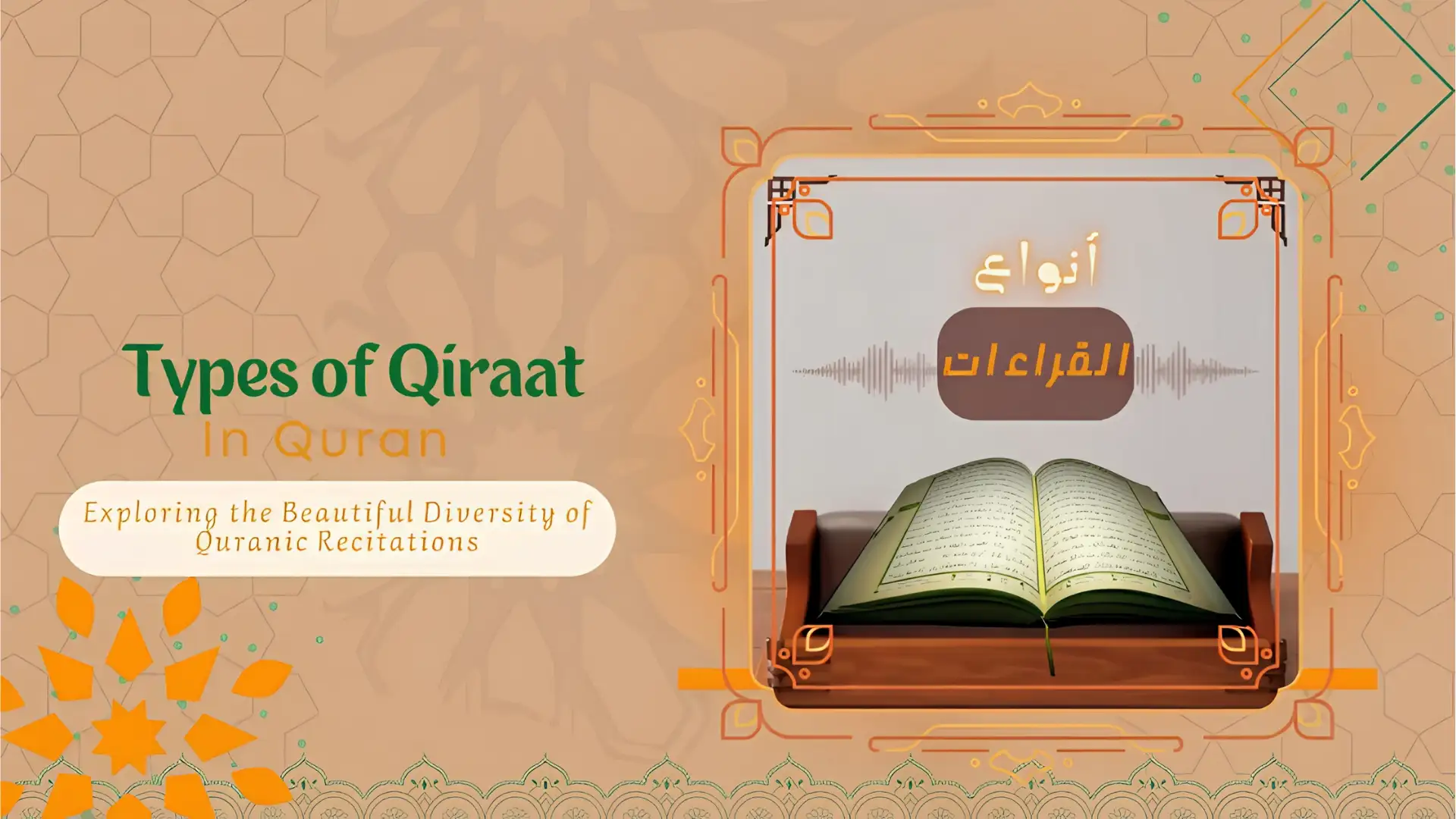
The 7 Qira’at of the Quran are seven authenticated systems of reciting the same divine text, each traced through an unbroken chain of narrators back to the Prophet ﷺ. They are not different versions of the Quran. They are different, equally valid ways of pronouncing, elongating, and voicing the same Uthmani script. Together with 3 additional recitations, they form the 10 mutawatir (mass-transmitted) Qira’at that Islamic scholarship recognizes today.
What Are the 7 Qira’at of the Quran?
The 7 Qira’at rest on a small set of terms and rules that define the entire science. Here are the essentials.
- Qira’at: The word (قراءات) means “recitations.” It is the plural of Qira’ah, a single reading tradition named after the Imam who mastered and transmitted it.
- Madd: The rule governing elongation, one of the main points where the 7 Qira’at differ from each other.
- Hamzah: The glottal stop sound, pronounced with distinct emphasis or softness depending on the Qira’ah.
- Imalah: A vowel inclination applied by some Imams, such as Al-Kisa’i, and not by others.
- Idgham: The rule of assimilation, where one letter’s sound merges into the next.
- Uthmani rasm: The written script every Qira’ah must match exactly, regardless of pronunciation differences.
- Riwayah: The specific transmission passed down by a student, called a Rawi, from his Imam. Scholars distinguish this from the Qira’ah itself: the Qira’ah belongs to the senior Imam, while the Riwayah belongs to the Rawi who narrated directly from him. So scholars say Qira’at ‘Asim bi-riwayat Hafs, meaning the recitation of ‘Asim as narrated by Hafs. Two Rawis of the same Imam can differ on minor points, which is why 7 Imams produced 14 recognized narrations.
The 7 Ahruf: Why the Quran Carries Multiple Modes
To understand the Qira’at, start one step earlier, with the Ahruf (أحرف), meaning “modes” or “styles.”
The Hadith Evidence for the 7 Ahruf
Ibn Abbas narrated that Jibreel taught the Prophet ﷺ one mode of recitation, then kept expanding it at the Prophet’s ﷺ own request, until 7 modes were confirmed (Sahih al-Bukhari 4991; Sahih Muslim 819).
A second hadith sharpens the picture. Umar ibn al-Khattab once heard Hisham ibn Hakim reciting Surah al-Furqan differently from how the Prophet ﷺ had taught him. Umar brought the dispute straight to the Prophet ﷺ, who confirmed that both recitations were correct and had been revealed exactly that way, then said the Quran had come down in 7 different modes, so recite whichever eases you (Sahih al-Bukhari 2419; Sahih Muslim 818).
What the 7 Ahruf Actually Mean
Scholars debated the exact meaning of Ahruf for centuries and recorded nearly 40 different opinions. The most widely accepted view holds that the 7 Ahruf are 7 ways of reciting the same verse, where wording sometimes shifts but meaning never contradicts, only varies by synonym, as when one Arab says halumma and another says ta’aal, both meaning “come here.”
Ahruf vs. Qira’at: The Key Distinction
One point deserves emphasis: the 7 Ahruf are not the same thing as the 7 Qira’at. Shaykh al-Islam Ibn Taymiyyah stated this plainly in Majmu’ al-Fatawa (13/210), rejecting the common confusion between the two. The 7 Qira’at emerged centuries after the 7 Ahruf and represent only a portion of what the Ahruf originally contained.
This is usually the point where a student’s next question shifts from history to practice: if the Ahruf gave this much flexibility, why do most Muslims only ever hear one recitation at the masjid? That question is really about Ibn Mujahid, and it’s worth answering properly before moving further.
The Quran’s text carries several other layers of organization built for similar practical reasons; Kitaab Academy’s piece on the divisions of the Quran covers how Ayah, Surah, Juz, and Ruku each came about for their own reasons, in much the same spirit as the standardization discussed below.
How Ibn Mujahid Standardized the 7 Qira’at
Before the 4th century AH, authenticated Quranic recitations had multiplied to nearly 50 documented systems across the Muslim world. This created a real risk of confusion between sound and weak narrations.
Imam Abu Bakr Ibn Mujahid al-Baghdadi (d. 324 AH) solved this problem in his foundational work Kitab al-Sab’ah. He selected exactly 7 Imams whose recitations met the strictest scholarly conditions, deliberately matching the number 7 to echo the number of Ahruf mentioned in hadith. This selection was a scholarly act of standardization, not a claim that only 7 authentic recitations existed.
The remaining valid recitations were never invalidated; three of them were documented later by Imam Ibn al-Jazari (d. 833 AH) in An-Nashr fi al-Qira’at al-‘Ashr, completing the 10 mutawatir Qira’at recognized today. Tareq Moqbel’s 2022 paper in the Journal of Islamic Studies traces a related question in far more depth: whether classical scholars believed every one of these readings carried the same divine authority, or whether some carried a lesser, permitted status.
Ibn Mujahid’s number 7 and the hadith’s number 7 may be coincidental, or Ibn Mujahid may have chosen it deliberately to mirror the Ahruf. No classical scholar equates the two directly, and treating them as identical is a documented mistake.
The 7 Imams of Qira’at and Their Narrators
Each of the 7 Imams represents a major early Islamic city and transmitted his recitation through 2 primary Rawis, giving 14 major narrations in total.
# | Imam | City | Rawi 1 | Rawi 2 |
1 | Nafi’ al-Madani | Madinah | Qalun | Warsh |
2 | Ibn Kathir al-Makki | Makkah | Al-Bazzi | Qunbul |
3 | Abu ‘Amr al-Basri | Basra | Al-Duri | Al-Susi |
4 | Ibn ‘Amir al-Dimashqi | Damascus | Hisham | Ibn Dhakwan |
5 | ‘Asim al-Kufi | Kufa | Shu’bah | Hafs |
6 | Hamzah al-Kufi | Kufa | Khalaf | Khallad |
7 | Al-Kisa’i al-Kufi | Kufa | Abu al-Harith | Al-Duri |
A short profile of each Imam:
- Nafi’ al-Madani: Died 169 AH. Studied under 70 Tabi’in in Madinah. His recitation, through Warsh and Qalun, dominates North and West Africa today, including Morocco, Algeria, and Mauritania.
- Ibn Kathir al-Makki: Died 120 AH. Learned directly from companions of the Prophet ﷺ, giving his chain near-immediate transmission back to revelation.
- Abu ‘Amr al-Basri: Died 154 AH. Born in Makkah and raised in Basra. His recitation, through Al-Duri and Al-Susi, still survives in parts of Sudan.
- Ibn ‘Amir al-Dimashqi: Died 118 AH. Led prayer at the Umayyad Mosque in Damascus and became the leading recitation authority of greater Syria.
- ‘Asim al-Kufi: Died 127 AH. Studied under students of Ibn Mas’ud, Ali ibn Abi Talib, Uthman ibn Affan, and Zayd ibn Thabit. His recitation through Hafs is the most recited Qira’ah in the world today.
- Hamzah al-Kufi: Died 156 AH. Known for distinct rules around Hamzah pronunciation and longer Madd extensions.
- Al-Kisa’i al-Kufi: Died 189 AH. Mastered both Qira’at and Arabic grammar, and his recitation uses Imalah in places Hafs does not.
The 3 Additional Qira’at That Complete the 10
Beyond the famous 7, Islamic scholarship recognizes 3 more authentic, mutawatir recitations, systematized primarily by Ibn al-Jazari.
# | Imam | City | Rawi 1 | Rawi 2 |
8 | Abu Ja’far al-Madani | Madinah | Ibn Wardan | Ibn Jummaz |
9 | Ya’qub al-Basri | Basra | Ruways | Rawh |
10 | Khalaf al-‘Ashir | Baghdad | Ishaq | Idris |
Khalaf al-‘Ashir, the 10th Imam, is the same person as Khalaf, the Rawi of Hamzah (the 6th Imam). As a Rawi, he narrates a riwayah; as an independent Imam, his own system counts as a full qira’ah. Students working through this level of detail on their own often want a structured curriculum rather than scattered articles; Kitaab Library houses self-paced Quranic sciences and Tafsir courses built for exactly that kind of gradual, self-directed study.
The 4 Categories of Qira’at
Scholars sort every reported reading into 4 categories, based on strength of transmission and conformity to the Uthmani script.
- Mutawatir: Transmitted through so many independent, reliable chains that error becomes practically impossible. The 10 Qira’at above fall here.
- Mashhur: Widely transmitted and correct, but with slightly fewer chains than Mutawatir, and still required to match Arabic grammar and the Uthmani script.
- Ahad Sahiha: Authentically transmitted, yet it departs from either standard Arabic usage or the Uthmani script.
- Shadhdh: Irregular readings that scholarly consensus does not authenticate for recitation.
Reciting Mutawatir Qira’at in prayer earns reward and satisfies valid recitation; Shadhdh readings carry neither and cannot be attributed reliably to the Prophet ﷺ. Kitaab Insights breaks down several other Quranic sciences topics like this one at a similar level of detail, for anyone who wants to keep building on this foundation.
How the 7 Qira’at Differ From Each Other
Every difference between the Qira’at is rule-governed, never arbitrary, and never changes the Quran’s core meaning.
Category of Difference | Example |
Madd (elongation) length | Warsh extends certain Madds to 6 counts; Hafs uses 4 to 5 |
Imalah (vowel inclination) | Al-Kisa’i applies Imalah where Hafs does not |
Hamzah pronunciation | Hamzah al-Kufi emphasizes the glottal stop; Abu ‘Amr softens it through Tashil |
Vowel marking | Maaliki (Master) in Hafs vs. Maliki (King) in Warsh, Quran 1:4 |
Word substitution | fatabayyanu (verify) in Hafs vs. fatathabbatu (confirm) in Warsh, Quran 49:6 |
Stops and pauses | Some Qira’at permit a pause where others require continuation |
A few more examples show how narrow these differences really are. In Surah Al-Baqarah (2:184), Hafs reads fidyatun ta’aamu miskeen while another narration reads the plural ta’aamu masaakeen, a grammatical shift rather than a change in ruling. In Surah An-Naml (27:24), Hamzah and Al-Kisa’i read zayyana. In contrast, the majority read zuyyina, an active-versus-passive distinction that Tafsir scholars have used to draw out two complementary layers of meaning from a single verse, not two conflicting ones.
Ammar Khatib and Dr. Nazir Khan’s research paper for the Yaqeen Institute walks through dozens of these cases in detail and reaches the same conclusion: the variations add nuance rather than contradiction. These differences preserve the linguistic ease that the 7 Ahruf were revealed to provide, while every variant still conforms to the same Uthmani script and carries a verified chain back to the Prophet ﷺ.
Why a Reciter Cannot Mix Qira’at Mid-Recitation
One rule trips up new students more than any other: Talfiq, or mixing elements of two Qira’at inside a single recitation, is not permitted. A reciter who starts a verse in Warsh cannot suddenly borrow a Hafs pronunciation halfway through and call the result valid.
Each Qira’ah is a complete, internally consistent system; a reciter learns one at a time and applies it as a whole. This is precisely why certified instruction matters more here than in ordinary Tajweed practice, since a teacher trained in a specific chain can catch a slip toward another Qira’ah before it becomes a habit.
Where Each Qira’at Is Recited Today
Region | Recitation Used |
Middle East, South Asia, Southeast Asia, Turkey | Hafs ‘an ‘Asim |
Morocco, Algeria, Mauritania, parts of West Africa | Warsh ‘an Nafi’ |
Tunisia, parts of Libya | Qalun ‘an Nafi’ |
Parts of Sudan | Abu ‘Amr al-Basri |
Parts of the Arabian Peninsula | Warsh or Qalun alongside Hafs |
A reciter from Morocco and a reciter from Pakistan can sound noticeably different in Madd length and vowel choice. Both recite the same preserved Quran correctly.
The Classical Texts That Preserve the Qira’at
- Ash-Shatibiyyah: A 1,173-line poem by Imam al-Qasim al-Shatibi (d. 590 AH) encoding the 7 Qira’at, still the primary text studied by students today.
- Ad-Durrah al-Mudiyyah: Ibn al-Jazari’s supplement encoding the 3 additional Qira’at.
- At-Tayyibah an-Nashr: Ibn al-Jazari’s advanced poem encoding all 10 Qira’at in one system.
- At-Taysir: Abu ‘Amr al-Dani’s (d. 444 AH) foundational prose reference, which the Shatibiyyah later turned into verse.
Why Allah Revealed the Quran in Multiple Modes
Classical scholars identify several wisdoms behind the 7 Ahruf and the Qira’at that preserve them.
- Eases recitation: Across Arab tribes that once spoke different dialects.
- Displays the Quran’s linguistic miracle: Since no reading introduces a flaw despite centuries of scrutiny. Kitaab Academy’s piece on the symmetry of ‘Alhamdulillah’ in the Qur’an unpacks a similar kind of linguistic depth, found in how certain phrases pattern across the whole text.
- Sharpens legal understanding: As scholars weigh certain Fiqh rulings using the reading that clarifies a verse’s meaning most precisely.
- Enriches the Arabic language: By drawing out linguistic nuances embedded in the text.
- Multiplies communal reward: Since learning, teaching, and transmitting the Quran with precision carries its own merit.
How to Learn the 7 Qira’at
- Master Tajweed first: No Qira’ah makes sense without solid articulation and pronunciation rules already in place.
- Choose one Qira’ah to start: Hafs ‘an ‘Asim is the standard entry point, since it is the most widely taught recitation.
- Study under a certified teacher: Qira’at is a science of oral transmission; it cannot be self-taught from books or recordings alone.
- Compare verses across readings: Reviewing the same ayah in two Qira’at builds recognition of exactly where and why they diverge.
- Progress gradually: Memorize short passages first, then extend to longer sections once the rules feel natural.
- Listen and repeat consistently: Daily listening to a qualified reciter sharpens the ear for subtle Madd and Hamzah differences.
None of these steps skip the fundamentals. A reciter who hasn’t built solid Tajweed and classical Arabic first tends to hit a wall the moment Qira’at study begins, simply because the terminology and grammar behind each rule assume that foundation already exists. That’s the gap most self-taught students run into, and it’s also where a structured program closes it faster than another YouTube playlist. Kitaab Academy’s Arabic program for busy adults builds that grammar and vocabulary foundation through 2-hour-a-week live classes, with recordings available for anyone who misses a session.
A Note on Studying the Qira’at Further
As Kitaab Academy founder Arhum Ali puts it, the barrier for most adult learners was never ability; it was access to a structured path. That applies just as much to the Qira’at as it does to Arabic grammar: the science rewards steady, guided study far more than scattered reading.
For a sense of how deep the Quran’s internal patterns run once you start looking, Kitaab Academy’s piece on the four stages of transformation in the Qur’an traces a similar structure found in Surah Yunus, a reminder that this text rewards close, patient attention at every level, from a single verse’s sequence of words to a whole science of recitation.
FAQs
Are the 7 Qira’at different versions of the Quran?
No. The 7 Qira’at are not different versions of the Quran. They are different authenticated systems of pronunciation, voweling, and Tajweed application for the same divine text. Every Qira’ah matches the Uthmani rasm and carries a verified chain back to the Prophet ﷺ.
What is the difference between the 7 Qira’at and the 10 Qira’at?
Ibn Mujahid formalized 7 Qira’at in the 4th century AH to standardize authentic recitation. The 10 Qira’at add 3 more mutawatir recitations, Abu Ja’far, Ya’qub, and Khalaf al-‘Ashir, documented primarily by Ibn al-Jazari. All 10 carry equal authenticity; the distinction is historical, not theological.
Which Qira’ah is most widely recited today?
Hafs ‘an ‘Asim leads globally, dominant across the Middle East, South Asia, Southeast Asia, and Turkey. Warsh ‘an Nafi’ leads across North and West Africa, and Qalun ‘an Nafi’ remains common in parts of Tunisia and Libya.
Can a Muslim recite using any of the 7 Qira’at?
Yes. Any of the 10 mutawatir Qira’at is valid in prayer and daily recitation, on the condition that it is learned correctly from a qualified teacher rather than mixed informally between narrations.
Are the 7 Ahruf the same as the 7 Qira’at?
No. The 7 Ahruf are the original modes revealed to the Prophet ﷺ. The 7 Qira’at are a later scholarly selection that preserves only part of what the Ahruf contained, a distinction Ibn Taymiyyah documented directly.