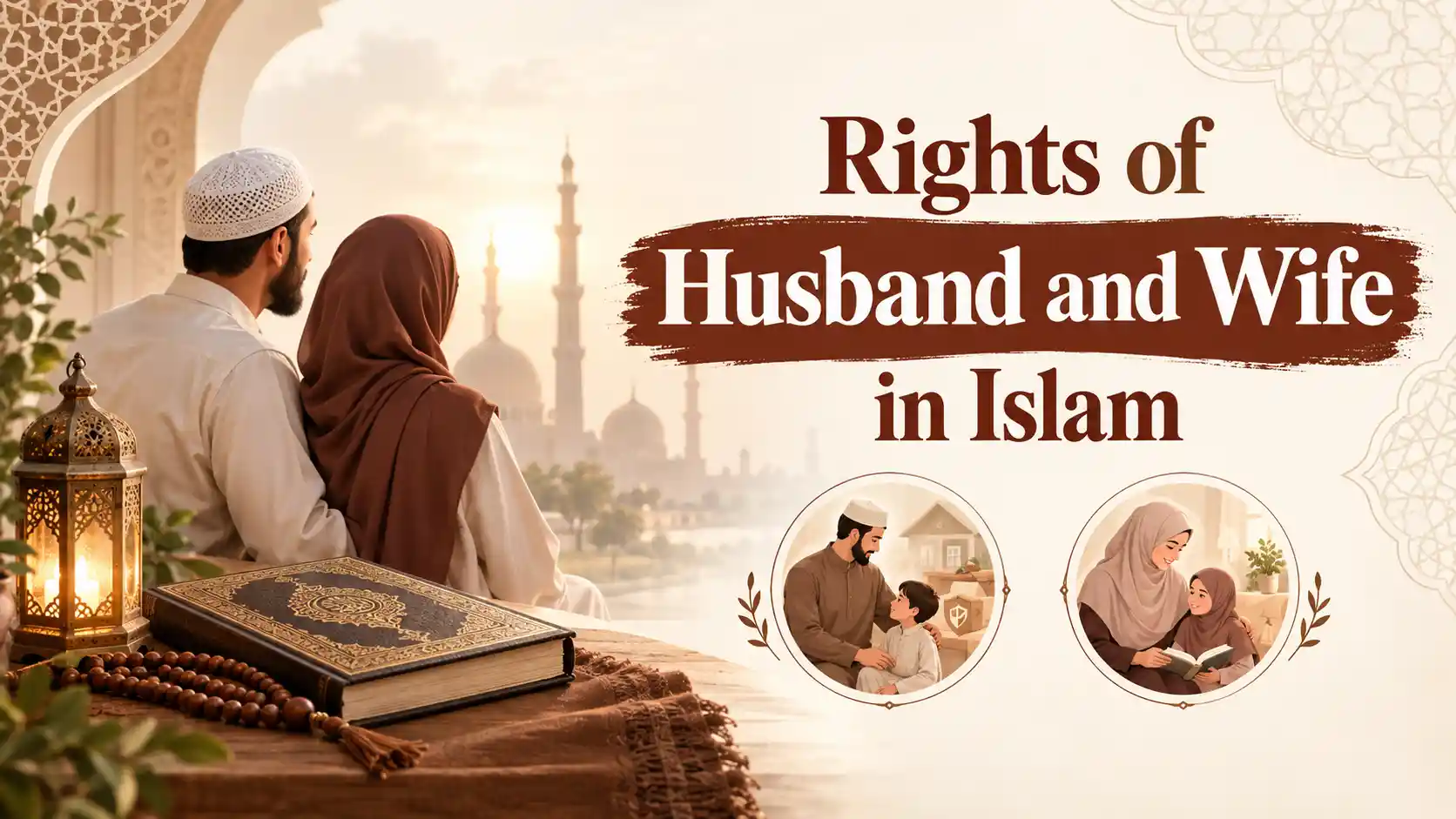
Rights of Husband and Wife in Islam
Rights of Husband and Wife in Islam
Islam gives the wife specific financial rights, including the mahr and ongoing maintenance, along with the right to fair and kind treatment. It gives the husband the right to be obeyed in lawful matters and to his wife’s availability within the marriage. Beyond this legal floor sits a further, ethical layer. The Quran calls it treatment bil-ma’ruf, covered in detail further down. This guide walks through both: the enforceable rights and the standard built on top of them.
The Quranic Foundation for Mutual Rights
Marriage in Islam rests on a single verse that scholars return to again and again when discussing spousal rights:
وَلَهُنَّ مِثْلُ الَّذِي عَلَيْهِنَّ بِالْمَعْرُوفِ ۚ وَلِلرِّجَالِ عَلَيْهِنَّ دَرَجَةٌ
“And due to the wives is similar to what is expected of them, according to what is reasonable. But the men have a degree over them [in responsibility].” (Quran 2:228)
Al-Qurtubi explained this verse as establishing that wives are owed good companionship and fair treatment, in exchange for the obedience they owe in return. The “degree” at the end refers to added responsibility. Specifically, it points to financial duties a husband carries that a wife does not; it says nothing about relative worth.
Financial Rights
The Mahr:
The mahr is a payment the husband owes his wife at marriage, and it belongs to her alone. Allah commands this directly:
وَآتُوا النِّسَاءَ صَدُقَاتِهِنَّ نِحْلَةً
“And give the women [upon marriage] their bridal gifts graciously.” (Quran 4:4)
Most jurists set no upper limit on the mahr, and Imams Ahmad and al-Shafi’i rejected any fixed minimum as long as the gift held real value. Imams Malik and Abu Hanifa took a different position. They set minimum thresholds ranging from 3 to 40 dirhams, based on the social norms of their time. In one well-known case, the Prophet ﷺ married a man to a woman in exchange for teaching her what he had memorized of the Quran. What counts is the value the gift represents to the couple, more than any specific price tag attached to it.
Nafaqa (Ongoing Maintenance):
Nafaqa is the husband’s obligation to cover his wife’s food, clothing, and housing throughout the marriage. Scholars agree this obligation exists regardless of the wife’s own wealth. Custom rather than a fixed formula shapes its exact scope. The Shafi’i school set specific benchmarks.
The Hanafi, Maliki, and Hanbali schools tied the standard to prevailing social norms instead. Hind bint Utbah once complained to the Prophet ﷺ that Abu Sufyan, her husband, wasn’t providing enough. He told her: “Take what is sufficient for you and your children, on a reasonable basis” (Sahih al-Bukhari 5049, Sahih Muslim 1714).
Ownership of Her Own Wealth:
A wife’s earnings, inheritance, and mahr remain hers alone once received. Marriage creates no shared ownership between spouses in the way some legal systems assume. No automatic claim exists over her salary or savings, or over any property she brings into or acquires along the way. She may spend, invest, or give it away exactly as she chooses. The financial obligation runs one direction only, through nafaqa, regardless of what she independently owns.
Non-Financial Rights
Fair Treatment Among Co-Wives:
Where a husband has more than one wife, he must divide his time, spending, and attention between them equally. Favoring one over another in these matters is not permitted.
Protection From Harm:
A wife has the right to be free from harm, verbal or physical, at her husband’s hands. This sits under a broader legal maxim, one the Prophet ﷺ established for all relationships, not marriage alone. “There should be neither harming nor reciprocating harm” (Sunan Ibn Majah 2340), graded by Imam al-Nawawi and other hadith scholars. Applied to marriage, it rules out harm inflicted first and harm returned in kind.
This right rests on one of the clearest facts recorded about the Prophet’s ﷺ own marriages. A’ishah reported:
مَا ضَرَبَ رَسُولُ اللَّهِ ﷺ خَادِمًا لَهُ وَلَا امْرَأَةً وَلَا ضَرَبَ بِيَدِهِ شَيْئًا
“The Messenger of Allah ﷺ never struck any of his servants or wives, and his hand never hit anything.” (Sunan Ibn Majah 198, Sahih Muslim 2328)
The Prophet ﷺ also openly criticized men who struck their wives, asking: “How does one of you beat his wife as he beats the stallion camel, and then embrace her?” (Sahih al-Bukhari 5695). Classical fiqh manuals do discuss disciplinary hitting as a last resort within marriage, describing it as symbolic and non-injurious. But that was never Prophetic practice. Imam al-Nawawi’s own comment on the hadith above was direct. Even where discipline is technically permitted, he said, avoiding it entirely remains the better path (Sharh al-Nawawi ‘ala Sahih Muslim 15/84).
What his kindness actually looked like is recorded too. A’ishah described once standing at the door of her room, watching a group of Abyssinians play with spears in the mosque courtyard. The Prophet ﷺ stood beside her, shielding her with his cloak so she could watch for as long as she liked. He stayed there until she herself grew tired of watching (Sahih al-Bukhari 443, Sahih Muslim 892).
Studying hadith like this one in their original Arabic, rather than a summarized translation, is where terms carry their real precision. Kitaab Academy’s self-paced Kitaab Library covers Arabic, fiqh, and Islamic history for readers who want to work through classical texts like these directly.
Rights of the Husband
A husband’s authority within marriage traces back to one specific verse.
الرِّجَالُ قَوَّامُونَ عَلَى النِّسَاءِ بِمَا فَضَّلَ اللَّهُ بَعْضَهُمْ عَلَىٰ بَعْضٍ وَبِمَا أَنفَقُوا مِنْ أَمْوَالِهِمْ
“Men are the protectors and maintainers of women, because Allah has given one more strength than the other, and because they support them from their means.” (Quran 4:34)
Al-Qurtubi read this verse as resting on 2 reasons. One is a difference in physical and worldly capability. The other is the financial burden a husband alone carries. He added a point worth remembering: the benefit of this arrangement ultimately returns to her, since it’s what frees her from the responsibility of providing for herself.
The Obligation of Obedience
A wife owes her husband obedience in matters that are lawful and within her ability. This obedience has clear limits built in from the start. It never extends to sin, and scholars stress it should demand nothing beyond what she can reasonably bear. The Hanafi jurist Ibn Nujaym looked at how far this obedience reaches. He concluded that she need only comply with requests connected to the marriage itself.
Availability and Household Privacy
Islamic law places one central obligation on a wife: making herself available to her husband once the marriage has been consummated. Built-in exemptions apply during menstruation, obligatory fasting, illness, or whenever intimacy would cause her genuine harm.
A well-known hadith warns against refusing this right without valid reason. “When a man calls his wife to his bed, and she refuses, and he spends the night angry with her, the angels curse her until morning” (Sahih al-Bukhari 3065, Sahih Muslim 1436). Ibn Hajar al-Asqalani commented on this hadith. He tied its scope specifically to intimacy withheld for no valid reason at all (Fath al-Bari 9/294).
The same underlying right shapes 2 further, smaller expectations. She should not admit someone into the home whom her husband dislikes, or leave the house without his knowledge. Scholars connect both back to his right to her availability, since her whereabouts and who enters the home can directly affect it. Neither point functions as a general power to restrict her movement; each addresses a specific situation tied to that one underlying right.
Several obligations in Islamic marriage run in both directions rather than favoring one spouse over the other.
Raising Children Together
Both parents share responsibility for their children’s upbringing. The Prophet ﷺ used the language of guardianship to describe this duty:
كُلُّكُمْ رَاعٍ وَكُلُّكُمْ مَسْؤُولٌ عَنْ رَعِيَّتِهِ … وَالْمَرْأَةُ رَاعِيَةٌ فِي بَيْتِ زَوْجِهَا وَمَسْؤُولَةٌ عَنْ رَعِيَّتِهَا
“Each of you is a guardian, and each of you is responsible for those in his care… and the woman is a guardian in her husband’s house, and she is responsible for those in her care.” (Sahih al-Bukhari, Sahih Muslim)
This hadith places a mother’s role inside the home on the same conceptual footing as a ruler’s responsibility over his subjects. The scale differs; the weight of the duty doesn’t.
The Right to Intimacy Runs Both Ways
Marital intimacy is often framed around a husband’s access to his wife. The early sources record the reverse just as clearly. Salman al-Farisi once visited the household of Abu al-Darda and found his wife visibly neglected. She explained that Abu al-Darda, absorbed in constant fasting and night prayer, had “no need for this world.” Salman reminded him that she had rights too. When the matter reached the Prophet ﷺ, he affirmed Salman’s counsel (Sahih al-Bukhari 1968). Even sincere devotion, in other words, doesn’t excuse neglecting a spouse’s intimacy.
A separate account describes Umar ibn al-Khattab overhearing a woman’s verses of longing for her absent spouse, away on military duty. Concerned, he asked his daughter Hafsa how long a woman could reasonably go without her spouse’s company. Her answer, 6 months, led Umar to cap how long deployments could keep couples apart (Musannaf Abd al-Razzaq). Later jurists, including Ibn Taymiyyah, treated that figure as a guideline rather than a rigid limit. It was to be judged against each woman’s actual circumstances.
Looking Good for Each Other
Grooming and attractiveness run in both directions too, not as a standard held only against one side. Ibn Abbas, commenting on the “similar rights” clause in Quran 2:228, said: “I like to adorn myself for my wife, just as I like her to adorn herself for me” (Tafsir al-Tabari). Staying clean, well-dressed, and pleasant to be around is a shared marital duty under this reading, resting on both spouses alike.
Arabic classes let readers trace a line like Ibn Abbas’s straight back to its source rather than relying on someone else’s summary. Arabic classes for busy adults at Kitaab Academy build that ability through a structured 7-level curriculum, moving from the alphabet to independent comprehension of primary Islamic texts.
The Ethical Layer: Treating Each Other With Ihsan
Legal rights describe the floor of a marriage, never its ceiling. Dr. Tesneem Alkiek makes this point directly in a peer-reviewed paper on marriage and gender roles in Islamic law and ethics, published by the Yaqeen Institute for Islamic Research. Legal permissibility and moral virtue are 2 different standards. The legal minimum in a marriage was never meant to double as its moral ceiling.
The Quran’s repeated command to live together bil-ma’ruf, meaning according to what is recognized as good, sits above the enforceable list of rights and duties. It calls spouses toward the everyday generosity, patience, and care that no court could ever require.
When These Rights Are Neglected
Islamic law gives each spouse recourse when the other persistently fails in their obligations.
When a Husband Neglects Nafaqa
If a husband habitually neglects nafaqa, the Maliki, Shafi’i, and Hanbali schools allow the wife to seek a judicial divorce on those grounds. The Hanafi school takes a different approach, preferring reconciliation, and permits her to take out a loan in her husband’s name to cover her needs instead.
Distinguishing Hardship From Neglect
Scholars across all 4 schools draw a firm line between temporary hardship and real neglect. They cite the Quranic principle that a debt owed by someone in difficulty deserves more time rather than immediate enforcement:
وَإِن كَانَ ذُو عُسْرَةٍ فَنَظِرَةٌ إِلَىٰ مَيْسَرَةٍ
“And if someone is in hardship, then let there be postponement until a time of ease.” (Quran 2:280)
Habitual, clearly deliberate neglect is a different matter, and that’s where the patience these schools counsel finally runs out.
Rights That Continue After Divorce
These financial obligations don’t simply end if a marriage does. A husband remains responsible for her maintenance throughout the iddah, the waiting period following divorce, regardless of which of the 2 paths, talaq or khula, ended the marriage.
FAQs
Does a wife have to work or contribute financially to the household?
No. Financial provision is the husband’s legal responsibility. She may choose to work and contribute, and there’s a long history of Muslim women doing exactly that, but Islamic law leaves that choice to her.
Can a husband stop his wife from visiting her own family?
Only with real justification tied to his rights within the marriage, not as a general power over her. Scholars connect her need for permission to leave the home to his right to her availability. Using it to cut her off from her own family runs against the same principle against causing harm that governs the whole marriage.
Is a wife required to do housework?
Housework isn’t listed among her strict legal obligations, and jurists differ on how far it extends. Ibn Taymiyyah held that any service she provides follows what’s customary among people of similar standing. That standard shifts with circumstances.
A Bedouin woman’s household duties won’t match a town-dweller’s, and a strong woman’s contribution won’t match a weaker woman’s. Historically, many households, including the Prophet’s ﷺ own, divided labor by mutual arrangement rather than a fixed rule. He himself mended his clothes, swept his home, and helped with daily tasks.
What happens if a husband doesn’t provide the mahr he agreed to?
The mahr becomes a binding debt the moment the marriage is consummated, even if it was never written down. She can pursue it as a financial claim at any point, and passing time doesn’t erase it.
Can a husband access or control his wife’s personal savings?
No. Her wealth, whatever its source, stays under her own control throughout the marriage. The financial duty owed to her runs through nafaqa; it creates no claim over what she independently owns.
Do these rights differ between the 4 Sunni schools of law?
The core rights (mahr, nafaqa, obedience within lawful limits, and availability) are agreed upon across all 4 schools. Where they differ is in specifics: minimum mahr amounts, how nafaqa is calculated, and what recourse a wife has when nafaqa is neglected.