How Many Words Are in the Arabic Language?
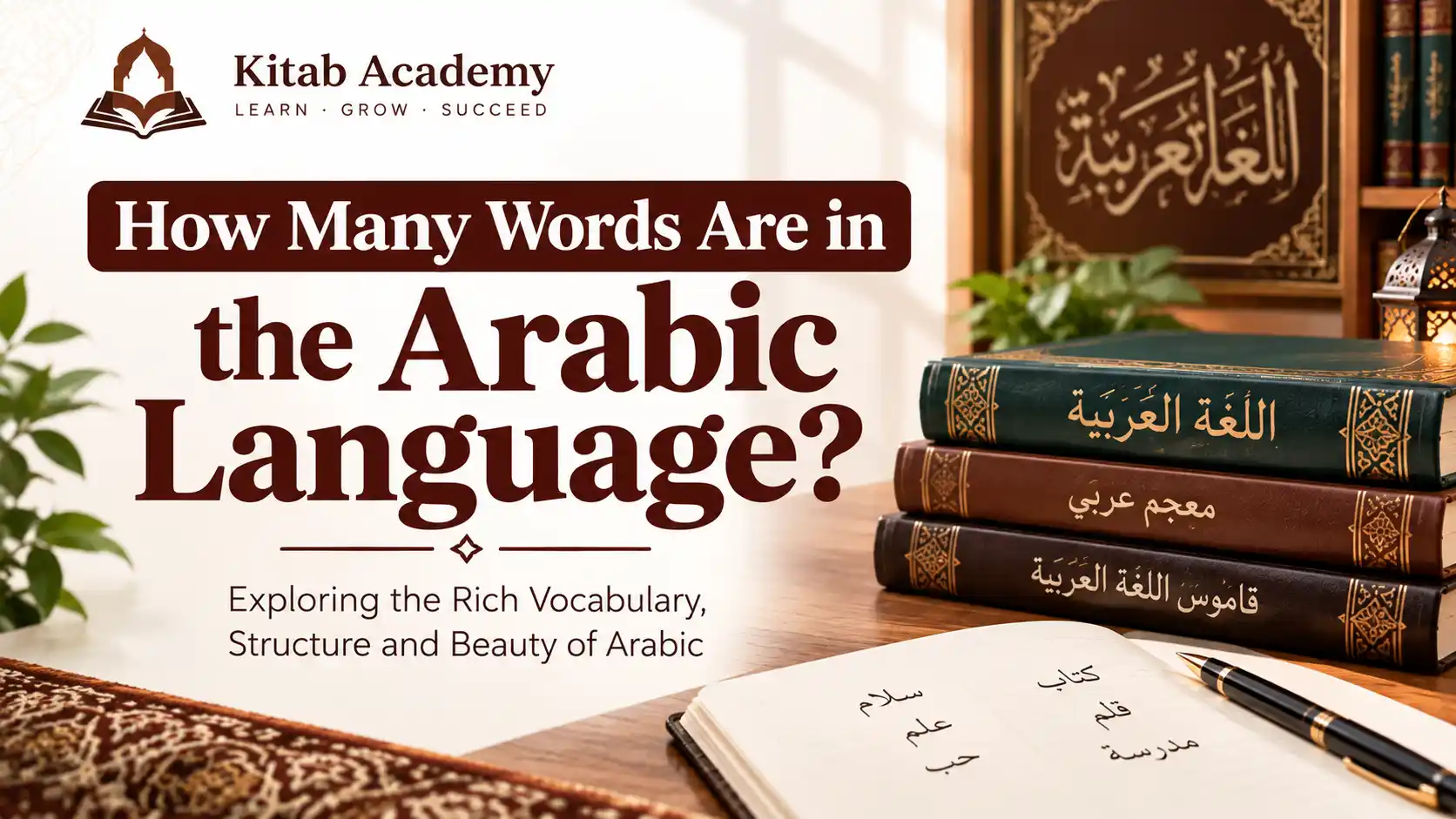
How Many Words Are in the Arabic Language?
The most widely cited estimate puts Arabic at 12.3 million words, making it one of the largest vocabularies on earth. That figure, attributed to the SEBIL centre in Palestine, includes every derived form the language has ever produced from its root system. For comparison, English holds roughly 600,000 words according to the Oxford English Dictionary, and French holds about 150,000.
Not everyone accepts the 12.3 million figure at face value, though. Some linguists argue the real count of distinct, non-overlapping terms sits closer to 200,000 to 500,000, since the higher number treats every inflected form of a single root as a separate word, the way counting “write, writes, writing, written, writer” as 5 words inflates English’s count too. The truth likely sits somewhere between: the root system generates an unusually large number of derivations, but calling each one a separate “word” depends on a definition not all scholars share.
The number sounds staggering, but it makes more sense once you understand how the language builds words. A single 3-letter root can generate dozens of related terms through fixed patterns, and the language has roughly 10,000 of these roots documented across its history. This guide breaks down where the number comes from, why it’s so large, and how many of those millions a learner actually needs.
Why the Number Is So Hard to Pin Down
Counting words in any language is complicated. Here, it’s especially tricky because the answer depends entirely on what you count.
Root-Based Counting
Traditional lexicography organizes entries by root rather than by individual word. The root ك-ت-ب (K-T-B, related to writing) covers كَتَبَ (he wrote), كِتَاب (book), كَاتِب (writer), مَكْتَبَة (library), and مَكْتُوب (written), all under a single entry. Counting by base forms yields roughly 6,500 to 10,000 across Arabic’s entire history, with about 3,000 to 4,000 still in active, productive use today.
Dictionary-Based Counting
Major classical dictionaries reach very different totals depending on scope. Lisan al-Arab by Ibn Manzur was completed in the 13th century. It contains roughly 80,000 base entries that expand to over 500,000 derived forms. The modern Al-Mu’jam Al-Wasit, published by the Academy of the Arabic Language in Cairo, is more selective. It covers about 30,000 base entries, generating 120,000 to 150,000 contemporary forms.
Corpus-Based Counting
A 2016 study by Ibrahim Abu El-khair at Umm Al-Qura University built a corpus of 1.5 billion words drawn from 5 million newspaper articles. The data came from 8 Arab countries, collected over 14 years. Out of that 1.5 billion, only about 3 million were unique. The theoretical count may reach into the millions, but the portion in active, daily use is far smaller.
The Root System: How 3 Letters Produce Millions of Words
This derivational engine is what makes the vocabulary so large. Most words trace back to a 3-consonant base that carries a core meaning. By slotting that root into fixed patterns (called awzan), Arabic generates families of related terms from a single starting point.
Root Example: ع-ل-م (A-L-M, related to knowledge)
Pattern | Word | Meaning |
فَعِلَ | عَلِمَ | He knew |
فَعَّلَ | عَلَّمَ | He taught |
فِعْل | عِلْم | Knowledge / Science |
مُفَعِّل | مُعَلِّم | Teacher |
فَاعِل | عَالِم | Scholar |
مَعْلُومَات | مَعْلُومَات | Information |
Root Example: د-ر-س (D-R-S, related to studying)
Pattern | Word | Meaning |
فَعَلَ | دَرَسَ | He studied |
فَعَّلَ | دَرَّسَ | He taught |
فَعْل | دَرْس | Lesson |
مَفْعَلَة | مَدْرَسَة | School |
مُفَعِّل | مُدَرِّس | Teacher |
فِعَالَة | دِرَاسَة | Study (noun) |
A learner who masters 500 of these bases and understands the major patterns gains access to roughly 3,000 to 5,000 functional words, enough to cover over 90% of everyday text. Learning 1,000 of them pushes that figure to 5,000 to 10,000. Experienced teachers focus on these base forms early for exactly this reason, rather than treating each new term as something to memorize in isolation.
Arabic classes for busy adults at Kitaab Academy build exactly this kind of root-first fluency, moving through a structured 7-level curriculum from the alphabet to independent reading of primary texts.
How Arabic Compares to Other Languages
Language | Estimated Total Vocabulary | Primary Source |
Arabic | 12.3 million (all derived forms) | SEBIL centre, Palestine |
English | ~600,000 (Oxford English Dictionary) | OED |
French | ~150,000 | Various French dictionaries |
Russian | ~130,000 | Various Russian dictionaries |
Hebrew | ~70,000 (modern) | Academy of the Hebrew Language |
These comparisons are rough. Each language counts differently. The root-based derivation system generates far more forms from a single starting point than English’s linear affixation does, which is the main reason the gap looks so dramatic.
How Many Words Does a Native Speaker Actually Know?
The 12.3 million figure describes the language as a whole, not any individual’s head. A peer-reviewed vocabulary study, published in The Language Learning Journal, tested 339 native Arabic speakers at schools and universities in Saudi Arabia. Educated native speakers scored a recognition vocabulary of roughly 25,000 words. The researchers noted this is large compared with equivalent scores for English native speakers.
Active vocabulary sits lower. That’s the portion a person actually uses in speech and writing. For an educated adult, it ranges from 8,000 to 16,000, depending on profession, education level, and how regularly they engage with MSA versus their regional dialect. Religious scholars and literary specialists tend to sit at the higher end. Some reach 20,000 active and 40,000 to 50,000 passive.
How Many Words Does a Learner Need?
Words Known | What It Gets You | Typical Study Time |
300 to 500 | Survival basics: greetings, directions, shopping | 3 to 6 months |
1,000 | Roughly 85% of everyday text | 6 to 12 months |
2,000 to 3,000 | Roughly 90 to 95% of daily media and general reading | 12 to 24 months |
5,000 to 6,000 | About 98% of non-specialized texts | 2 to 3 years |
10,000+ | Near-native comprehension | 4+ years |
This system compresses those timelines. Grasping 500 roots with their major patterns means a learner has already built the internal logic connecting 3,000 or more terms, without memorizing each one separately.
Where Arabic’s Richness Shows
11 Distinct Words for Love
The language doesn’t stop at one or two terms for love. The British Council documented at least 11, each describing a different stage or quality. A few examples: Hawa refers to the initial pull of attraction. Alaaqa is when the heart begins to attach itself to someone. Ishq describes blind desire. Shaghaf means a love so complete it wraps around the heart entirely. Huyum is the stage where reason itself is lost. English, by comparison, covers this entire spectrum with “fall in love” and “be in love.”
Hundreds of Words for Camel
This fact gets cited often enough to sound like a cliché, but it’s documented. The lexicon contains specific terms for a baggage camel, a camel that drinks once every 3 days, a camel frightened by anything, and a camel that has grown obese from too much grass. Classical sources also catalogued over 400 terms for describing a lion, each capturing a different quality: age, aggression, appearance, or behavior.
A Single Word Can Carry 3 Meanings, 7 Pronunciations, and 12 Interpretations
The National, a leading English-language news outlet in the UAE, reported that on average, a single written Arabic word carries 3 distinct meanings, 7 possible pronunciations, and 12 potential interpretations depending on context. This density is a direct product of the derivational system, since one consonant skeleton can map to multiple patterns with different voweling.
Modern Standard Arabic vs Dialect: Two Vocabularies in One
Native speakers effectively maintain 2 overlapping vocabularies throughout their lives. Modern Standard Arabic (MSA), called Fusha, is the version used in education, news broadcasts, official documents, and religious texts. Regional dialects, called Amiyyah, are what people actually speak at home, in markets, and among friends.
The overlap is significant, but the differences are substantial. A Moroccan dialect, heavily influenced by Berber and French, sounds almost unintelligible to a Gulf speaker, whose own dialect incorporates more Persian and Hindi/Urdu loanwords. This diglossic structure is one reason the total count is so large. The standard form and each dialect have developed their own distinct terms for many everyday concepts.
Historical Development: Where Did All These Words Come From?
Pre-Islamic and Early Islamic Period
The earliest documented form of the language comes from pre-Islamic poetry (6th century CE) and the Quran (7th century CE). This early corpus contained roughly 50,000 to 60,000 terms, centered on desert life, tribal relations, warfare, and commerce.
The Islamic Golden Age
The biggest vocabulary expansion happened under the Abbasid Caliphate (750 to 1258 CE). Terminology grew by an estimated 200 to 300% during this period, especially in science, philosophy, and medicine. Major translation movements brought Greek, Persian, and Indian knowledge into the language. New terms were created to handle concepts that had no existing equivalent.
Modern Development
Contemporary usage grows through 2 parallel tracks: language academies in Cairo, Damascus, Amman, and elsewhere officially standardize new terms by deriving them from classical roots; and organic usage in media, social platforms, and daily speech introduces informal vocabulary that may or may not enter the standard language. This gives the language unusual flexibility, since new terms can be built from existing bases rather than borrowed wholesale from other languages.
Words That Entered English
The influence on English runs deeper than most people realize. Hundreds of everyday English terms trace back to originals from this language, borrowed primarily during the Islamic Golden Age (8th to 13th centuries). During that period, it was the dominant language of science, mathematics, and philosophy across a vast multicultural empire.
- Algebra: from al-jabr (الجبر), meaning restoration or reunion
- Algorithm: from al-Khwarizmi (الخوارزمي), the name of the mathematician whose work introduced the concept
- Alcohol: from al-kuhl (الكحل), originally referring to a fine metallic powder
- Coffee: from qahwa (قهوة)
- Cotton: from qutun (قطن)
- Zero: from sifr (صفر), meaning empty
- Magazine: from makhazin (مخازن), meaning storehouses
For readers who want to trace this historical depth themselves, the self-paced Kitaab Library covers Arabic, Tafsir, and Islamic history at the same depth, alongside the root-pattern system that makes classical texts accessible.
FAQs
Does Arabic really have 12 million words?
The 12.3 million figure counts every inflected and derived form from every root. Conservative estimates that count only distinct lemmas sit between 200,000 and 500,000. The intro covers this dispute in detail.
How many words do I need to hold a conversation in Arabic?
Around 1,000 for comfortable everyday exchanges in MSA. The learner table above gives the full breakdown by level. Dialect learners should add roughly 1,000 to 2,000 dialect-specific terms on top.
Is Arabic the richest language in the world?
By raw count, it’s a strong contender, but “richest” depends on how you measure. Its distinctive advantage is the derivational system, which produces a density of related meaning most other languages don’t match.
Why does Arabic have so many words for the same thing?
Precision carried practical value in the culture where classical Arabic developed. Hundreds of terms for camels, for instance, each distinguished a specific quality (age, gait, hydration) that affected how the animal was used.
Can I learn Arabic without memorizing millions of words?
Yes. A single root unlocks an entire family of related terms through predictable patterns. The root section above explains how this works in practice.
Is Arabic harder to learn than English?
The Foreign Service Institute ranks Arabic as a Category IV language for English speakers, estimating 2,200 class hours to reach professional proficiency. That’s roughly 4 times the hours needed for French or Spanish. The root system eases vocabulary acquisition, but the script, grammar, and diglossia (MSA vs dialect) add complexity that English learners won’t have encountered before.
How many letters are in the Arabic alphabet?
28 letters, all consonants. Vowels are represented by short marks (harakat) placed above or below the consonants rather than as separate letters, which is partly why a single written word can carry multiple pronunciations.
What is the longest word in Arabic?
A commonly cited example is أفاستسقيناكموها (“did we ask you to give us water from it”), built from the root س-ق-ي (S-Q-Y, related to watering). It packs a subject, object, question form, and additional pronouns into a single word, which is typical of how the derivational system works at its most extended.
How many Arabic speakers are there in the world?
Over 400 million people speak some form of Arabic as their first language, making it the 5th most spoken language globally. An additional 250+ million use it as a second language, primarily for religious study and Quranic recitation.