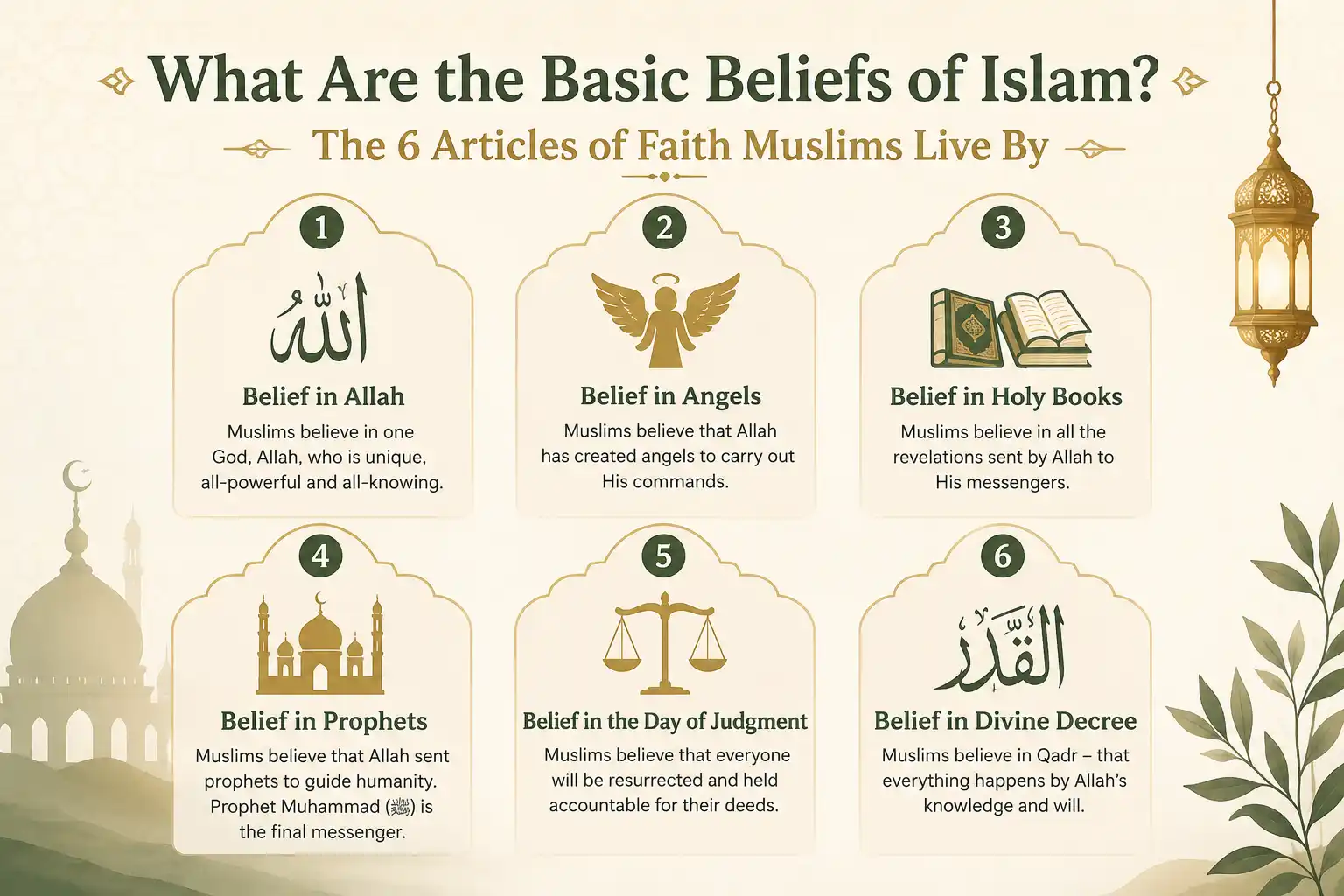
What Are the Basic Beliefs of Islam?
The basic beliefs of Islam are the 6 Articles of Faith: belief in Allah, belief in angels, belief in the holy books, belief in the prophets, belief in the Day of Judgment, and belief in divine decree. These 6 beliefs, known in classical texts as Iman al-Mufassal, answer what Islamic people believe at the core of their faith. Every practice in Islam, from daily prayer to fasting in Ramadan, grows out of these 6 beliefs. This guide breaks down each one against its Quranic basis, then covers the law, history, and sects built on top of it.
Quick Glossary: Key Islamic Terms
Term | Meaning |
Tawhid | Oneness of Allah |
Iman al-Mufassal | The 6 detailed Articles of Faith |
Shahada | Declaration of faith |
Akhirah | Life after death |
Qadar | Divine decree |
Sharia | Islamic law |
Sunnah | Prophet Muhammad’s recorded teachings and practice |
Hijrah | Muhammad’s migration from Mecca to Medina |
1. Belief in Allah: One God, Without Partners
The first belief in Islam is Tawhid, the oneness of Allah. Muslims believe Allah created the universe, sustains it, and rules it alone, without a partner, a child, or an equal. He has no partners who share His power, no children in the human sense, and no physical form; this last point is why Muslims avoid drawing or picturing Him.
Tawhid isn’t just a statement about God’s identity. It sets the terms for how a Muslim directs worship, gratitude, and fear toward one source rather than splitting them across many. Five surahs in the Quran open and five close on this same note of praise, a pattern traced in the symmetry of ‘Alḥamdulillāh’ in the Qur’an.
2. Belief in Angels: Unseen Servants of Allah
Muslims believe Allah created angels from light to carry out His commands without the option to disobey. The Quran and hadith name several angels by their assigned role:
- Jibril (Gabriel) delivers revelation to the prophets.
- Mikail (Michael) oversees rain and provision.
- Israfil will sound the trumpet that begins the Day of Judgment.
- Malak al-Mawt takes the soul at the moment of death.
Believing in angels means accepting that an unseen world runs alongside the visible one, and that a person’s actions are recorded even without a human witness present.
3. Belief in the Holy Books: Four Scriptures Before the Quran
Muslims believe Allah revealed guidance through multiple scriptures before sending the final one. The Quran names 4 earlier books, with itself as the fifth and final revelation:
- The Tawrat (Torah), given to Musa (Moses)
- The Zabur (Psalms), given to Dawud (David)
- The Injil (Gospel), given to Isa (Jesus)
- The Scrolls (Suhuf), given to Ibrahim (Abraham)
Muslims hold that these earlier texts were altered over centuries, while the Quran stayed preserved word-for-word since its revelation to Muhammad ﷺ across 23 years. That one revelation still splits into chapters and parts without losing its coherence, a structure covered in the divisions of the Quran.
4. Belief in the Prophets: 25 Messengers Named in the Quran
Muslims believe Allah sent a chain of prophets to guide different nations toward the same message: worship one God and live justly. The Quran names 25 prophets directly, including Adam, Ibrahim, Musa, Dawud, and Isa.
Every prophet in that chain taught the same core message, and Muhammad ﷺ closes it as the final prophet, carrying a message meant for all people rather than one nation. Muslims honor prophets deeply but never worship them; the line between reverence and worship is one of the sharpest distinctions in Islamic belief.
The story of Musa returning to confront Pharaoh shows this prophetic mission in action, unpacked in the promised return in Surah Al-Qasas. Muhammad’s own mission carried that same pattern forward, even through moments that looked like setbacks, as shown in the hidden victory of Hudaybiyah.
5. Belief in the Day of Judgment: Paradise or Hell
Muslims believe every person will be resurrected after death and held accountable for their deeds. Allah weighs each person’s good and bad actions, then assigns one of two outcomes: Jannah (Paradise) for those who lived in obedience and sincerity, or Jahannam (Hell) for those who rejected guidance and lived unjustly.
This belief pushes Muslims to treat even small actions as meaningful, since nothing gets left off the record. It also ties into end-times signs Muslims are taught to recognize, including the Dajjal, a false figure of deception expected to appear before the Last Day. The Prophet ﷺ urged believers to memorize the opening verses of Surah al-Kahf for exactly this reason, a protection explained in why Surah al-Kahf protects against the Dajjal.
6. Belief in Divine Decree: Allah’s Plan and Human Free Will
The sixth article of faith is Qadar, often translated as divine decree or predestination. Muslims believe Allah knows and has written every event before it happens, yet still holds each person accountable for the choices they make. Allah’s knowledge covers everything a person will choose, and that person still answers for the outcome; classical scholars spent centuries working out exactly how these two ideas hold together without contradiction.
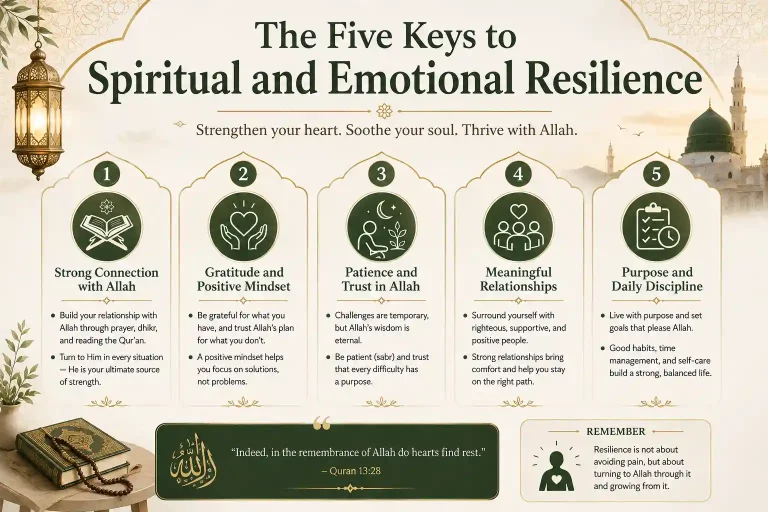
In daily life, Qadar functions less like fatalism and more like resilience. Muslims lean on it during hardship, trusting that difficulty carries a purpose even when the reason stays hidden.
Sharia: How Belief Becomes Law
Sharia is the body of Islamic law drawn primarily from the Quran and the Sunnah (the Prophet’s recorded teachings and practice). It sorts human actions into 5 categories rather than a simple allowed-or-forbidden split:
- Fard/Wajib: Obligatory, such as the 5 daily prayers
- Mustahabb: Recommended but not required.
- Mubah: Neutral, neither rewarded nor punished
- Makruh: Discouraged but not sinful
- Haram: Forbidden, such as consuming pork or alcohol
Food and daily conduct fall under the halal (permissible) and haram (forbidden) framework most people recognize. A meal, a business deal, or a friendship can be evaluated against these same 5 categories, which is why Sharia functions as a full way of life rather than a narrow legal code.
Muhammad ﷺ began receiving revelation in Mecca around 610 CE, at age 40, through the angel Jibril. Early followers faced persecution for a decade before the Hijrah, the migration to Medina in 622 CE that marks the start of the Islamic calendar. From Medina, the message spread through the Arabian Peninsula within the Prophet’s lifetime, then across the Middle East, North Africa, and parts of Asia and Europe within a century after his death, carried by trade, scholarship, and governance rather than belief alone.
Out of this expansion grew multiple schools of thought, including Sufism, a spiritual tradition inside both Sunni and Shia Islam that emphasizes the inner, devotional dimension of worship alongside its outward rules.
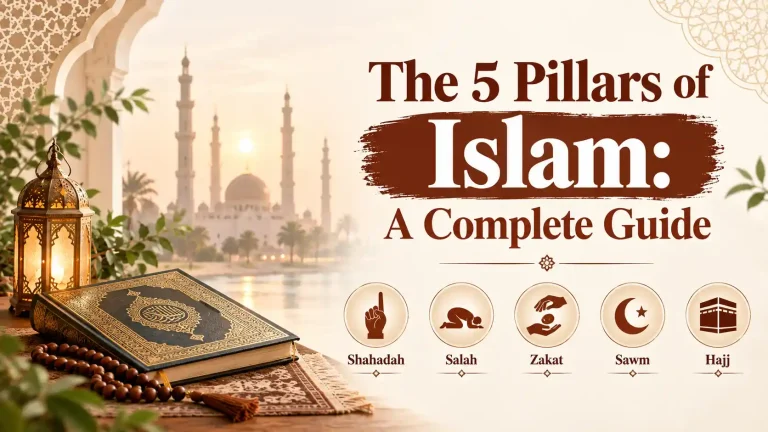
5 Pillars of Islam: Putting Belief Into Practice
Belief alone doesn’t complete a Muslim’s faith; practice does. The 5 Pillars turn the 6 Articles of Faith into daily action.
Shahada (Declaration of Faith)
The Shahada is the verbal testimony that there is no god but Allah and that Muhammad is His messenger. It’s the sentence that formally makes someone a Muslim.
Salat (Prayer)
Muslims pray 5 times daily, facing Mecca, at dawn, noon, mid-afternoon, sunset, and night. Scholars also identify a “middle prayer” singled out for special protection in the Quran, an idea unpacked in guarding the middle prayer.
Zakat (Charity)
Muslims give 2.5% of their savings each year to the poor and needy, purifying their remaining wealth in the process.
Sawm (Fasting)
Muslims fast from food, drink, and other needs from dawn to sunset during Ramadan, the ninth month of the Islamic calendar.
Hajj (Pilgrimage)
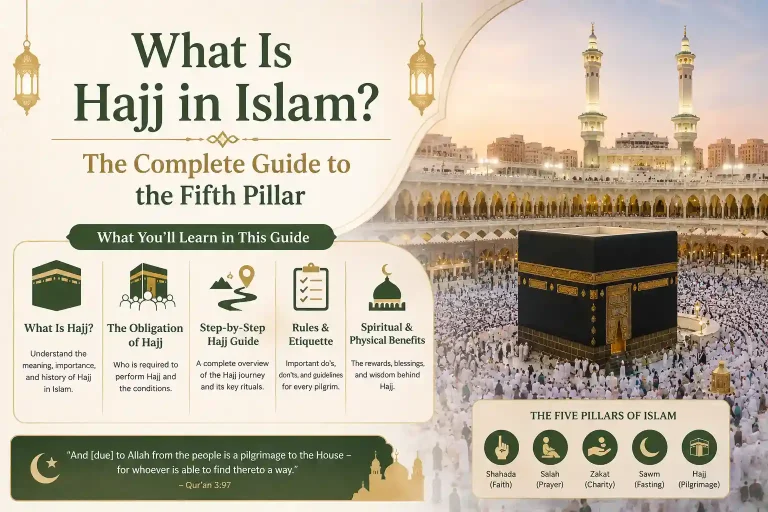
Every Muslim who is physically and financially able must perform the pilgrimage to Mecca at least once in their lifetime.
Sunni and Shia Muslims share all 6 Articles of Faith, the 5 Pillars, and the same Quran. Their split traces back to a single disagreement over leadership after the Prophet’s death. Sunnis make up roughly 90% of Muslims worldwide and accept the first four caliphs as legitimate successors.
Shia Muslims believe leadership belonged to Ali, the Prophet’s cousin and son-in-law, and to his descendants after him. Both groups pray, fast, give charity, and perform Hajj through the same core framework, and Sufi orders exist within each branch as a devotional layer rather than a separate sect.
What Do Muslims Believe About Jesus?
Muslims honor Isa (Jesus) as one of the greatest prophets, born of a virgin and granted the ability to perform miracles by Allah’s permission. Islam departs from Christianity in where his story ends: Muslims don’t believe he is divine or the son of God; they don’t believe he was crucified, and they believe Allah raised him to heaven before crucifixion could take place. Muslims also believe he will return before the Day of Judgment as one of the signs of the end times.
Genuine curiosity mixed with misinformation drives a lot of search traffic on this topic. Three misconceptions come up on repeat. Muslims worship Allah alone, not Muhammad, who is honored strictly as a messenger. Allah is simply the Arabic word for God, tracing the same prophetic lineage back to Ibrahim that Judaism and Christianity share.
And Muslim communities don’t share one uniform political outlook; Pew Research Center’s global survey across 39 countries, based on more than 38,000 face-to-face interviews, found wide variation in Muslims’ social and political views even where core religious beliefs stayed consistent.
The 6-article framework itself isn’t a modern simplification. Scholar Yedullah Kazmi traces its development into organized doctrine in Articles of Faith and Organized Religion in Islam, published in the journal Islamic Studies (Vol. 47, No. 2, 2008).
Start Learning the Foundations of Islamic Belief
Understanding the 6 Articles of Faith is a starting point, not a finish line. Real depth comes from reading the Quran in Arabic, tracing each prophet’s story, and studying how scholars across history explained these beliefs.
Kitaab Academy offers a path for each stage of that journey: live Arabic classes for adults, a dedicated Qur’an program for children, and the self-paced Kitaab Library for studying Arabic, Tafsir, and Islamic history at your own speed. Every course builds on the same 6 beliefs covered in this guide, so foundational knowledge turns into lasting understanding.
FAQs
What are the six basic beliefs of Islam?
The six basic beliefs of Islam are belief in Allah, angels, the holy books, the prophets, the Day of Judgment, and divine decree. Muslims call this set Imam al-Mufassal, and every Islamic practice traces back to one of these six.
What are the basic Muslim beliefs besides the Five Pillars?
The Five Pillars cover practice, not belief. The basic Muslim beliefs sit separately, in the Six Articles of Faith, covering God, angels, scripture, prophets, judgment, and decree. Practice and belief work together but answer different questions: what a Muslim does versus what a Muslim holds to be true.
What do Islamic people believe about God?
Islamic people believe in one God, Allah, who has no partners, no children, and no physical form. This belief, Tawhid, sits at the center of every other Islamic teaching.
Is Allah the same God worshipped in Christianity and Judaism?
Muslims trace Allah back to the same lineage of prophets as Judaism and Christianity, starting with Ibrahim (Abraham). Where the three faiths diverge is on Jesus’s divinity and Muhammad’s role as the final prophet.
What do Muslims believe happens after death?
Muslims believe the soul is judged after death, then every person is resurrected on the Day of Judgment to be judged on their deeds. Allah assigns each person to Jannah (Paradise) or Jahannam (Hell) based on that judgment.
What is the difference between Sunni and Shia beliefs?
Sunni and Shia Muslims hold identical core beliefs; their disagreement is about who should have led the Muslim community after Muhammad’s death, not about God, the Quran, or the afterlife.
Do Muslims believe in Jesus?
Yes. Muslims believe Jesus was a prophet born of a virgin who performed miracles, but they don’t believe he was divine or that he died on the cross.
How many Muslims are there in the world today?
Islam is the world’s second-largest religion, with roughly 2 billion followers globally, according to Pew Research Center’s demographic studies. Muslim communities span every continent, with the largest populations concentrated in Asia and Africa.